本站提供正體中文版。切換到正體中文本站提供简体中文版。切换到简体中文このサイトには日本語版があります。日本語で表示이 사이트는 한국어로도 제공됩니다.한국어로 보기Diese Website ist auch auf Deutsch verfügbar.Auf Deutsch ansehenEste sitio web también está disponible en español.Ver en españolQuesto sito è disponibile anche in italiano.Visualizza in italianoCe site est également disponible en français.Afficher en françaisEste site também está disponível em português.Ver em portuguêsDeze website is ook beschikbaar in het Nederlands.In het Nederlands bekijkenЭтот сайт также доступен на русском языке.Смотреть на русскомयह वेबसाइट हिन्दी में भी उपलब्ध है।हिन्दी में देखेंهذا الموقع متاح أيضًا باللغة العربية.عرض بالعربيةSitus ini juga tersedia dalam bahasa Indonesia.Lihat dalam bahasa IndonesiaBu site Türkçe olarak da mevcut.Türkçe görüntüleTa strona jest dostępna także po polsku.Wyświetl po polskuTrang web này cũng có phiên bản tiếng Việt.Xem bằng tiếng Việtاین وب‌سایت به فارسی هم در دسترس است.مشاهده به فارسی

NASA Astronomy Picture of the Day
AWARD · APOD · 2025.02.27
M35 與 NGC 2158 疏散星團

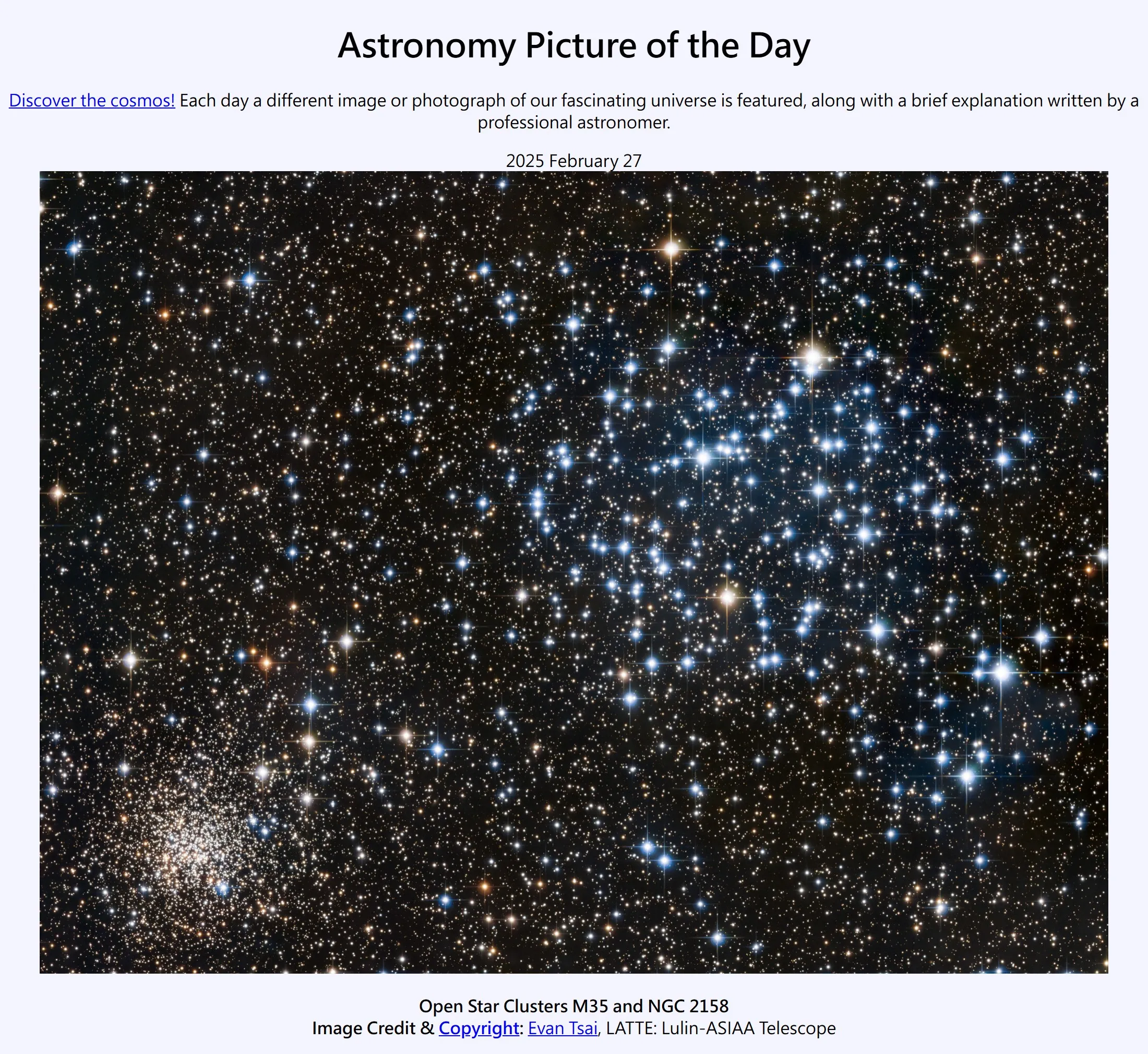
Open Star Clusters M35 and NGC 2158

Some images begin long before the shutter opens. This one began with a question: when two different ages of the universe appear side by side, what does time actually look like?

M35 and NGC 2158 share the same patch of sky in Gemini, yet they are separated by nearly ten thousand light-years — and a billion years of stellar history. M35 blazes with the blue-white fire of young stars, born a mere 150 million years ago; NGC 2158 gathers quietly in the background, its golden glow already more than two billion years old.

Taken with the Lulin-ASIAA Telescope (LATTE) in Taiwan, this image was selected as NASA's Astronomy Picture of the Day (APOD) on February 27, 2025 — a single frame in which the universe conceals more history than language can hold.

Link