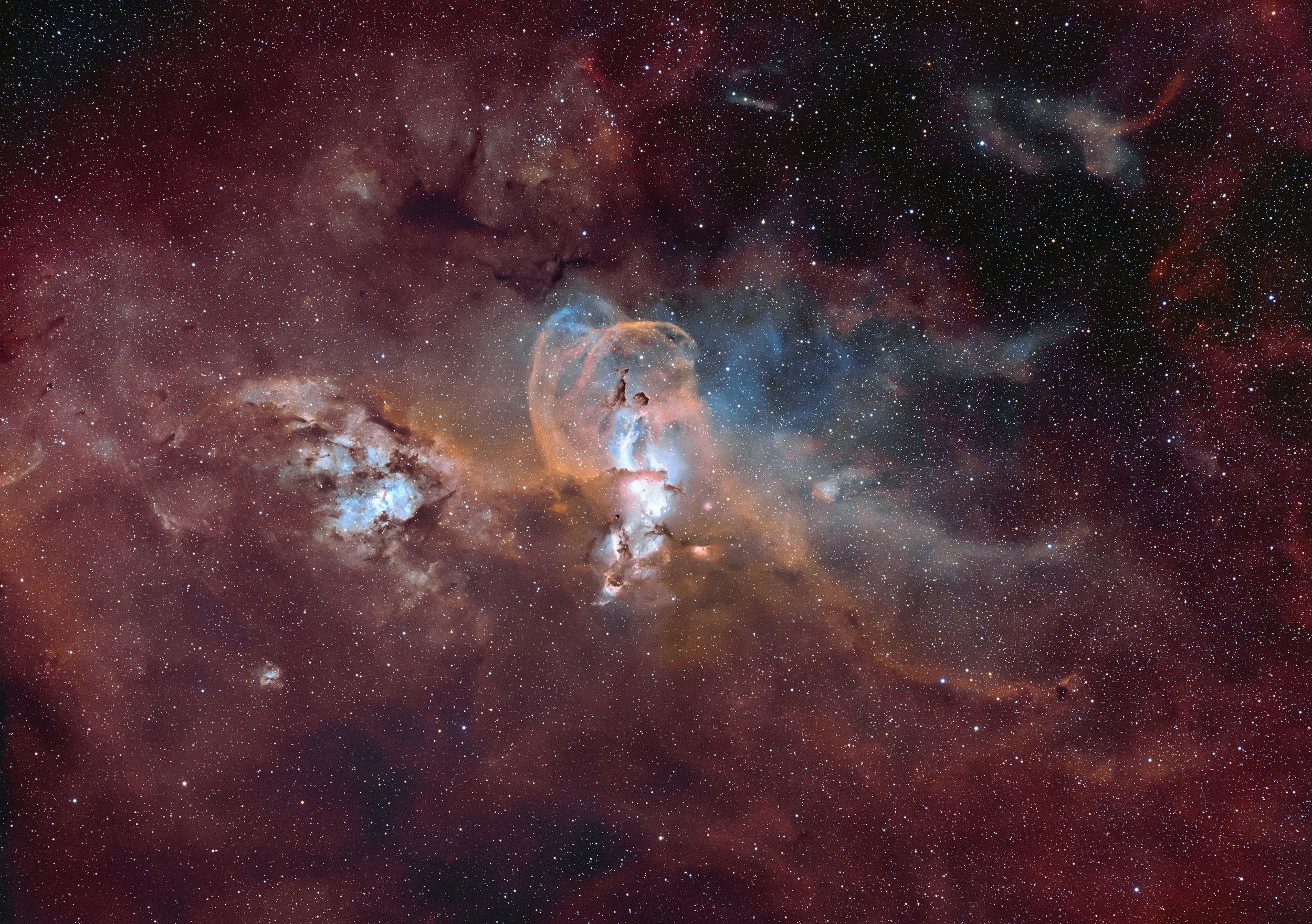
NGC 3576 Statue of Liberty Nebula
- Type
- Nebula
- Acquisition
- Sky-Watcher Esprit 100ED · QHYCCD QHY163M
- Integration
- 13.4h
NGC 3576, also known as the Princess Leia Nebula, is a bright emission nebula located in the constellation Carina, approximately 9,000 light-years away from Earth, with a diameter of about 100 light-years. It lies within the Sagittarius Arm of the Milky Way and is near the famous Eta Carinae Nebula. NGC 3576 is nicknamed the "Statue of Liberty Nebula" due to the distinctive shape of its central region, a name coined by Dr. Mazlin of the Star Shadows Remote Observatory. The gas and dust within the nebula are shaped by the powerful stellar winds and radiation from newborn stars, creating dramatic forms and structures.
NGC 3576 contains several smaller nebulae, sculpted into various shapes by high-energy radiation and winds, some resembling curved arcs and bright structures. This nebula region is an active star-forming area, nurturing a large number of newborn stars. These stars not only illuminate the surrounding gas but also create spectacular scenes.
550mm telescope
Antlia Hax62 O3x61 S2x38, 300sec
Total integration time: 13.5 Hours
Location: Australia