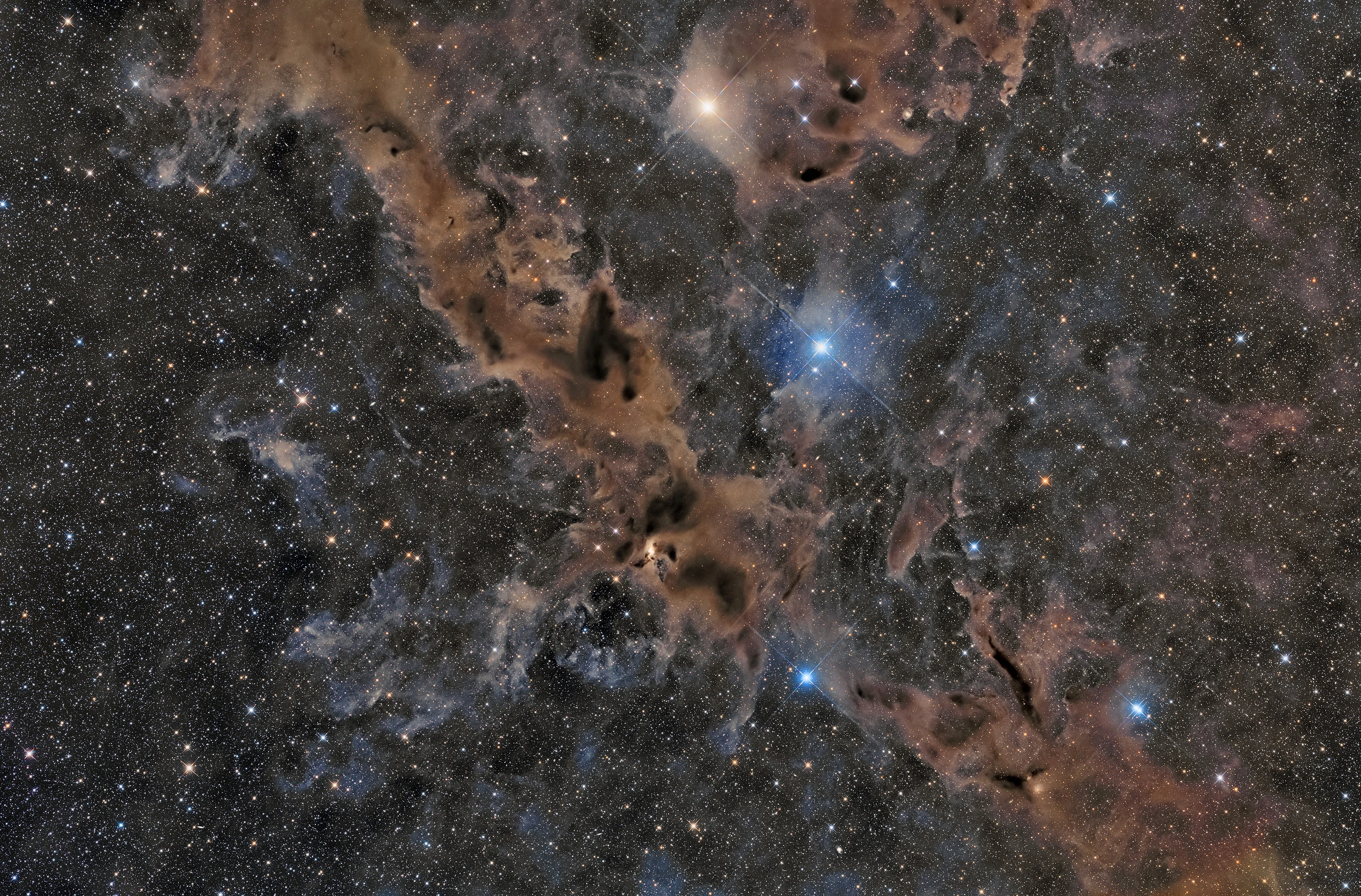
B228 Dark Wolf Nebula
- Type
- Nebula
- Acquisition
- Askar FRA600 · QHYCCD QHY600PH M
- Integration
- 6h
These dark clouds in the sky become visible only when set against a bright and densely packed background of stars. Barnard 228, also known as the Dark Wolf Nebula, is located in the southern constellation Lupus and is part of the Lupus Molecular Cloud, approximately 500 light-years away from Earth. This dense cloud of dust blocks the light from background stars, making it appear especially dark.
However, observations in the far-infrared spectrum reveal that the core of this nebula is collapsing under gravity, giving birth to clusters of low-mass stars. In addition to this enigmatic dark nebula, the colorful stars of Lupus further enhance the beauty of this celestial landscape. Spanning approximately 8 degrees across the sky, the Dark Wolf Nebula lies near the center of the Milky Way, offering a valuable window into the processes of star formation and interstellar medium dynamics.
Location: Chile