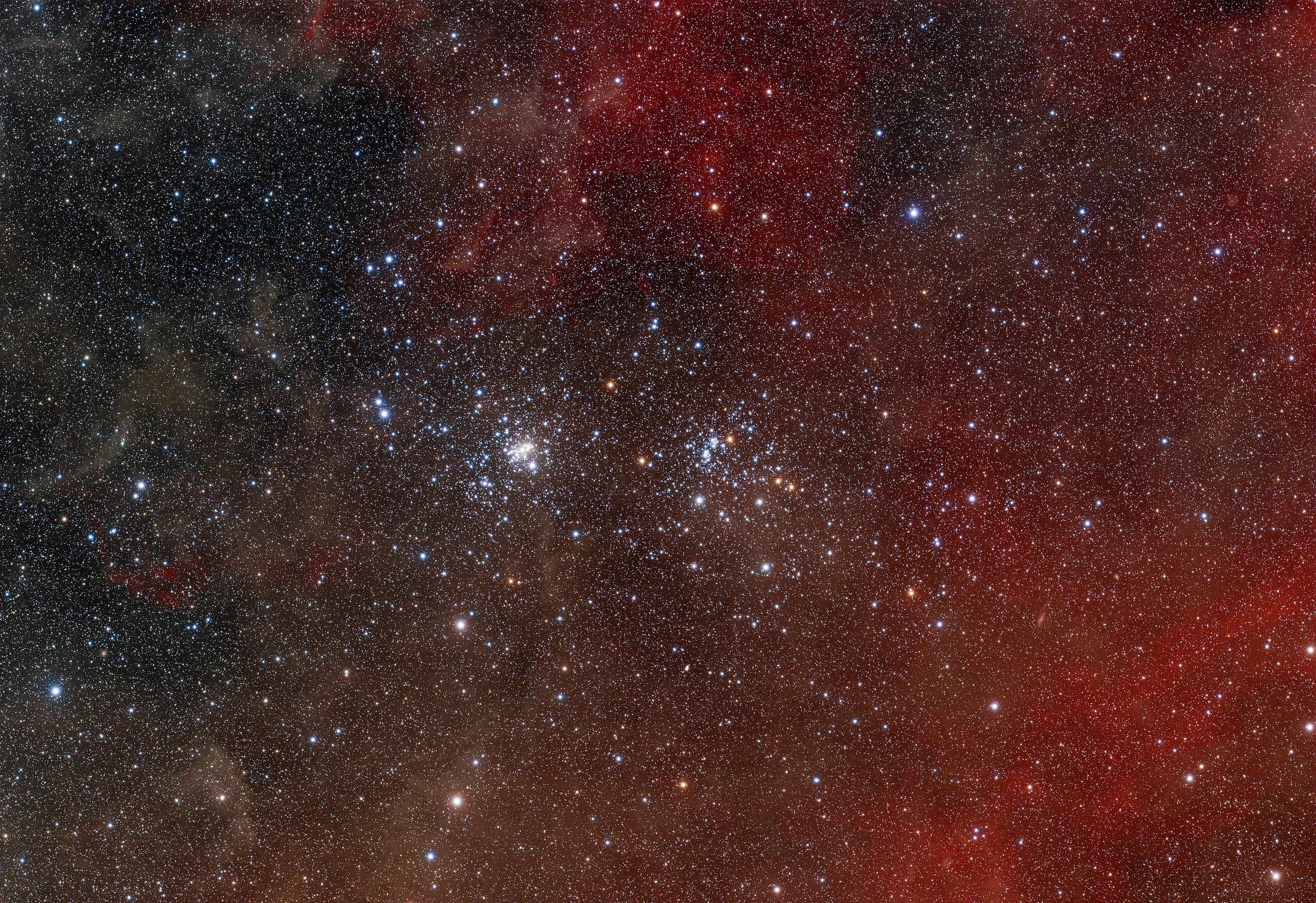
Caldwell 14 – The Double Cluster in Perseus
- Type
- Cluster
- Acquisition
- Sky Rover 130 SA · ZWO ASI6200MM Pro
- Integration
- 9.7h
Caldwell 14, also known as the Double Cluster in Perseus, consists of two bright open star clusters in the constellation Perseus: NGC 869 to the west (traditionally designated h Persei) and NGC 884 to the east (designated χ Persei). Separated by only a few hundred light-years, both clusters are members of the Perseus OB1 association and lie about 7,500 light-years from Earth. With an apparent magnitude of about 3.7 and an apparent diameter of roughly 1°, equivalent to the width of two full moons, the Double Cluster is visible to the naked eye and is a favorite target among amateur astronomers. Estimated to be around 12 million years old, it is dominated by bright blue stars interspersed with a few orange stars, creating a striking color contrast.
Located north of the famous variable star Algol in Perseus, the Double Cluster is one of the most prominent features in the winter Milky Way. Through 10×50 binoculars or a small telescope, observers can clearly distinguish the two separate clusters side by side in the night sky—a truly magnificent sight.
SkyRover 130 APO F5
ZWO ASI6200MM
Sky-Watcher AZ-EQ6 GT
Chroma Lx41,Rx10,Gx12,Bx11, 300s; 3nm Hax14, 900s
Total integration time: 9.66hrs