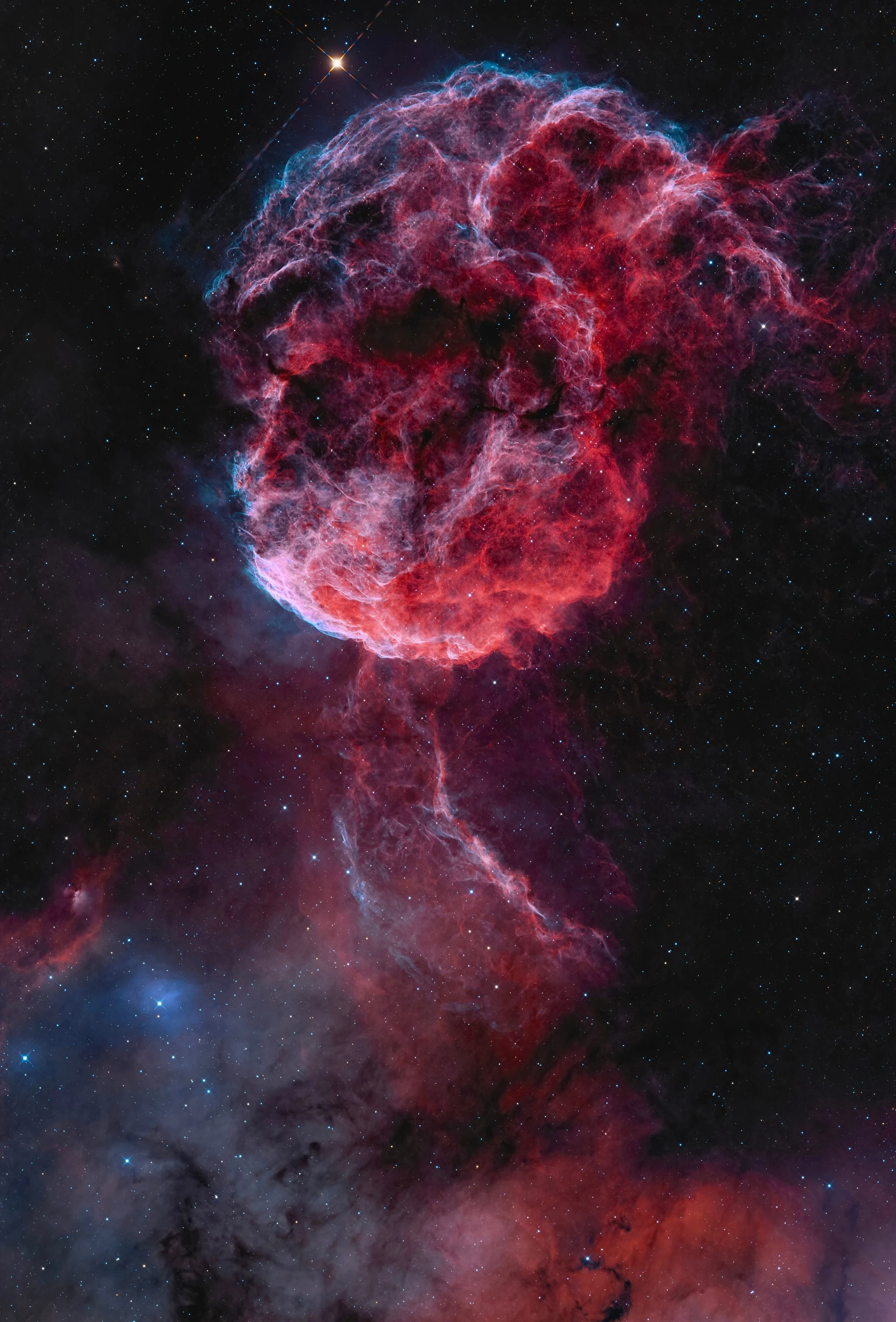
IC443 Queen's Head
- Type
- Nebula
- Acquisition
- Sky Rover 130mm APO Pro · ZWO ASI2600MM Pro
- Integration
- 24.8h
The Jellyfish Nebula, officially designated as IC 443, is a well-known supernova remnant located in the constellation Gemini within our Milky Way galaxy, approximately 5,000 light-years from Earth. It is the aftermath of a massive star that exploded around 3,000 to 30,000 years ago, leaving behind a dense neutron star, CXOU J061705.3+222127, at its core. Named for its resemblance to a jellyfish, the nebula features prominent filamentary gas structures and tentacle-like outflows of radiation.
When viewed in a vertical orientation (with the main body of the jellyfish at the top and its trailing gas plumes extending downward), the nebula not only evokes the image of a jellyfish adrift in the cosmic ocean, but also strikingly resembles Taiwan’s iconic geological formation—the “Queen’s Head.” The upper, rounded region resembles a queen’s flowing hair, while the narrowing stream of gas below forms a slender “neck,” creating the impression of a graceful face emerging from the stars.
Scientific studies have shown that IC 443 is a mixed-morphology supernova remnant, exhibiting both shell-like features and complex internal structures. It interacts intensely with the surrounding molecular clouds. On its southeastern side, the shockwave collides with high-density molecular clouds, producing a vivid ring-like emission structure, while on the western side, where the interstellar medium is less dense, the shockwave spreads more freely.
Skyrover 130 apo Pro
ZWO ASI2600mm
Skywatcher Azeq6 pro
Antlia 3nm SHO, 36mm
S2x92, Hax88, O3x118 300s
Total integration time: 24.8 hrs