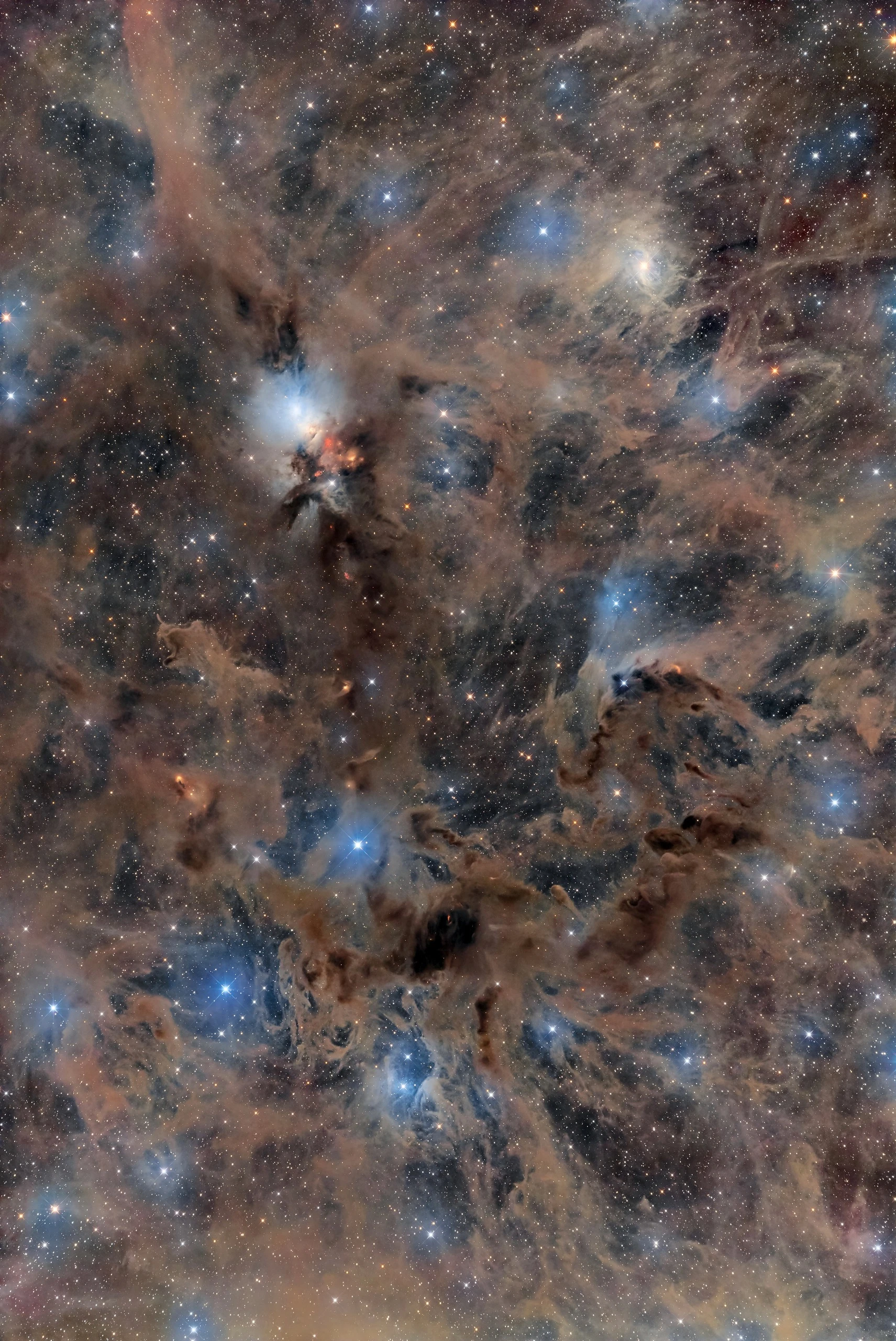
NGC 1333 Embryo Nebula
- Type
- Nebula
- Acquisition
- Sharpstar 13028HNT · ToupTek ATR2600M
- Integration
- 32h
NGC 1333, also known as the Embryo Nebula, is a reflection nebula located in the constellation Perseus, approximately 1,000 light-years from Earth. Situated in the western part of the Perseus molecular cloud, it is an active star-forming region containing a large number of newborn stars less than one million years old. The star formation activity within NGC 1333 is highly dynamic, featuring numerous Herbig-Haro objects—emission regions formed by the interaction of high-velocity gas ejected from young stars with the surrounding material. Additionally, the region hosts many brown dwarfs and planetary-mass objects, highlighting the nebula’s diversity and complexity.
LDN 1448 (Lynds Dark Nebula 1448) is a dark nebula in the constellation Perseus, located adjacent to NGC 1333. This nebula also exhibits active star formation, containing multiple young stars and molecular outflows. Research indicates that the young stars within LDN 1448 eject high-velocity molecular gas, forming distinct molecular outflow structures. These outflows have been clearly detected in near-infrared observations at the H₂ 2.12-micron wavelength.
Sharpstar13028HNT
ToupTek2600MM
Sky-WatcherAZ-EQ6 GT
Antlia 36mm Lx144, RGBx80, 300sec
Location: Liaoning, China