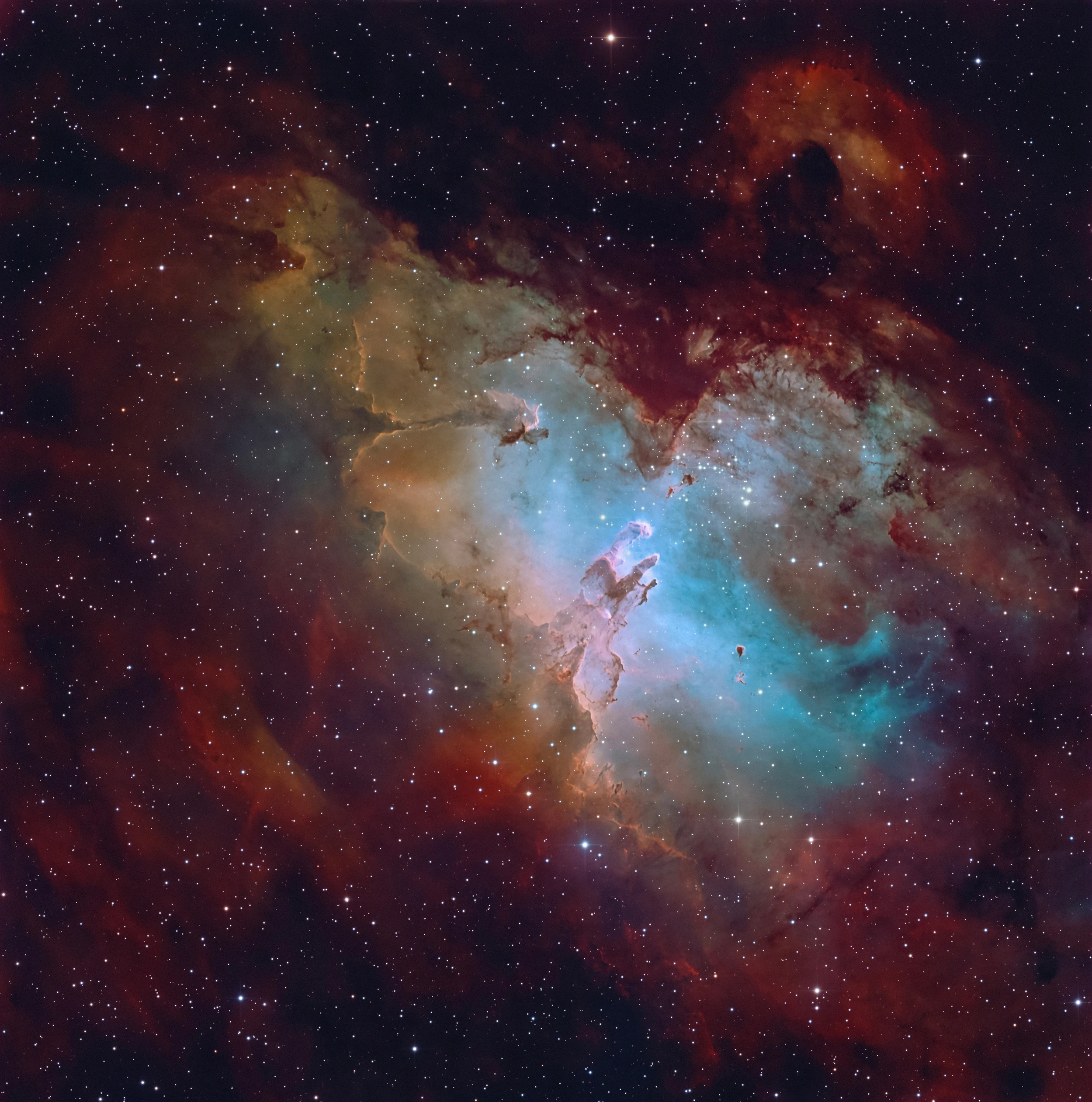
M16 Eagle Nebula
- Type
- Nebula
- Acquisition
- Planewave CDK20 (f/6.8 version) · FLI ML16803
- Integration
- 26h
M16, the Eagle Nebula, also known as the Star Queen Nebula, is a famous nebula located in the constellation Serpens. It is approximately 7,000 light-years from Earth, with an apparent magnitude of 6.0, making it visible through small telescopes under good observing conditions.
The most renowned feature of the Eagle Nebula is the "Pillars of Creation," captured in a classic photograph by the Hubble Space Telescope in 1995, showing massive column-like structures formed by gas and dust. Inside and on the surface of these pillars, new stars are being born. These pillars are about 4 light-years long and are composed of cold molecular hydrogen and dust, sculpted and eroded by intense ultraviolet radiation and stellar winds from nearby young stars.
The M16 nebula also contains the NGC 6611 star cluster, filled with hot, young blue stars whose intense radiation illuminates the surrounding Eagle Nebula. The entire nebula spans approximately 70 x 55 light-years, corresponding to 30 arcminutes in the sky.
Planewave CDK 20"
CCD 16803
Astrodon Hax17 O3x25 S2x10, 1800sec
Total integration time: 26 Hrs