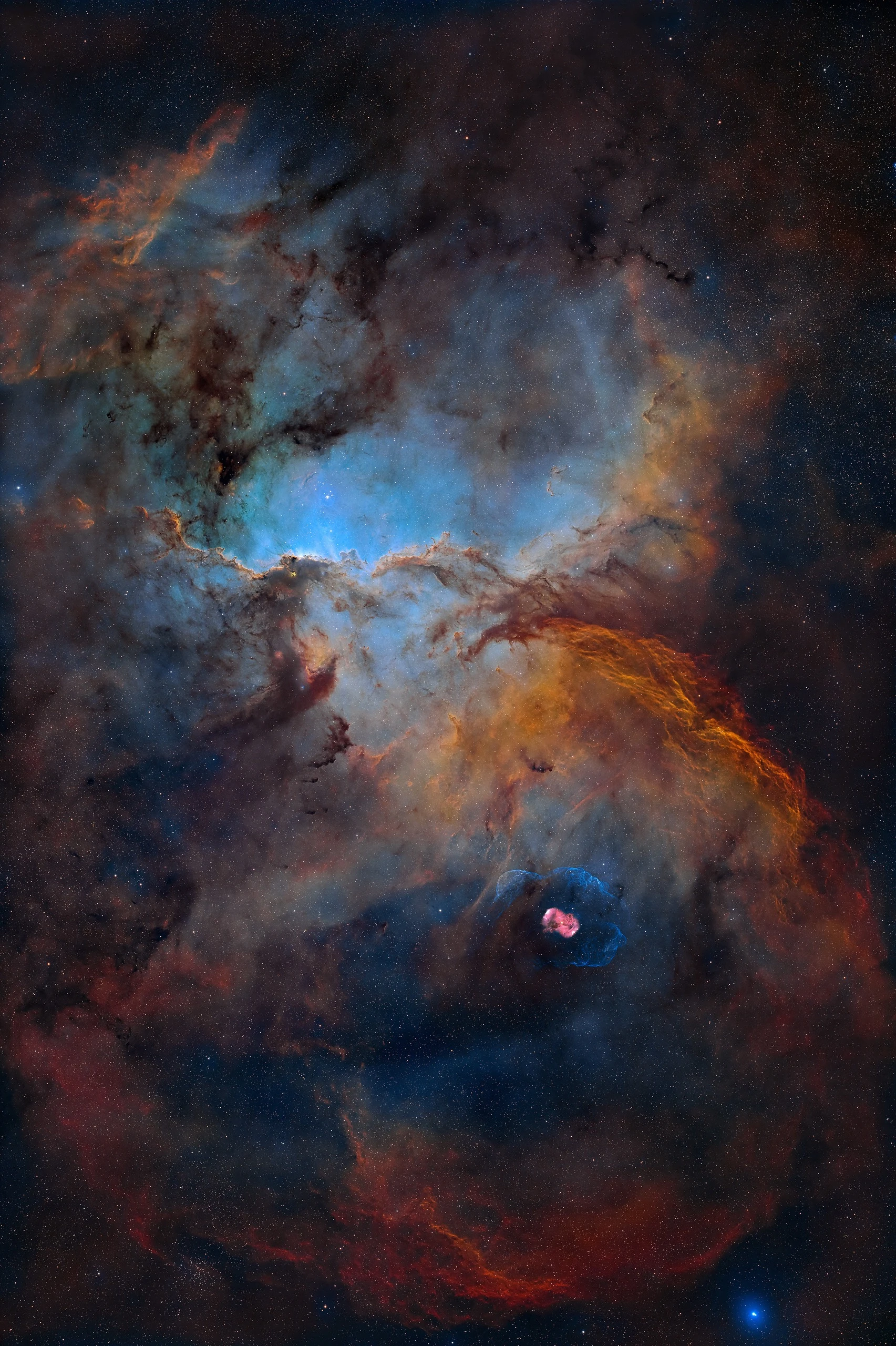
Roar of the Celestial Dragon
- Type
- Nebula
- Acquisition
- Takahashi FSQ-106ED · ZWO ASI6200MM Pro
- Integration
- 31.7h
NGC 6188 and NGC 6164 are a pair of famous celestial objects located in the constellation Ara, separated by about 150 light-years. NGC 6188 is an emission nebula situated approximately 4,000 light-years from Earth. It lies along the edge of a large molecular cloud, where embedded young stars are part of the Ara OB1 stellar association. These stars formed a few million years ago, releasing intense ultraviolet radiation and stellar winds that illuminate the surrounding gas, creating peculiar shapes. Their formation was likely triggered by supernova explosions and stellar winds from a previous generation of massive stars.
NGC 6164 is a relatively rare emission nebula, about 4,200 light-years away from Earth. It was created by a massive O-type star and features symmetric shells of gas and a faint halo surrounding its bright central star. This nebula resembles many planetary nebulae in appearance, though its formation process differs.
Together, these two objects form a spectacular cosmic canvas, illustrating the complex processes of star formation and evolution. NGC 6188 and NGC 6164 are not only popular targets for amateur astronomers but also provide important data for scientists studying stellar evolution. The stellar winds and supernova explosions in this region have triggered a new wave of star formation, continuously shaping the nebulae's structure and appearance.
Takahashi FSQ-106ED
ZWO ASI6200MM Pro
10Micron GM1000 HPS
Chroma Hax72 O3x65 S2x53, 600s
Total integration time: 31.6hrs