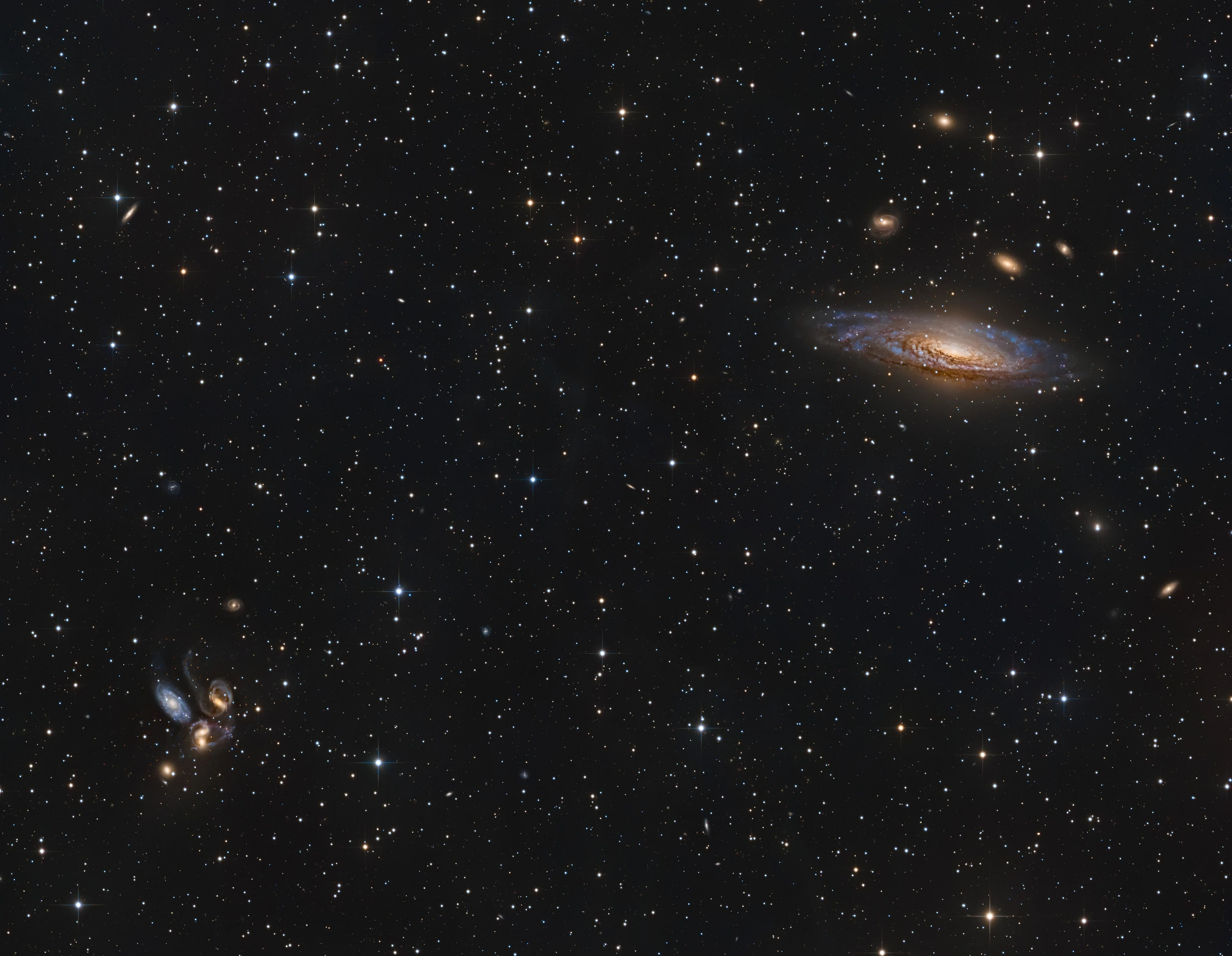
Deer Lick Group and Stephan's Quintet
- Type
- Galaxy
- Acquisition
- Planewave CDK14 · Moravian Instruments C5A-100M
- Integration
- 25h
NGC 7331, also known as the Deer Lick Galaxy, is a large spiral galaxy located in the constellation Pegasus, approximately 50 million light-years from Earth. It is often considered an analog of the Milky Way. Due to the inclination of its disk relative to our line of sight, long-exposure telescope images frequently create a strong sense of depth. This effect is further enhanced by the background galaxies situated beyond this beautiful galaxy. These background galaxies appear to be about one-tenth the angular size of NGC 7331, indicating that they are roughly ten times farther away. Their close alignment with NGC 7331 in the sky is purely coincidental. Through faint foreground dust clouds drifting above the plane of the Milky Way, these visually associated galaxies can be observed, collectively referred to as the Deer Lick Group.
Stephan’s Quintet is a visually compact galaxy group composed of five galaxies, four of which form a tightly interacting cluster. This group is also located in the constellation Pegasus. Among these five galaxies, four (NGC 7319, 7318A, 7318B, and 7317) are gravitationally interacting, exhibiting a yellowish hue and developing distorted rings and tidal tails due to intense gravitational interactions. In contrast, the galaxy NGC 7320 appears strikingly blue and is much closer to us, at a distance of about 40 million light-years—significantly nearer than the other four galaxies. As a result, it is not a true member of the interacting group.
Planewave CDK 14"
Moravian C5A-100M
AP 1100 w/ Absolute Encoders
Chroma LRGB 50x50, Lx60, RGBx30, 600s
Location: Pei Town, New Mexico