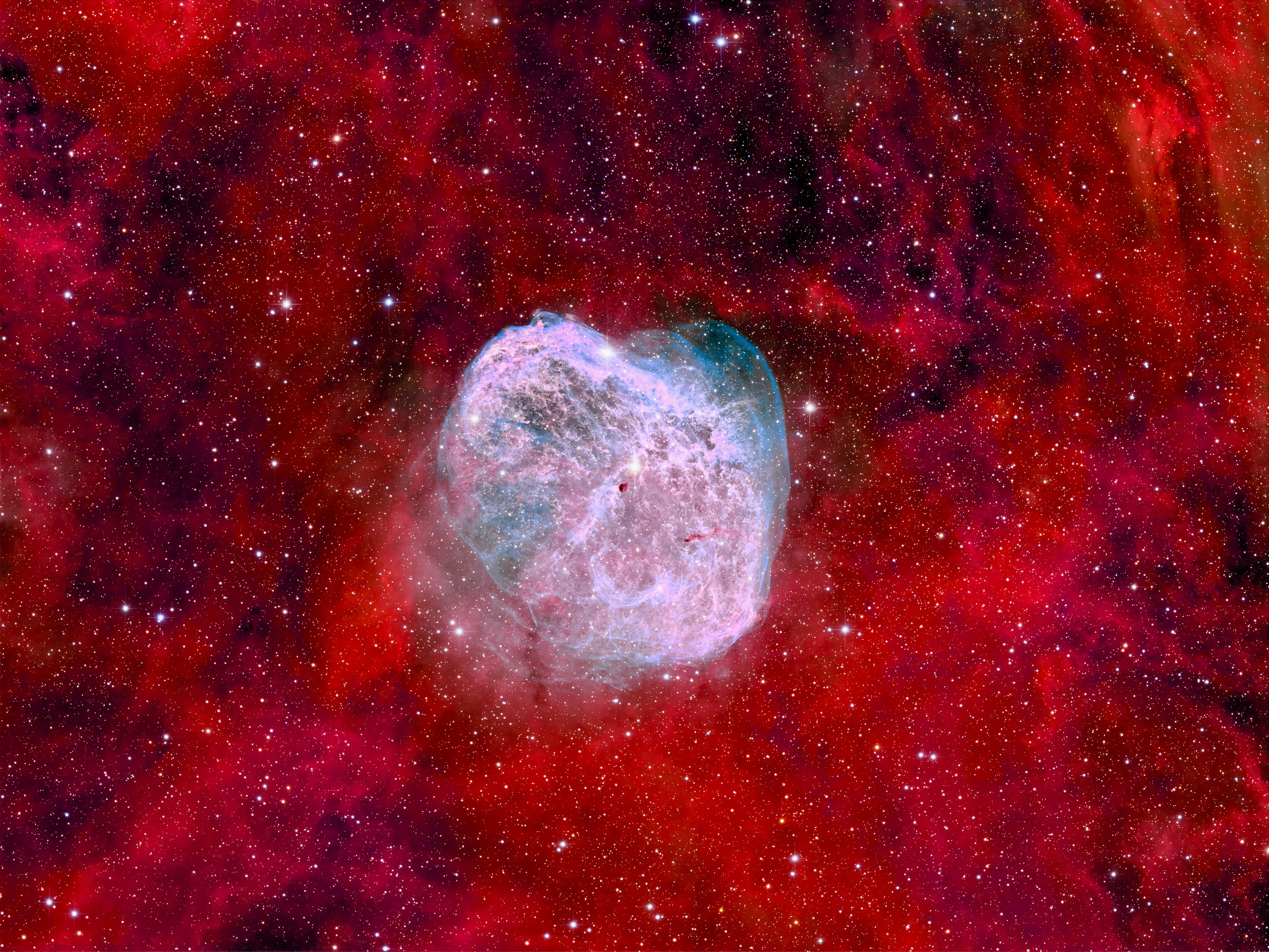
NGC 6888 Crescent Nebula
- Type
- Nebula
- Acquisition
- Planewave CDK14 · Moravian Instruments C5A-100M
- Integration
- 11.2h
Also known as the Bow-Shaped Nebula, it is a magnificent emission nebula located in the constellation Cygnus, about 4,700 to 5,000 light-years from Earth and spanning roughly 25 light-years across. It was sculpted by the powerful stellar winds from its central massive Wolf–Rayet star, WR 136. Approximately every 10,000 years, WR 136 ejects an outer shell of material equivalent to the Sun’s mass through its stellar wind. These high-velocity outflows collide violently with gas expelled in earlier episodes, producing the nebula’s layered and intricate structures. In narrowband images, the glow of hydrogen and oxygen atoms is especially striking, with oxygen emissions appearing in a bluish-green hue, resembling a thin mist enveloping the nebula’s folds and filamentary wisps.
The central star is burning through its nuclear fuel at an astonishing rate and is nearing the end of its life, destined to conclude in a spectacular supernova explosion. The formation of the Crescent Nebula dates back roughly 250,000 years, making it an important object for studying the late evolutionary stages of massive stars.
Planewave CDK 14"
Moravian C5A-100M
Chroma 5nm Hax47, OIIIx43, SIIx44 300s
Total integration time: 11h10m
Location: Texas, USA