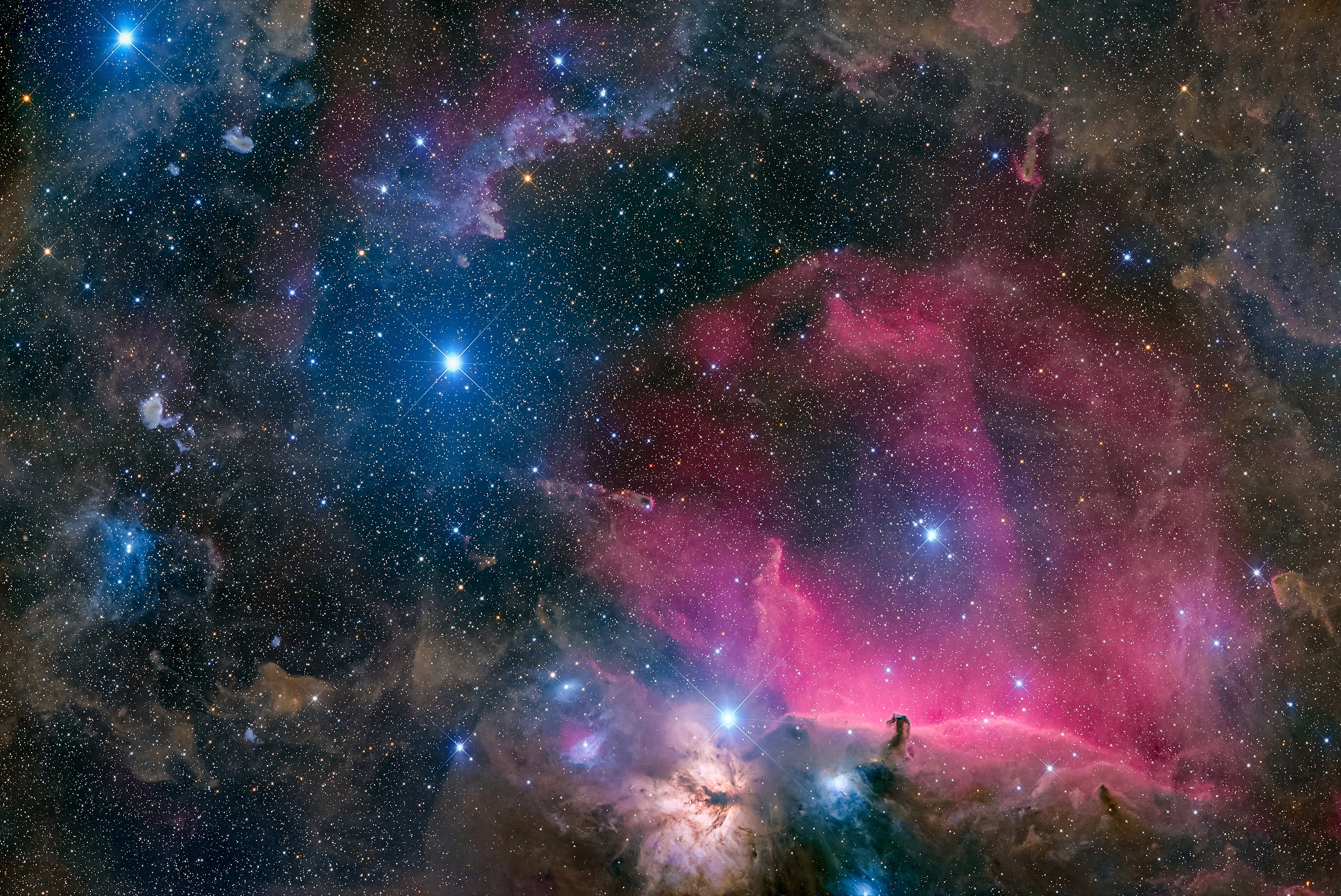
Orion's Belt and Surroundings
- Type
- Nebula
- Acquisition
- Takahashi Epsilon-180ED · SBIG STXL-11002M
- Integration
- 3.6h
Orion's Belt is composed of three bright stars: Alnitak, Alnilam, and Mintaka. These stars are nearly aligned in a straight line, making them one of the most easily recognizable asterisms in the winter night sky and a defining feature of the Orion constellation. All three are blue-white supergiants located several hundred light-years from Earth and are extremely luminous.
Southeast of Alnitak lies a famous deep-sky object — the Horsehead Nebula (Barnard 33). This is a dark nebula that appears in silhouette against the bright emission nebula IC 434, creating a distinctive horse-head shape. Located about 1,375 light-years away, the Horsehead Nebula is an active star-forming region. Though relatively faint, it is a favorite target among deep-sky astrophotographers due to its unique shape and mysterious appeal, especially in long-exposure images.
Takahashi Epsilon 180ED
SBIG STXL 11002
Lx16 Rx7 Gx10 Bx10 300s
Total integration time: 3.58hrs