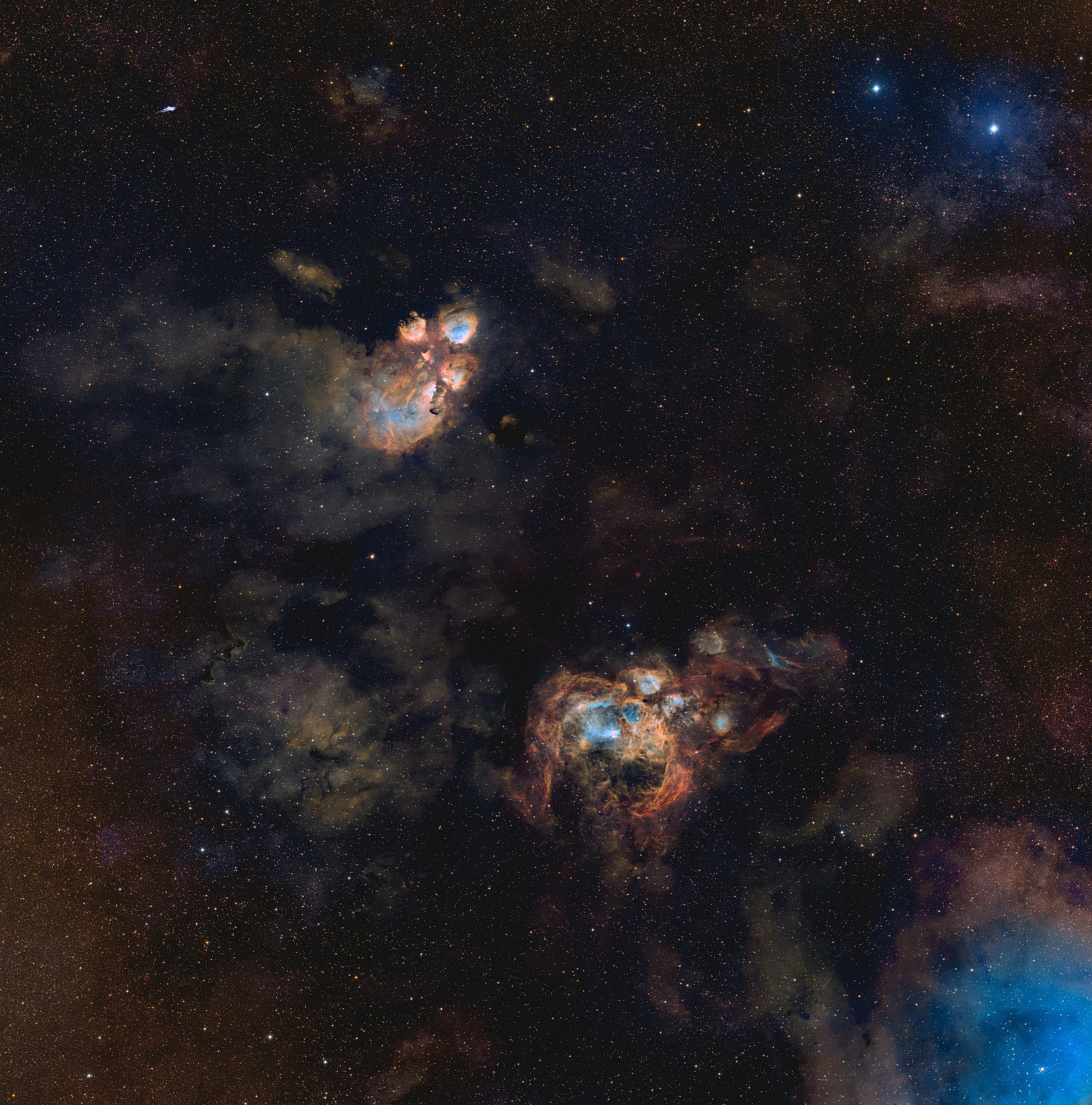
SH2-11 Lobster Nebula, SH2-8 Cat's Paw Nebula & NGC 6302 Butterfly Nebula
- Type
- Nebula
- Acquisition
- Takahashi FSQ-106EDX III · Moravian Instruments G4-16000 MK I
- Integration
- 13.3h
Three well-known emission nebulae — SH2-11 (the Lobster Nebula), SH2-8 (the Cat’s Paw Nebula), and NGC 6302 (the Butterfly Nebula) — appear together in a single wide-field image, revealing a magnificent view of stellar birth and death within our Milky Way galaxy. Toward the upper left of the image lies SH2-8, also cataloged as NGC 6334, whose cat-paw-like shape houses an active star-forming region that is giving rise to numerous massive stars. Below and slightly to the right is SH2-11, or NGC 6357, another intense stellar nursery known for its shrimp-like appearance and bright H-alpha and OIII emissions.
Near the top left corner of the frame is NGC 6302, the Butterfly Nebula, a planetary nebula formed by a dying Sun-like star expelling gas in its final stages of life. Its hot central star and striking bipolar lobes symbolize the final chapter of a star’s evolution. Together, these objects showcase the complete stellar life cycle—from formation (SH2-8 and SH2-11) to demise (NGC 6302)—in one breathtaking cosmic portrait.
Takahashi FSQ106 EDX3
Moravian Instruments, G4-16000
Planewave L500
Astrodon E-series SHO 50mm
SIIx60, Hax40, OIIIx60, 300sec
Total integration time: 13.3 hrs
Location: Chile