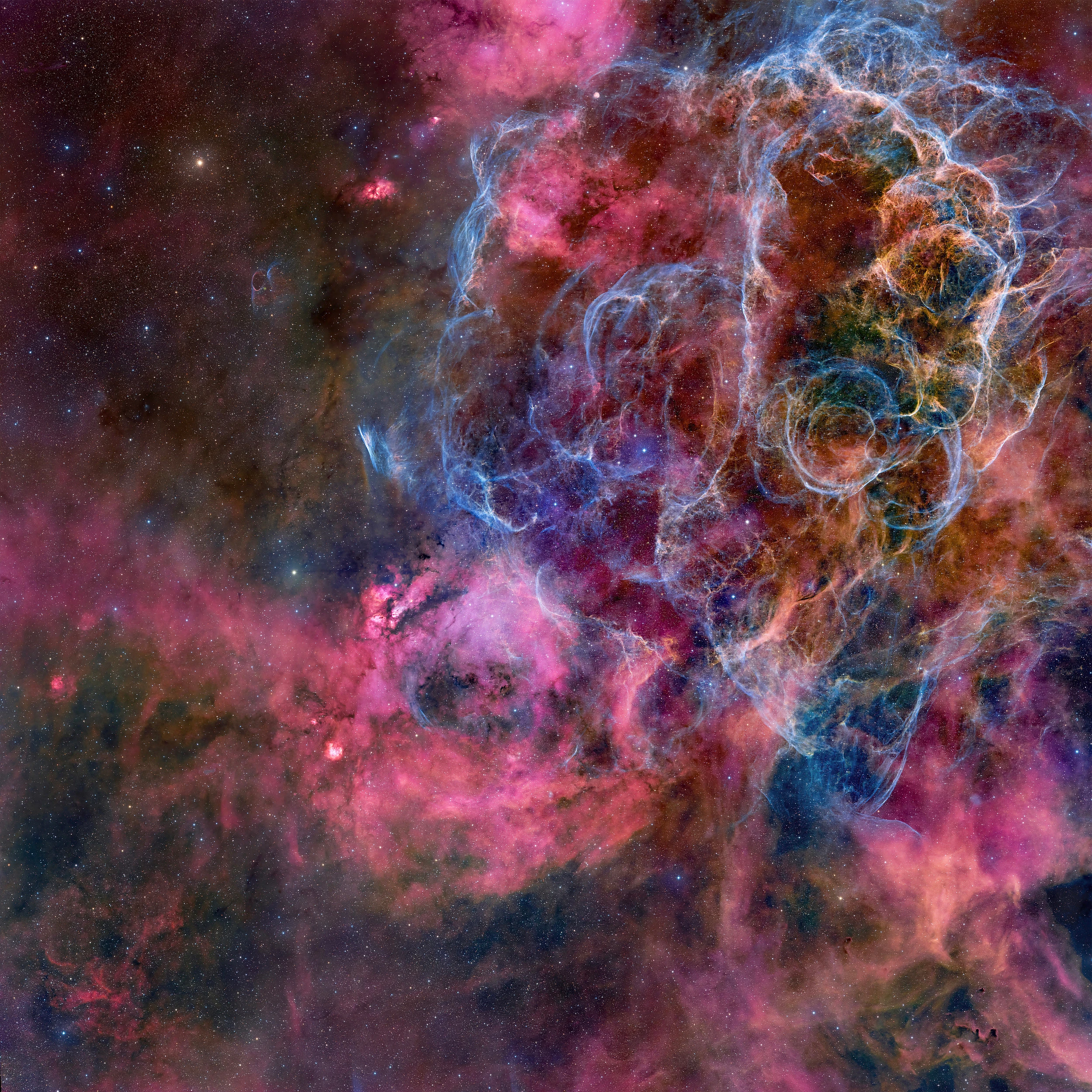
Vela Supernova Remnant
- Type
- Nebula
- Acquisition
- Takahashi FSQ-106EDX III · Moravian Instruments G4-16000 MK I
- Integration
- 109.2h
The Vela Supernova Remnant, located in the southern constellation Vela, is one of the most famous remnants of a stellar explosion. It originated from a supernova that occurred about 11,000 to 12,300 years ago and lies only about 800 light-years from Earth, making it one of the nearest known supernova remnants. Vast in scale and highly complex in structure, it consists of multiple overlapping shells of gas. Shock waves from the supernova continue to expand at tremendous speeds, exciting interstellar material and producing magnificent filamentary structures.
The most iconic feature is NGC 2736, also known as the “Pencil Nebula,” named for its long, bright shape that resembles a pencil or a witch’s broom. The brilliant emissions primarily come from excited hydrogen and oxygen ions. The Vela Supernova Remnant not only serves as a vital laboratory for studying supernova mechanisms and their interaction with the interstellar medium but is also one of the largest and brightest objects in the sky in X-ray wavelengths. At its center lies a rapidly rotating pulsar, offering direct evidence of the formation of a neutron star after a supernova explosion.
4-panel mosaic, and the output image is produced using a 2×2 binning mode (BIN2).
Takahashi FSQ106 EDX3
Moravian Instruments, G4-16000
Planewave L500
Astrodon E-series LRGBHa 50mm
Lx80, Rx80, Gx80, Bx80, Hax420, OIIIx280, SIIx290 300s
Total integration time: 109hrs
Location: Río Hurtado, Coquimbo, Chile