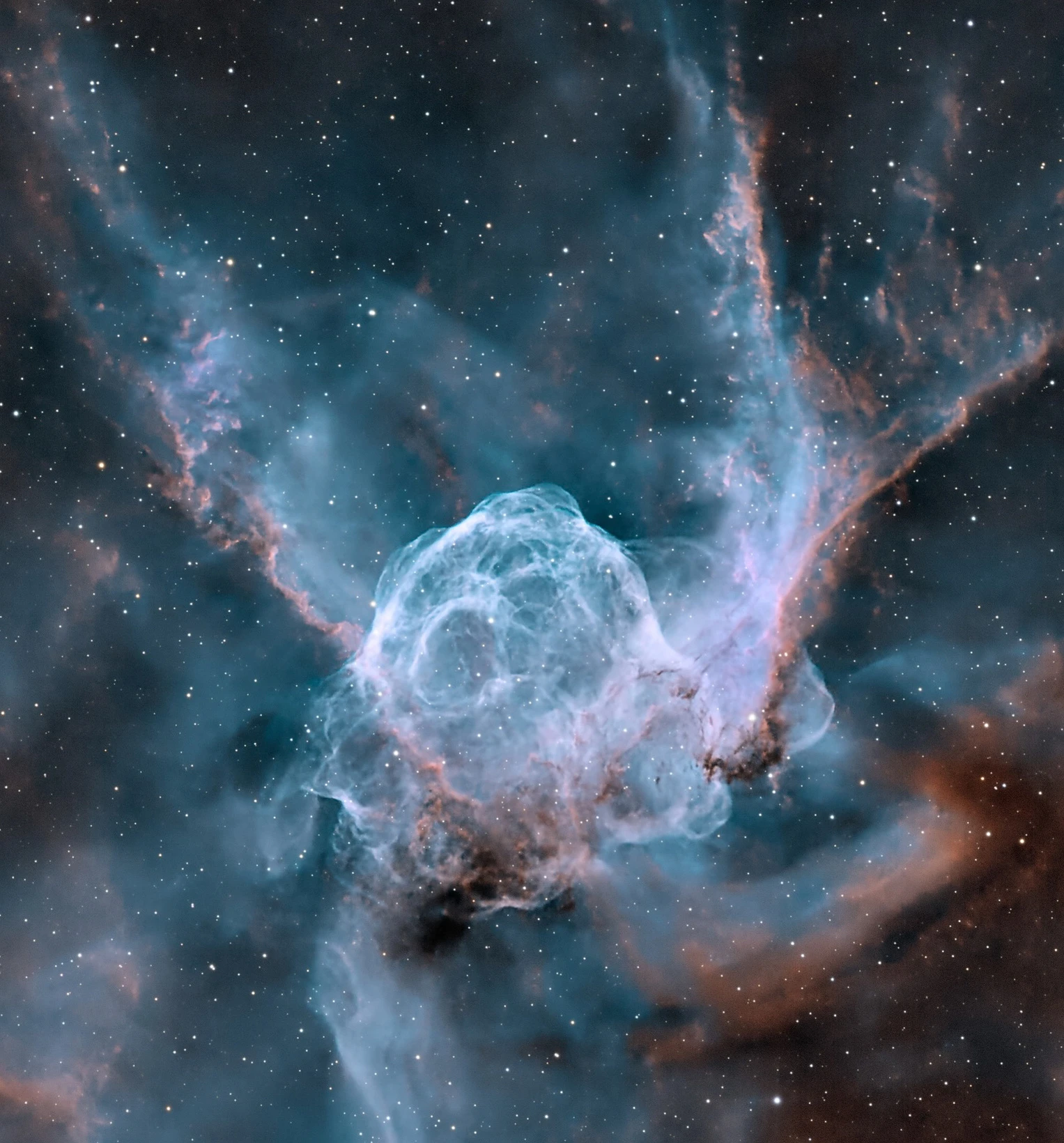
NGC 2359 Thor's Helmet
- Type
- Nebula
- Acquisition
- Planewave CDK14 · Moravian Instruments C5A-100M
- Integration
- 4.9h
NGC 2359, also known as the Stitch Nebula, is an emission nebula located in the constellation Canis Major, approximately 15,000 light-years from Earth and spanning about 30 light-years across. It is powered by a very hot Wolf-Rayet star (WR7), which is in the pre-supernova stage.
The nebula's shape resembles a helmet with wing-like appendages on either side, formed by the intense stellar wind from the central star expanding the surrounding molecular cloud into a bubble-like structure. These gases emit light under the influence of stellar radiation, particularly the blue glow from doubly ionized oxygen atoms.
Wolf-Rayet stars are massive, high-temperature stars usually in the late stages of their evolution and rapidly losing mass.
The high-energy particle wind released by these stars interacts with the surrounding gas and dust, creating structures like NGC 2359. The striking features and spectacular appearance of NGC 2359 make it an important target for astronomical observation and research.
Planewave CDK14
Moravian C5A-100M
Astro-Physics 1100
CHROMA Hax23 O3x25,300s; RGBx6, 180s
Total integration time: 5 Hrs
Location: Animas, New Mexico, USA