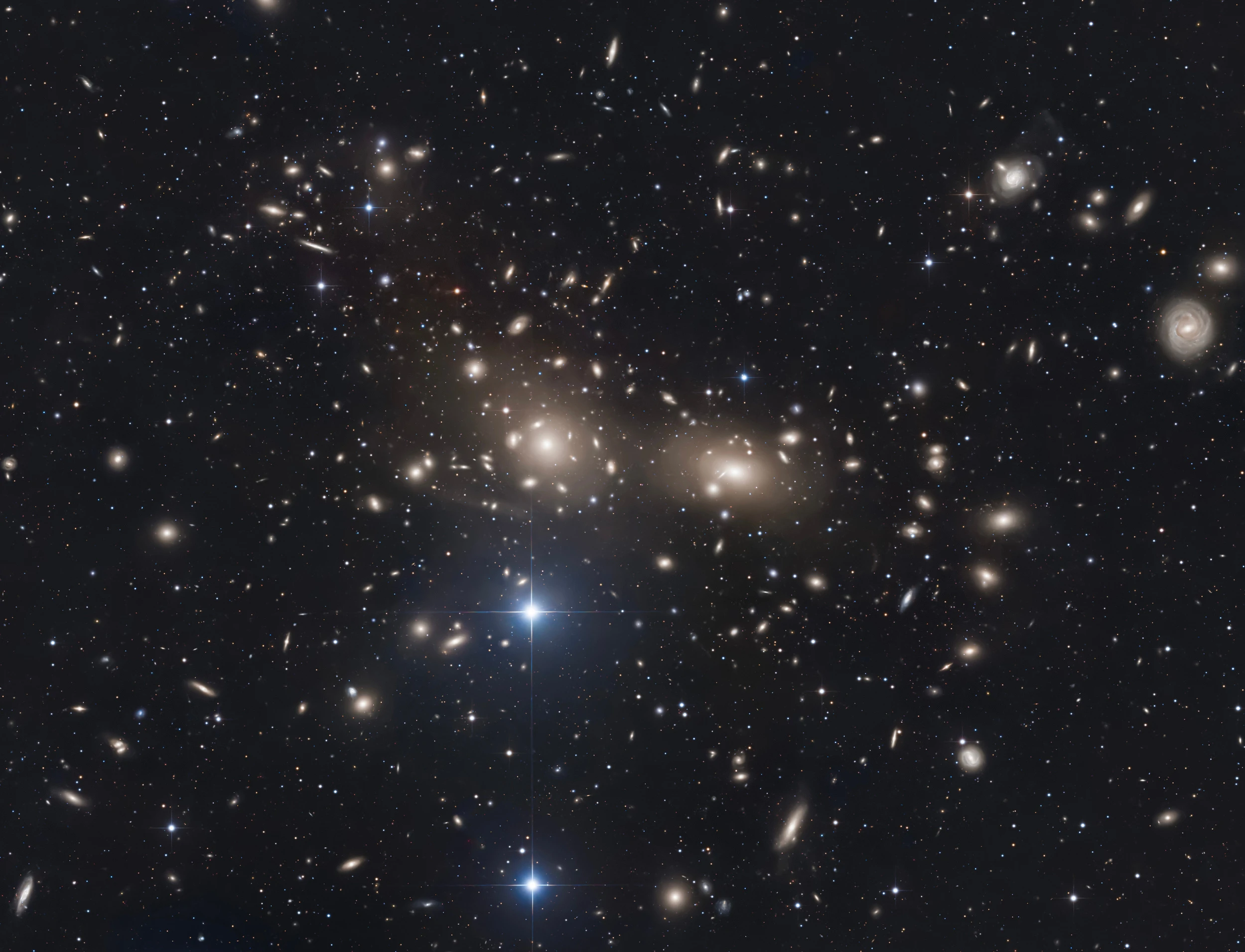
Abell 1656 Coma Cluster
- Type
- Galaxy
- Acquisition
- Planewave CDK14 · Moravian Instruments C5A-100M
- Integration
- 27h
The Coma Cluster (Abell 1656) is a massive galaxy cluster located in the direction of the constellation Coma Berenices, about 320 million light-years from Earth. It contains more than one thousand confirmed galaxies, the vast majority of which are elliptical or lenticular in type. Among them, the most prominent are the two supergiant ellipticals—NGC 4874 and NGC 4889. Notably, NGC 4889 harbors at its core an ultramassive black hole with a mass estimated at 21 billion times that of the Sun.
The Coma Cluster is a principal component of the Coma Supercluster, characterized by its extremely high galaxy density and predominance of evolved, early-type galaxies. Due to frequent collisions and tidal interactions among its members, spiral galaxies often evolve into ellipticals, giving rise to the cluster’s current structure. Remarkably, thousands of globular clusters have also been detected in its central region. These globular clusters are not bound to any single galaxy but are instead gravitationally tied to the cluster as a whole, forming a vast intra-cluster globular cluster system that highlights the complexity and richness of the Coma Cluster’s internal structure.
Planewave CDK 14"
Moravian C5A-100M
AP 1100 w/AE
Chroma 50x50 Rx110, Gx108, Bx116, 300sec
Total integration time: 27hrs
Location: New Mexico, USA