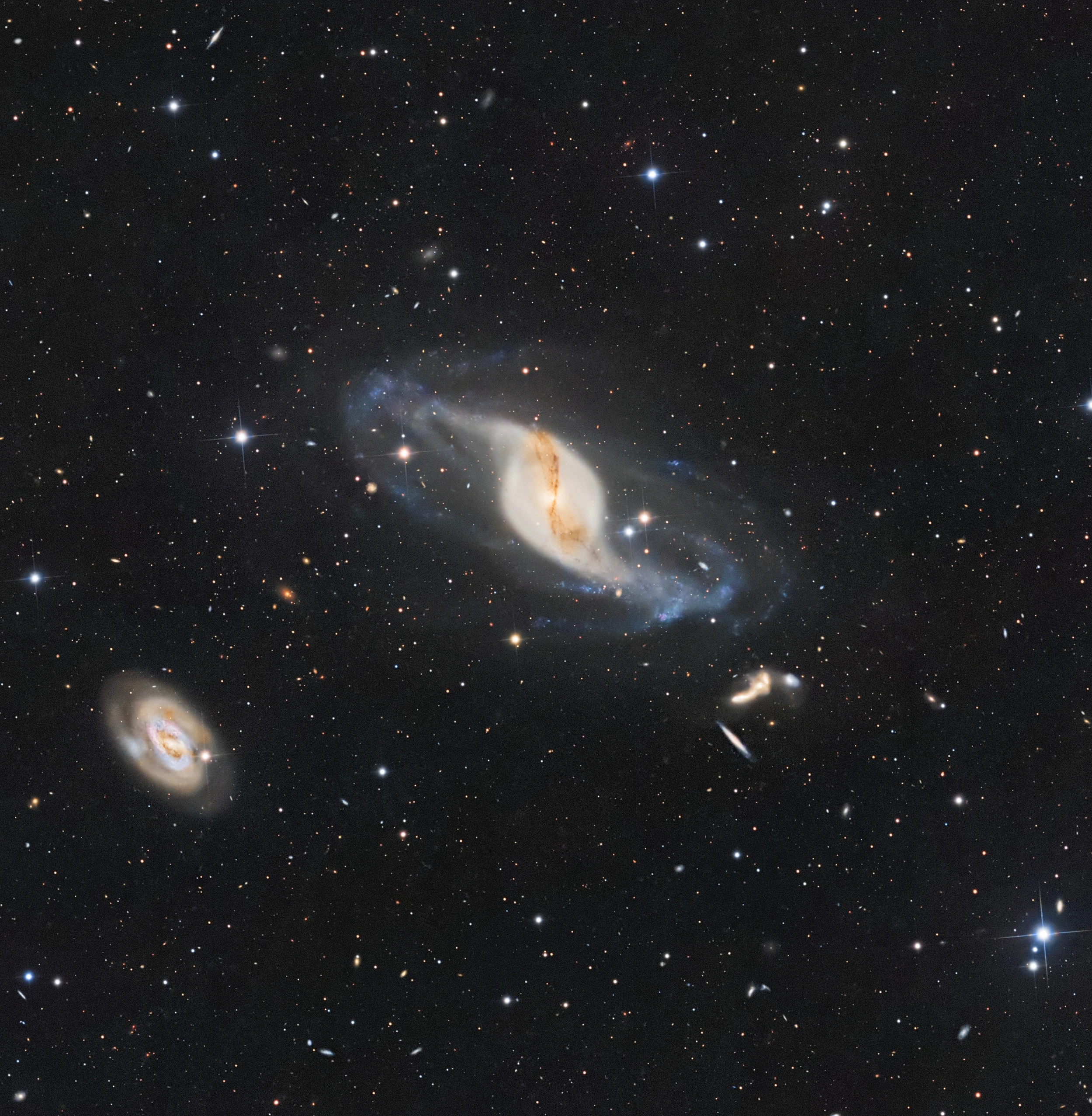
NGC 3718, NGC 3729 and Hickson 56
- Type
- Galaxy
- Acquisition
- RCOS 14.5" f/8 Carbon Truss Ritchey-Chrétien · Apogee Alta U16M
- Integration
- 12.3h
NGC 3718, NGC 3729 and Hickson 56
Look closely at this colorful cosmic scene and you will find Ursa Major holds a surprising variety of galaxies, at a surprising range of distances. Most striking is the warped galaxy at center, NGC 3718: its spiral arms curve and stretch far outward, studded with blue young star clusters, while a drawn-out dust lane cuts across the front of its yellow core. About 150,000 light-years to its lower left lies the large spiral NGC 3729. The pair is roughly 52 million light-years away, and their mutual gravitational pull is likely what makes NGC 3718 look so peculiar. To the lower right of NGC 3718 you can also spot the marvelous Hickson 56 — a group of five gravitationally entangled galaxies more than 400 million light-years distant.
14.5" RCOS F8
Apogee U16M
Lx24, RGBx13, 1200sec