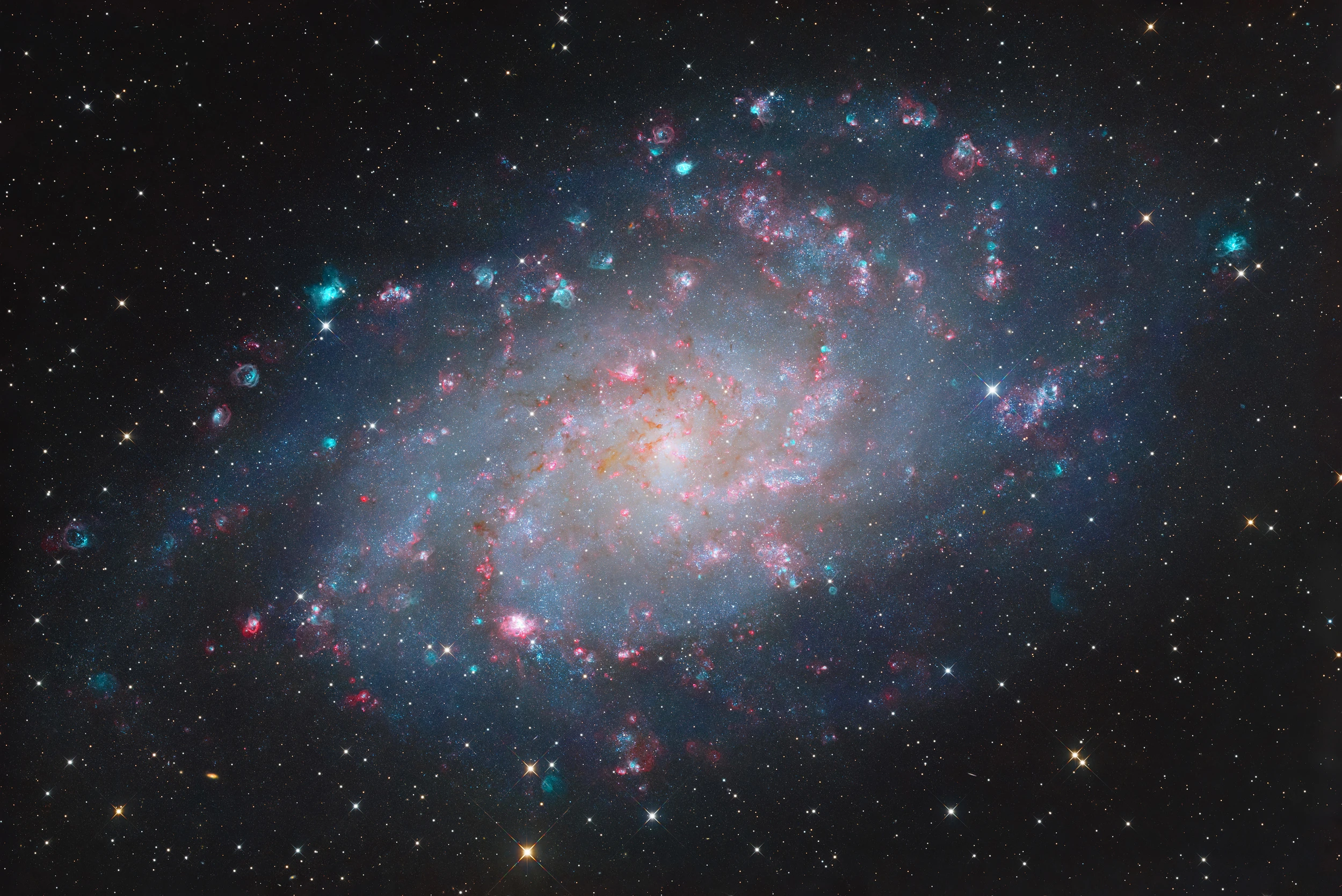
M33
- Type
- Galaxy
- Acquisition
- Sky-Watcher BKP 25012 · QHYCCD QHY268 M
- Integration
- 80h
The Triangulum Galaxy (M33) is one of the most prominent spiral galaxies in the Local Group, renowned for its vigorous star formation and strong emission lines. Its spiral arms are rich in Hα and O III emission regions, which form the core stage for stellar birth. Hα emission primarily originates from the widely distributed H II regions, glowing in shades of pink to red—a hallmark of massive young stars emitting ultraviolet radiation that ionizes surrounding hydrogen gas. Among these regions, giant H II complexes such as NGC 604 are particularly striking, not only for their immense scale but also for their diverse structural morphologies, including “composite” and “shell” types.
O III emission, on the other hand, is associated with ionized environments of higher energy and temperature, frequently observed in active star-forming areas and high-excitation nebulae. It produces a distinctive blue-green glow, often coexisting with Hα regions but appearing brighter in highly excited gas surrounding young star clusters. Studies have shown that the [O III]/Hβ ratio in the M33 galactic disk exhibits a gradual change from the center to the outskirts, with noticeable excitation differences between the northern and southern disks. These variations reflect the differing physical conditions and star formation histories across the galaxy.
Skywatcher BKP250 OTAW
QHY268m
iOptron CEM120
Optlong Lx120,Rx60,Gx60,Bx60, 600s; 3nm Hax60, 3nm OIIIx60, 900s
Total integration time: 80hrs