Truth and Falsehood in the Starry Sky: Physical Logic and Artistic Expression in Astrophotography
Recently, a discussion about “comet photography” has drawn considerable attention within Taiwan’s amateur astronomy community. It began with an image of Comet C/2025 R3 shot with a ZWO S30PRO—its sweeping composition of landscape and starry sky earned plenty of praise on social media. Yet when Dr. Wei-Hao Wang, an astronomer at Academia Sinica Institute of Astronomy and Astrophysics, questioned the physical plausibility of the image processing, he was accused by some of “not knowing how to appreciate art.”
This controversy laid bare a rather deep rift within astrophotography circles between two great value systems: “scientific realism” and “visual creation.”
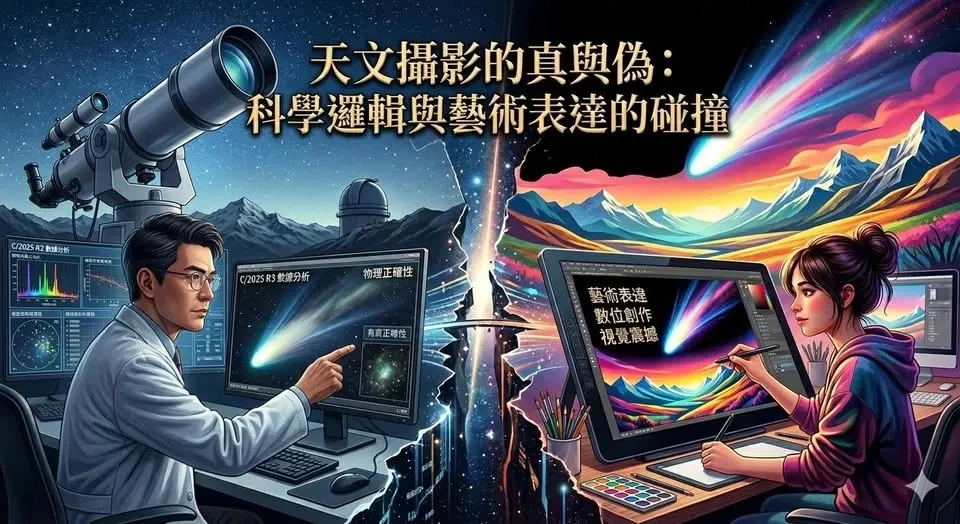
I. The Scientific Insistence: Atmospheric Laws and Physical Truth
In the discussion, Dr. Wei-Hao Wang pointed out that the image presented an extremely dark sky background paired with an unusually bright landscape—a visual contrast that is, in fact, extremely difficult to justify under the physical conditions of the Earth’s atmosphere. He questioned whether, when the landscape and the starry sky lack a natural transition in brightness and ambient light, this “vacuum-like feel” would rob the image of its persuasiveness.
This observation was not deliberate fault-finding, but grounded in the common sense of astrophysics. When you photograph a nightscape on Earth, there is a necessary link between the brightness of the landscape and the sky’s background glow (skyglow). When those two are forcibly stripped apart and then spliced back together in an unnatural way, then from a scientific standpoint the image has departed from the very essence of photography as a “record.”
II. The Definition and Boundaries of “Art”
Faced with this technical objection, some supporters argued that “photography is art,” holding that the creator should enjoy a freedom that transcends physical constraints and should not be bound by rigid scientific rules.
Yet this view also brings another layer of reflection: is the very distinctiveness of astrophotography built precisely on its reverence for the true face of the universe? If, in the pursuit of visual impact, one carelessly collages landscape and starry sky without logic, or even ignores the laws governing how light and shadow propagate through the atmosphere, then the nature of the work quietly shifts from “astrophotography” toward “digital painting.” What Wei-Hao Wang emphasized—“if you’re going to shoot the landscape, then do it properly and capture that sense of atmosphere”—is in fact a call: while pursuing beauty, the photographer should not abandon an understanding of environmental truth.
III. Technical Progress and Aesthetic Grounding Should Advance Together
As automated astrophotography equipment like the S30PRO becomes widespread, the barrier to entry for astrophotography has dropped dramatically, allowing many more newcomers to take part. But the convenience of the tool should not become an excuse for ignoring basic optical logic.
Genuine image-processing skill—whether the use of PixInsight or Photoshop—should have as its aim to overcome the limitations of the hardware and “restore” the deep layers of the universe, not to create a virtual space that does not physically exist.
Conclusion: When Truth Meets Beauty
To criticize a professional scholar who has long cultivated the field of astronomy as one who “doesn’t understand art” may be convenient, yet it cannot explain the break in physical logic within the image.
True astrophotographic art should not be set in opposition to scientific fact; on the contrary, it should be built upon a deep understanding of astrophysics and atmospheric optics. This controversy also reminds every enthusiast: when shooting, adjusting parameters, and processing images, beyond pursuing visual tension, respect for and honesty toward the laws of nature may be precisely what allows an astronomical work to withstand the test of time and truly move the heart.