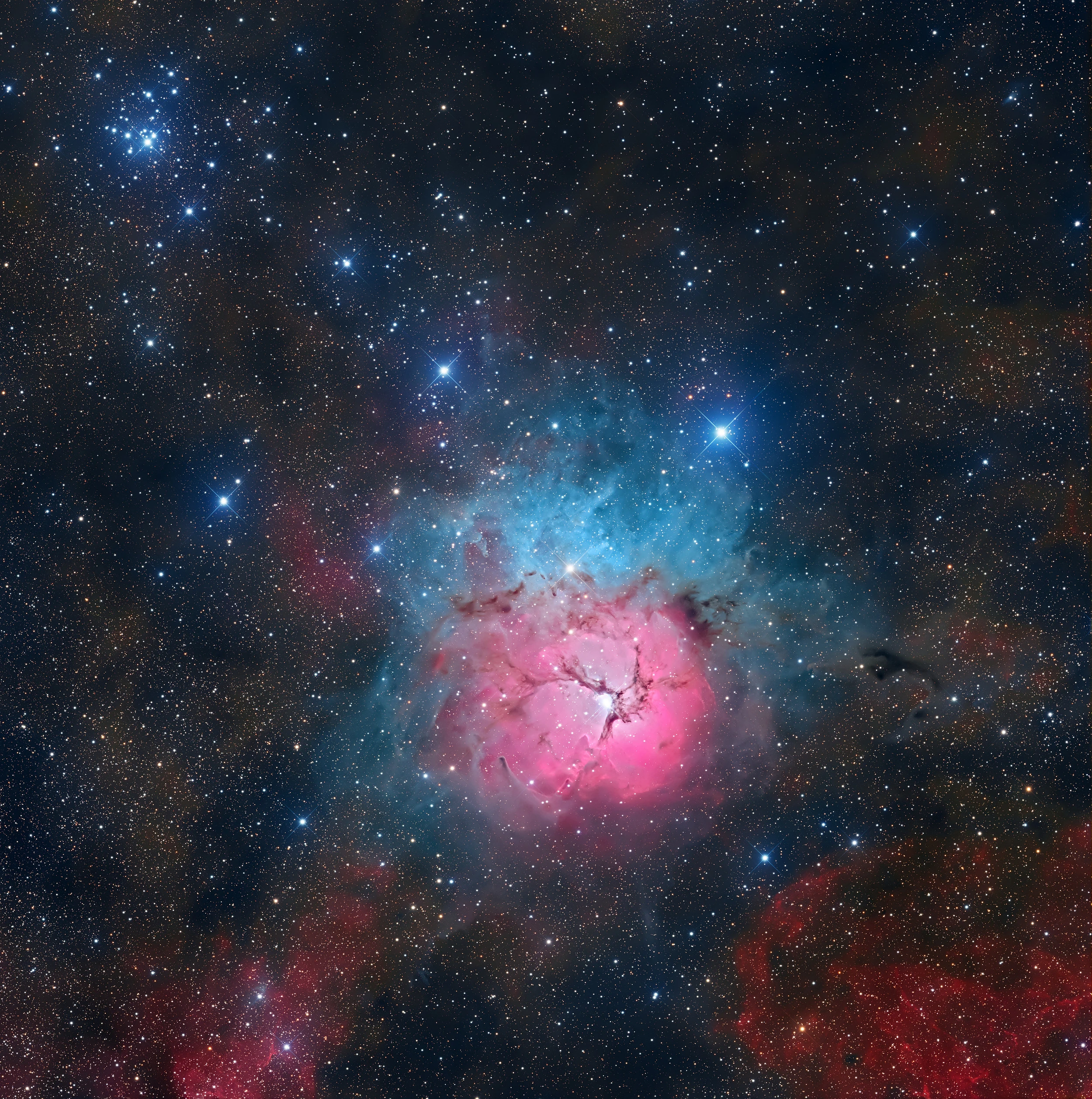
M20 Trifid Nebula
- Type
- Nebula
- Acquisition
- ASA 500N · FLI ML16803
- Integration
- 2.8h
M20 Trifid Nebula
The Trifid Nebula in Sagittarius is a "flower of the deep sky", blooming some 3,000 to 5,000 light-years from Earth. Discovered by French astronomer Charles Messier in 1764, it takes its name from the three dark dust lanes that split it into three lobes — a blossom cleaved in three.
What makes this nebula so beguiling is that it shows three faces at once:
- A red emission nebula: hydrogen set aglow by the fierce ultraviolet light of young stars.
- A blue reflection nebula: fine dust grains mirroring starlight into a dreamy blue halo.
- A dark nebula: dense dust casting the shadowed cracks that divide the petals.
Roughly 40 light-years across, the nebula has given birth to over a thousand young stars — some twenty times the mass of the Sun. It is at once a cosmic work of art and a natural laboratory for studying how stars are born.
For amateur astronomers, the Trifid is one of the highlights of the summer sky: even a small telescope will reveal its singular colors and structure — a cosmic flower in full bloom within the Milky Way.
ASA 500N
FLI Proline 16803
ASA DDM85
Astrodon 50mm RGB
Rx12, Gx13, Bx8, 300s
Total integration time: 3Hrs
Location: ChileScope