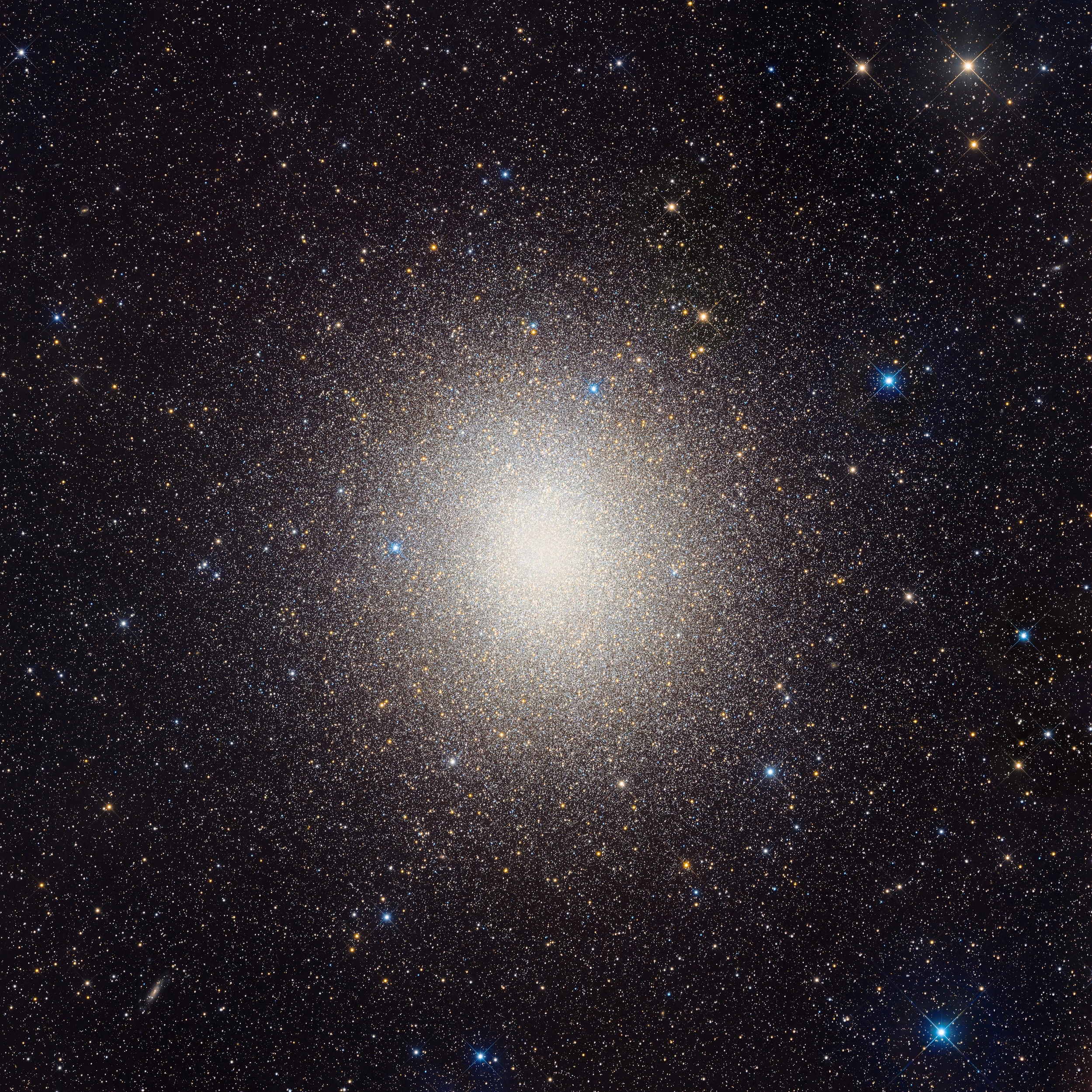
Omega Centauri
- Type
- Cluster
- Acquisition
- ASA 500N · FLI ML16803
- Integration
- 5h
This cluster is the largest and brightest globular cluster in the Milky Way, located in the southern sky within the constellation Centaurus, about 17,000 light-years from Earth. It spans approximately 150 light-years in diameter and contains around 10 million stars, with a total mass about 4 million times that of the Sun. Omega Centauri has an extremely high stellar density, with stars in its core separated by only about 0.1 light-years on average. This density leads to frequent stellar interactions, making it an important object for studying stellar dynamics and evolution.
Unlike typical globular clusters, Omega Centauri displays a wide range of metallicities and stellar ages, suggesting that it may not be a conventional globular cluster but rather the remnant core of a dwarf galaxy that was absorbed by the Milky Way. Additionally, researchers have discovered a possible intermediate-mass black hole at the center of the cluster, estimated to be around 8,200 times the mass of the Sun. This finding provides new insights into black hole formation and evolution. With a brightness of magnitude 3.9, Omega Centauri is one of the few globular clusters visible to the naked eye.
Chilescope T2, T3 ASA 500N
FLI Proline 16803
ASA DDM85
Astrodon 50mm RGB
RGBx20, 300s
Total integration time: 5hrs