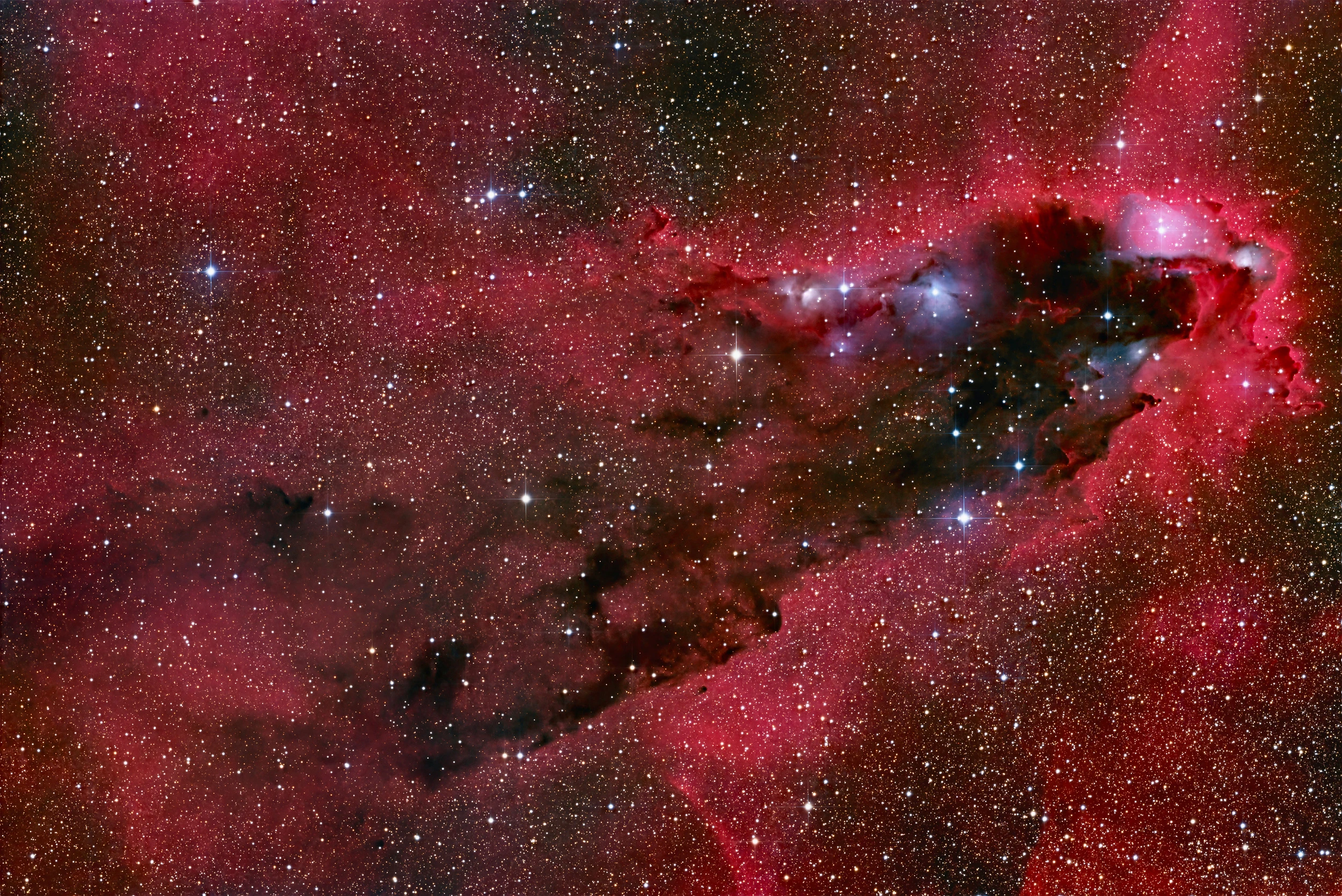
VdBH 73 The Dark Tower in Scorpius
- Type
- Nebula
- Acquisition
- Planewave CDK20 (f/6.8 version) · QHYCCD QHY600PH M
- Integration
- 19.3h
Located in the constellation Scorpius, the "Dark Tower" is a striking dark nebula classified as a typical globule. It lies approximately 5,000 light-years from Earth and spans about 40 light-years across. This isolated cloud of cold gas and dust obscures the background stars, outlining a towering silhouette against the interstellar backdrop. Due to its dense concentration of molecular gas and dust, astronomers believe it may be in the early stages of gravitational collapse, potentially forming new stars. As such, it is regarded as a stellar nursery within our galaxy.
The Dark Tower’s distinctive shape is closely linked to the nearby young star cluster NGC 6231, located roughly 100 light-years away. The cluster's hot, massive stars emit intense ultraviolet radiation that sculpts the surrounding nebula and creates a tail-like structure reminiscent of a comet. This radiation also causes the edges of the cloud to glow faintly red due to hydrogen emission, while embedded hot stars within the cloud generate vivid blue reflection nebulae. NGC 6231 is also known as the "False Comet Cluster" or the "Northern Jewel Box Cluster" and is a prominent member of the young stellar association Scorpius OB1.
Planewave CDK 20"
QHY600PH-M
Planewave L500
Chroma 50mm Rx40,Gx30,Bx30, 300s; 3nm Hax66, 600s
Total integration time: 19.33hrs
Location: El Sauce, Chile