Star Removal Tool Comparison: StarNet++, StarXTerminator, APP
This article is compiled from notes made in 2021; some of the tools or workflows have since been updated, so please keep that in mind while reading.
Star removal (removing the stars) is an increasingly common step in astro post-processing. This article takes the three mainstream tools of the time, back in 2021—StarNet++, StarXTerminator, and Astro Pixel Processor (APP)—and compares them across three aspects: price, speed, and star-removal results.
Price
From highest to lowest:
APP > StarXTerminator > StarNet++
Speed
- StarXTerminator (PS) >> StarNet++ (PI) >>>>>> APP
- StarXTerminator (PI) = StarNet++ (PI) >>>>>> APP
No matter the platform, APP’s star-removal speed lags far behind.
Results on Galaxies or Large Stars
StarXTerminator > StarNet++ >>>>>>>>>> APP
Personal Impressions
APP’s star-removal feature is a tragedy: it’s resource-hungry, slow, and prone to mangling the image with artifacts, so this feature can simply be ignored.
StarNet++ does better on small stars, which comes down to its training model at the time; its results on small stars are more satisfying than StarXTerminator’s. But apart from that—whether it’s star removal around galaxies and on large stars, or its handling of residual artifacts—StarXTerminator is the better one.
The biggest difference between the two is that StarXTerminator is paid software, while StarNet++ is free.
Larger Comparison Images
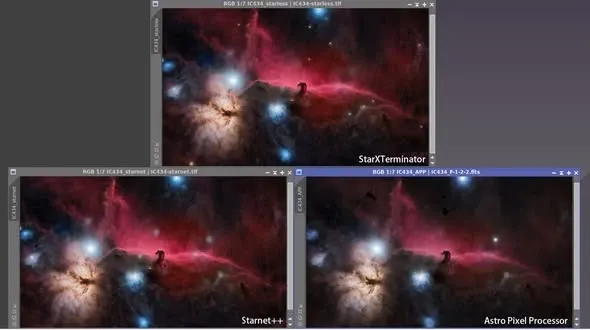
Using an IC434 image as an example, I did a star-removal comparison and attached links to the full-size results from each tool:
- StarNet++: https://www.astrobin.com/uwrg2q/C/
- StarXTerminator: https://www.astrobin.com/uwrg2q/D/
- APP: https://www.astrobin.com/uwrg2q/E/
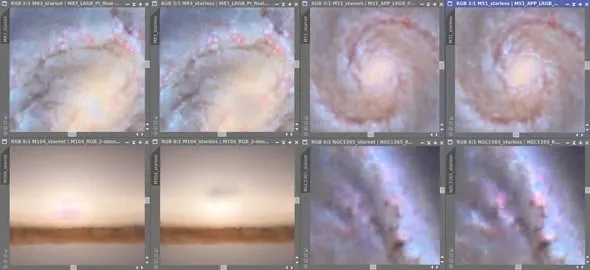
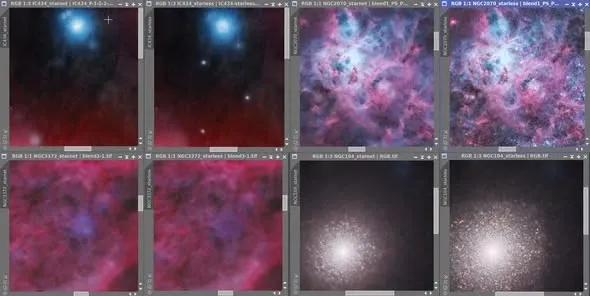
The remaining comparison images are ones I shot myself to test how StarNet++ (left) and StarXTerminator (right) perform on different types of targets, covering scenarios such as galaxies, star clusters, and large stars.