A Non-Standard Use of BlurXTerminator: Removing Chromatic Halos Around Stars
Think BlurXTerminator (BXT) can only be used to sharpen images? It actually has another rather clever “non-standard” use—reducing the halo around the edges of stars caused by chromatic aberration.
Adam Block’s Demonstration
Adam Block once released a video demonstrating how to use BXT in a non-standard way to remove the blue star halos caused by the chromatic aberration of a refractor. Along the way he also combined quite a few additional techniques to greatly reduce this phenomenon, such as using masks, channel separation, and so on.
In other words, this isn’t a matter of just throwing BXT on and clicking once—it’s about treating it as one link in a whole workflow, deployed together with other techniques.
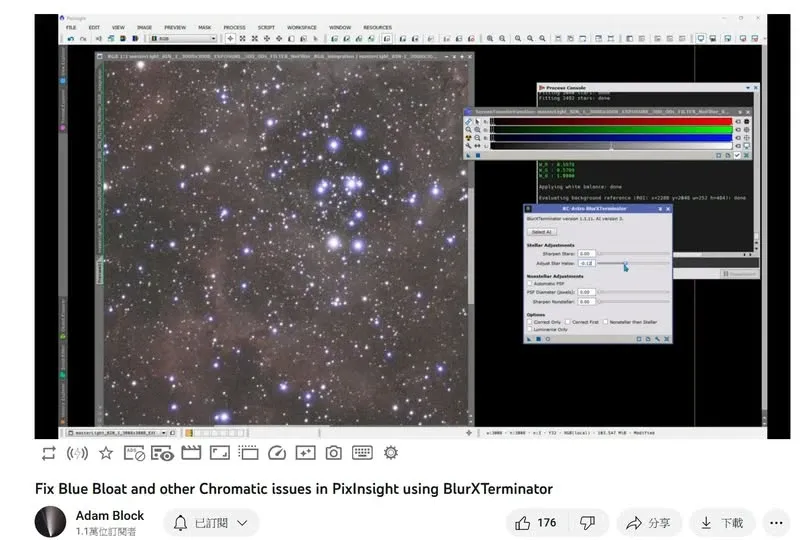
Also Applicable to Color Rings Around Stars from Mono Cameras
It’s worth noting that this technique isn’t only effective on color refractor images.
With a mono camera, star sizes are often inconsistent across different filters, and after integration this produces color rings or halos around the stars. This situation can likewise be reduced using the approach described above.
Wrap-Up
Although BXT’s core function is AI deconvolution and sharpening, applying its capabilities to the scenario of “handling stellar chromatic aberration” unlocks additional value. The key is this—it rarely works on its own; it has to be paired with techniques like masks and channel separation to push the blue halo or filter color rings to a minimum. For friends interested in going deeper, I highly recommend finding Adam Block’s original video to watch.