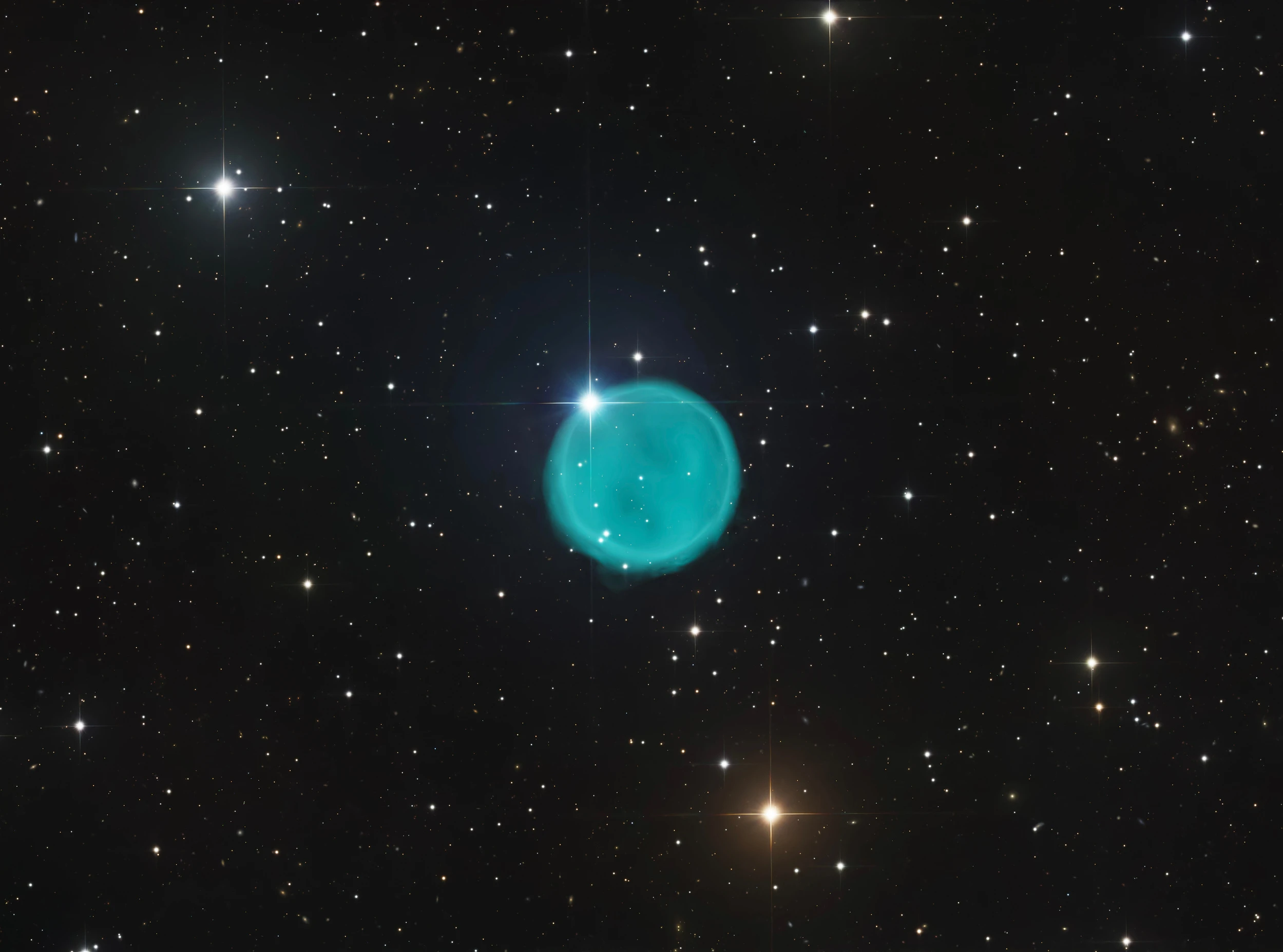
Abell 33
- Type
- Nebula
- Acquisition
- Planewave CDK20 (f/6.8 version) · QHYCCD QHY600PH M
- Integration
- 27.5h
Abell 33 — The Cosmic Diamond Ring
In the direction of Hydra, about 2,500 light-years from Earth, floats a beautiful planetary nebula named Abell 33. It was once a star much like our Sun; reaching the end of its life, it shed its outer atmosphere, leaving behind a round shell of gas — and so this nebula was born.
What makes Abell 33 so enchanting is its almost perfectly spherical shape, like a diamond ring set in space. By happy coincidence, the bright foreground star HD 83535 sits right on the nebula's rim — from our vantage point, a gem mounted on the band — earning Abell 33 its romantic nickname, the "Cosmic Diamond Ring". In truth, star and nebula share no physical connection at all; they merely line up along our line of sight.
At the center of the nebula shines a small white star: the remnant core of the original star — a white dwarf. Hotter than the Sun, it pours out intense ultraviolet radiation that sets the surrounding gas aglow in dreamlike rings of light. Interestingly, the white dwarf is not quite at the nebula's center, and in high-resolution images astronomers have found it is actually a binary pair.
Abell 33 is thus more than evidence of a star's final chapter — this "perfect coincidence" has made it one of the most romantic objects an astrophotographer can point at.
Planewave CDK 20"
QHY600PH-M
Planewave L500
Chroma 50mm Rx70,Gx70,Bx70, 300s; 3nm OIIIx60, 600s
Total integration time: 27.5hrs
Location: El Sauce, Chile