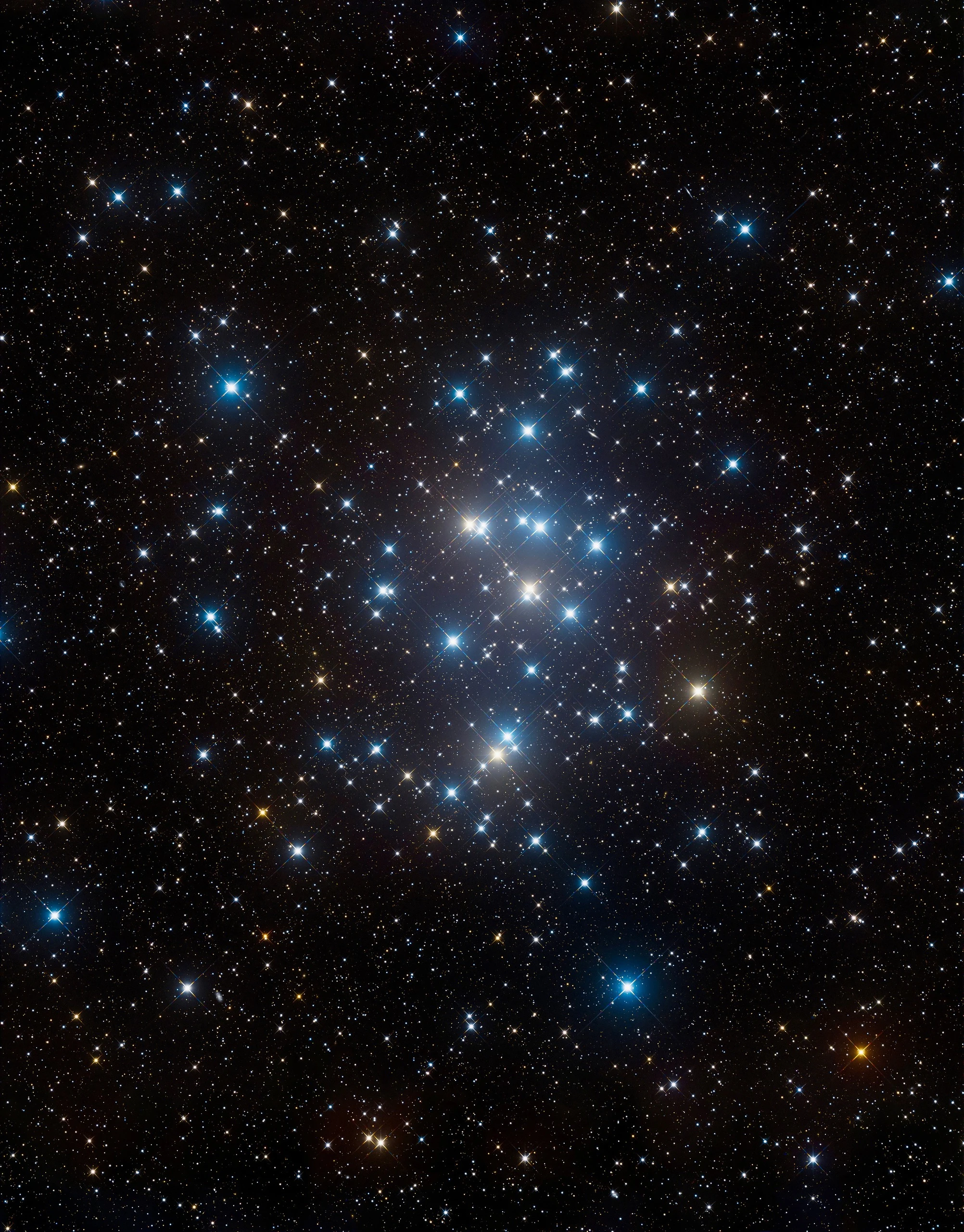
M44 Beehive Cluster
- Type
- Cluster
- Acquisition
- ASA H400 · Moravian Instruments C5A-100M
- Integration
- 6.1h
M44 is located in the constellation Cancer, about 577–610 light-years from Earth. It is one of the nearest and brightest open clusters to the Solar System, containing around 1,000 stars with a total mass equivalent to 500–600 Suns. Estimated to be 600–700 million years old, it shares a similar age and motion with the Hyades Cluster, suggesting a possible common origin. About 70% of its members are M-type red dwarfs, along with blue-white A-type stars, red giants, and white dwarfs.
With an apparent magnitude of 3.1–3.7, it is visible to the naked eye in dark skies. The cluster’s core radius is about 11 light-years, with an overall diameter of several dozen light-years, showing mass segregation with massive, bright stars concentrated toward the core. It is the third brightest and second nearest Messier object, added to the catalog by Charles Messier in 1769.
Its honeycomb-like appearance inspired the name “Beehive,” while in ancient Chinese astronomy it was called “Accumulation of Corpses” (積屍氣), part of the Ghost Mansion (鬼宿) in the Twenty-Eight Mansions. Observations date back to the early 17th century (1611 and 1612). The best viewing season is from February to May when Cancer is high in the sky.
ASA H400
Moravian Instruments C5A-100M
ASA DDM100
Chroma RGB 50mm Square
Rx22, Gx22, Bx29, 300s
Total integration time: 6hrs