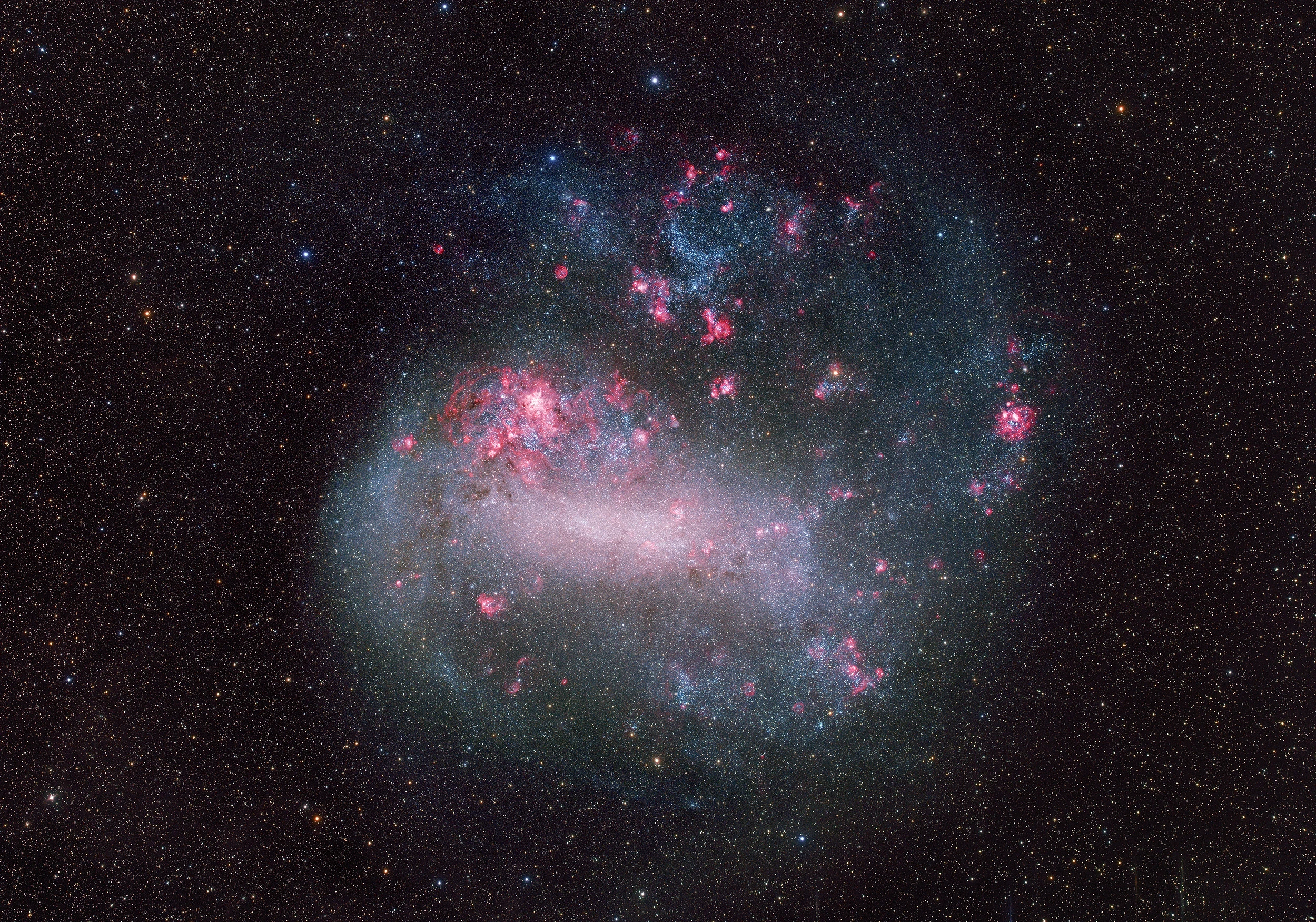
Large Magellanic Cloud
- Type
- Galaxy
- Acquisition
- Sigma 135mm F1.8 DG HSM (Art) · QHYCCD QHY600PH C
- Integration
- 5.5h
Large Magellanic Cloud
The Large Magellanic Cloud (LMC) is one of the most stunning sights of the southern sky. The Milky Way's largest satellite galaxy, it lies a mere 160,000 light-years away and ranks fourth in the Local Group, after the Andromeda Galaxy, the Milky Way and the Triangulum Galaxy. Most of the LMC lies within the southern constellation Dorado, spilling over into Mensa further south. To enjoy it you need to be south of roughly 20°N; to see it climb high into the middle of the sky, around 25°S.
Beyond the traces of its barred structure, the LMC's most captivating feature is the Tarantula Nebula (NGC 2070), seen right of and below center in this image. Through binoculars or a small telescope, bright loops of gas reach outward like the legs of a giant spider. It appears about the size of the full Moon, yet its true diameter is some 1,520 light-years — larger than the Orion Nebula — and it is a vigorous stellar nursery, with the star cluster 30 Doradus at its heart. In 1987, supernova SN 1987A erupted very close to the Tarantula Nebula, peaking at magnitude 2.8 — the brightest supernova seen from Earth since 1604 — and remaining visible to the naked eye for a remarkable ten months.
Sigma 135mm F1.8 DG HSM (Art)
QHYCCD QHY600PH C
Avalon M-zero HQ
IDAS HEUIB-II
Total integration time: 5.5hrs
Software: PixInsight, Photoshop