Lunar Stacking: Applying FFTRegistration
When processing lunar-surface and lunar-eclipse images, alignment and stacking are usually the first hurdle. This article shares the improvement I got when processing a total lunar eclipse image after swapping my traditional workflow for PixInsight’s FFTRegistration script.
The Trouble with the Traditional Workflow
For processing this total lunar eclipse, I initially used the traditional approach: first aligning and stacking with AutoStakkert! 3, then combining the RGB channels in PI, and manually aligning the three channels afterward. This step of manually aligning channels is both labor-intensive and error-prone.
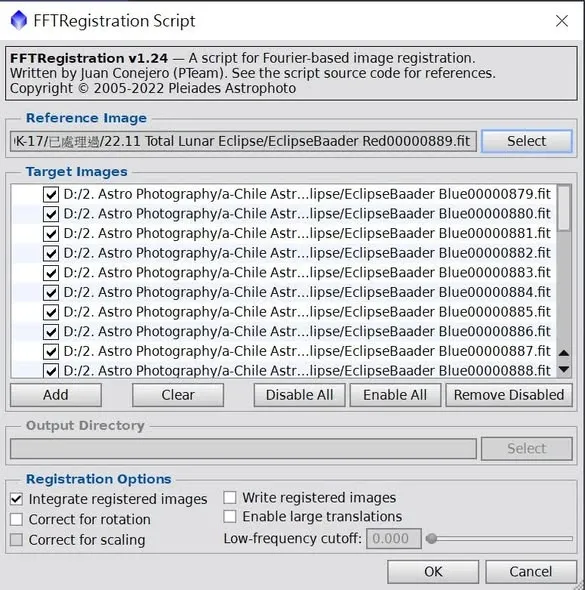
Later I recalled that a fellow hobbyist had mentioned a PI script before, FFTRegistration. So I switched to using this script to align the Moon, and then stacked with ImageIntegration.
Comparing the Results
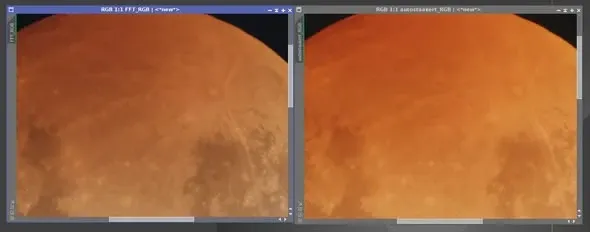
From the images above, you can clearly see that the result on the right, FFTRegistration combined with ImageIntegration, is better than the one on the left, AutoStakkert! 3 plus manual channel alignment. What’s more, FFTRegistration needs no manual alignment of the three channels at all, which is very convenient.
Recommendation
If you have a large number of lunar-eclipse or lunar-surface images to align, I recommend using PI’s FFTRegistration to do it; it’s worth a try both in terms of result quality and processing efficiency.