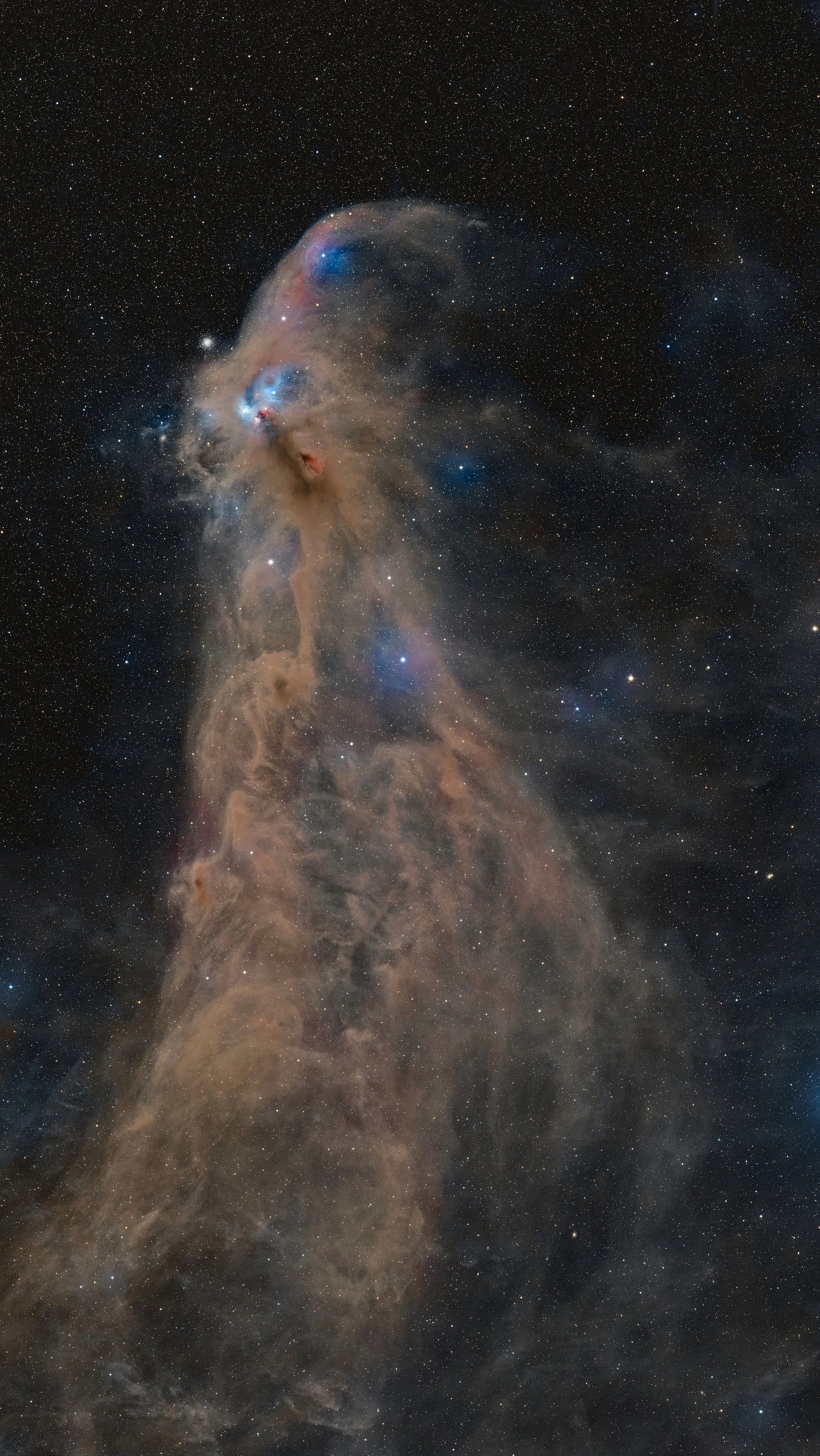
Rampaging Mandrill
- Type
- Nebula
- Acquisition
- Takahashi FSQ-106EDX III · Moravian Instruments G4-16000 MK I
- Integration
- 29.5h
In the shadowy starfields of the southern sky, a strange and haunting face quietly emerges—like a rampaging mandrill from a primordial jungle. This is no illusion, but the true visage of the Corona Australis Molecular Cloud, one of the most active stellar nurseries in the southern hemisphere. Here, dark clouds, reflection nebulae, and young stars converge, forming a vibrant tapestry of star formation that captivates astronomers and dreamers alike.
At the heart of this “face” lie the dark molecular filaments Sandqvist 40 and 41, stretching across the frame like thick fur. Alongside celestial objects such as NGC 6723 and NGC 6729, they shape a cosmic portrait that eerily resembles a beast’s countenance. NGC 6723 is an ancient globular cluster resting on the edge of the cloud, while NGC 6729 gleams like fire in the mandrill’s eyes—a fan-shaped reflection and emission nebula lit by the young star R CrA, showcasing intense gaseous activity.
Within the Coronet Cluster, where NGC 6729 resides, Herbig–Haro objects and high-speed stellar jets reveal the wild pulses of newborn stars. These dense, filamentary clouds are the very core of stellar birth—an active engine behind the cosmic stage.
This is no mere starfield image. It is a cosmic performance in motion: a mandrill born of interstellar dust, staring back with a chaotic yet beautiful gaze.
Did you see its face?
Takahashi FSQ106 EDX3
Moravian Instruments, G4-16000
Planewave L500
Astrodon E-series LRGBHa 50mm
Lx72, Rx36, Gx36, Bx42 300s, Hax56 900s
Total integration time: 29.5 hrs
Location: Río Hurtado, Coquimbo, Chile
2-panel mosaic