From "It Runs, Good Enough" to "Confident Enough to Change It": A Rookie's One-Month Coding Diary
Let me say this up front: I’m not a software engineer, and the coding I’m talking about here is all what people call Vibe Coding—the kind where you just go with the feel of it.
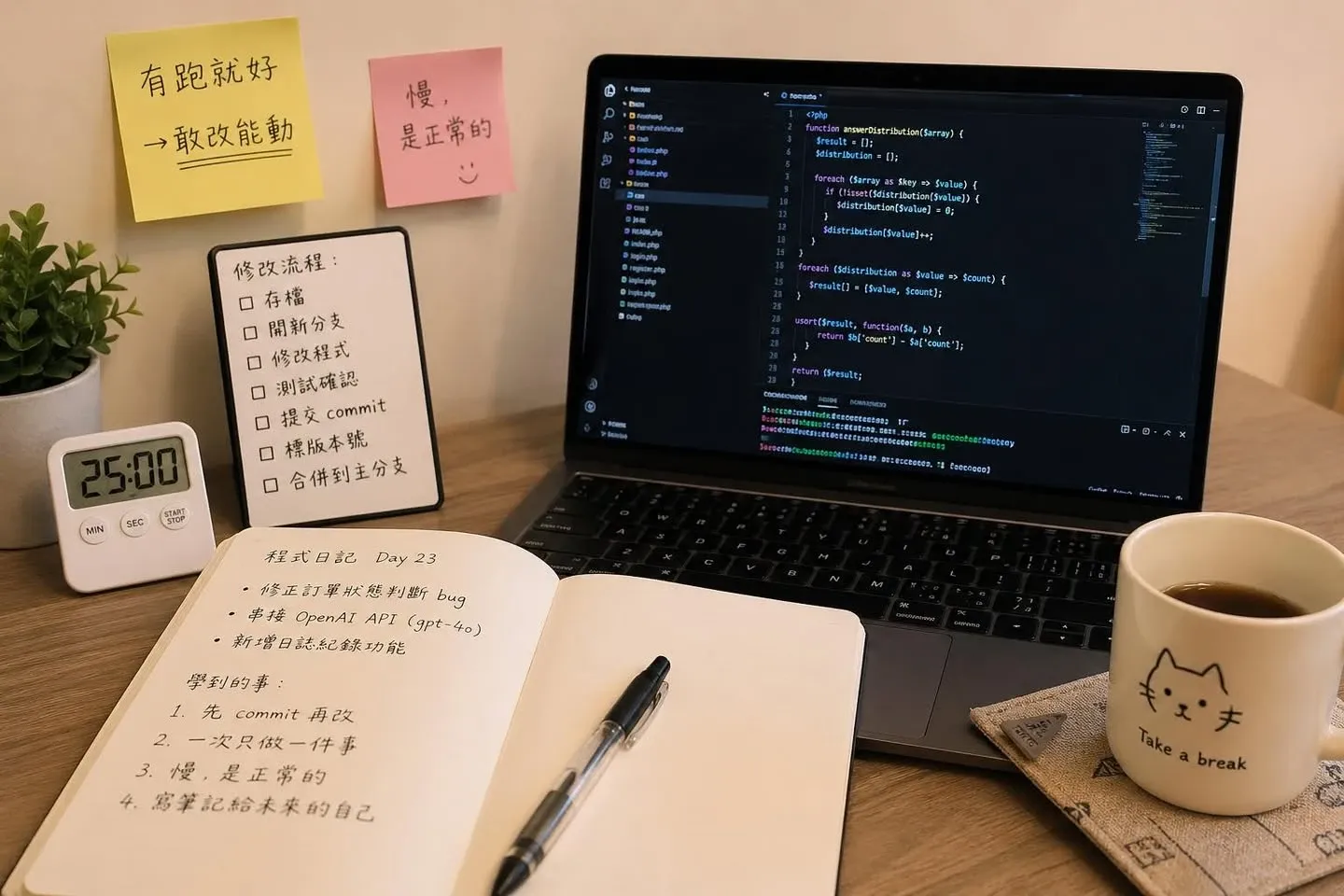
Lately, to make my work go a bit more smoothly, I’ve been building my own little tools. Over the past couple of days I did three things: I started backing up with Git, fixed a few bugs in the program logic, and hooked up a new AI model.
The Hardest Part Isn’t the Syntax—It’s Turning What You Want into Code
After a month of this, my biggest takeaway is that the hardest part of coding isn’t actually the syntax—it’s turning “what on earth I want” into “concrete code.”
Take “fixing a bug,” for instance. It’s three easy words to say, but before you actually get your hands dirty, you have to ask yourself a whole pile of questions:
- Should I save first?
- Should I open a new branch?
- When do I test? And how do I test?
- After I’m done, what counts as “done”?
- Should I tag a version number while I’m at it?
None of these are really programming questions—they’re questions of “working habits.” This kind of workflow may be commonplace in the industry, but for a coding beginner it’s an absolute nightmare.
A Few Small Things I Learned
Over this one month, I learned a few small things, which I’ll share with fellow beginners like me:
- Put up your safety shield first, then start hacking away. Use Git for version control, and even if you break everything, you can be back to the past in thirty seconds—as reassuring as a save point in a game.
- Do one thing at a time. Never “just change one more line while you’re at it”—that’s the kind of thing that makes your future self want to bang their head against the wall.
- Slow is normal. Get a single small feature working in a whole afternoon? Yes—that’s just daily life. Those get-good-quick tutorials are mostly lying to you.
- Write notes for your future self. Otherwise, next time you come back to it, you’ll think someone else wrote the program. (Okay, fine—this program really was written by an AI.)
From “it runs, good enough” to “confident enough to change it,” what lies in between is probably exactly these working habits—the ones that look unremarkable, yet have to be filled in one by one.