That Lens Patent the Astronomy Crowd Was Discussing—I Couldn't Resist Taking a Look
Recently I saw fellow astronomy enthusiasts discussing a patent for a certain lens, and as a practicing patent attorney I simply couldn’t resist digging it up to take a look.
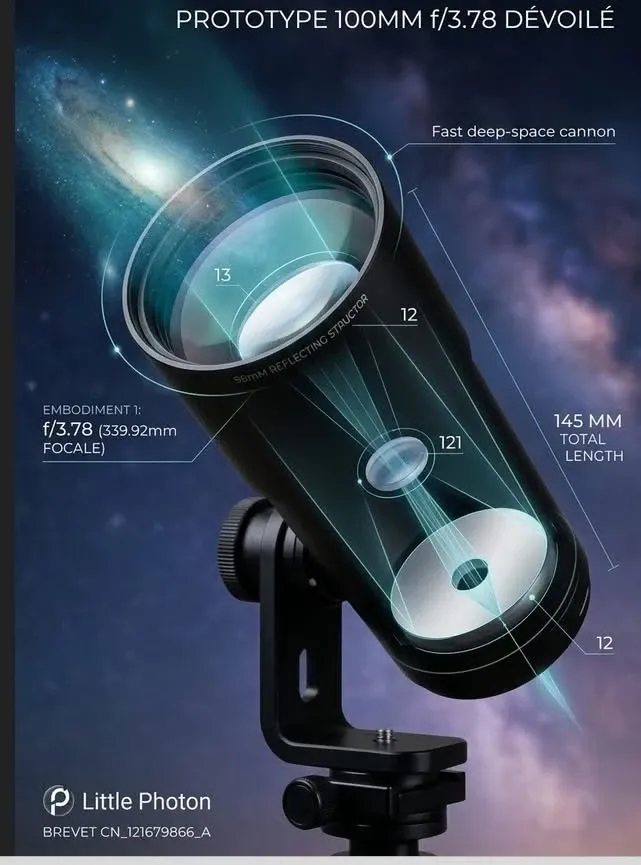
My first impression after reading it: the independent claim of this patent seems to be written rather “small”—the part that actually constitutes a limitation appears to be only the final paragraph. The structure of the lens itself hasn’t really changed much, and most of what comes before that final paragraph reads like existing, well-known prior art.
Below are the basic details of this patent and the text of its independent claim, offered for interested readers to cross-reference.
Basic Patent Information
- Publication number: CN121679866A, “An Optical System and Optical Lens”
- Number of claims: 16 in total
- Independent claims: Claim 1 (optical system) and Claim 16 (optical lens)
Claim 1 (Independent Claim), Rendered in English
(The original claim is in Chinese; the following is my English rendering, with the reference numerals preserved.)
An optical system, characterized in that:
it comprises, arranged in sequence along the optical axis from the object side toward the image side, a first lens group (11), a first reflective structure (12), a second reflective structure (13), a second lens group (14), and an image plane (15);
the first reflective structure (12) and the second reflective structure (13) are both optical structures for reflecting light; the first lens group (11) comprises a first lens (111) of negative refractive power and a second lens (112) of positive refractive power;
a through-hole (121) is provided through a first predetermined region of the first reflective structure (12), and the second lens group (14) is disposed at a position corresponding to that through-hole (121);
the second reflective structure (13) is disposed in a first predetermined region of the most image-side lens surface of the first lens group (11);
the second lens group (14) comprises a third lens (141) of negative refractive power, the third lens (141) being disposed at the most object-side position of the second lens group (14);
the ratio of the distance L1—between the reflective surface of the second reflective structure (13) and the object-side lens surface of the third lens (141)—to the distance L2—between the reflective surface of the second reflective structure (13) and the reflective surface of the first reflective structure (12)—is greater than or equal to 40% and less than or equal to 80%.
A Few Observations
Judging from how Claim 1 is written, most of the technical features up front (the two lens groups, the two reflective structures, the through-hole arrangement, and so on) describe architecture already common to catadioptric optical systems of this kind; what actually narrows the scope of protection is that final paragraph limiting the L1/L2 distance ratio to between 40% and 80%. An independent claim like this ends up with a relatively narrow scope of protection—so long as a competitor’s design falls outside this ratio, it won’t necessarily fall within the literal scope of this claim.
The above is purely a set of reading notes on the claims of this published patent, offered for fellow astronomy enthusiasts to reference when discussing the optical design of their gear.