Tilt Aberration on APS-C Sensors: Why Your Stars Always Come Out Skewed
Anyone who shoots deep-sky has run into it to some degree: no matter how you adjust, the stars in the four corners of the frame just won’t come out right, always skewing off in some direction. More often than not, this is the tilt of the image sensor at work.
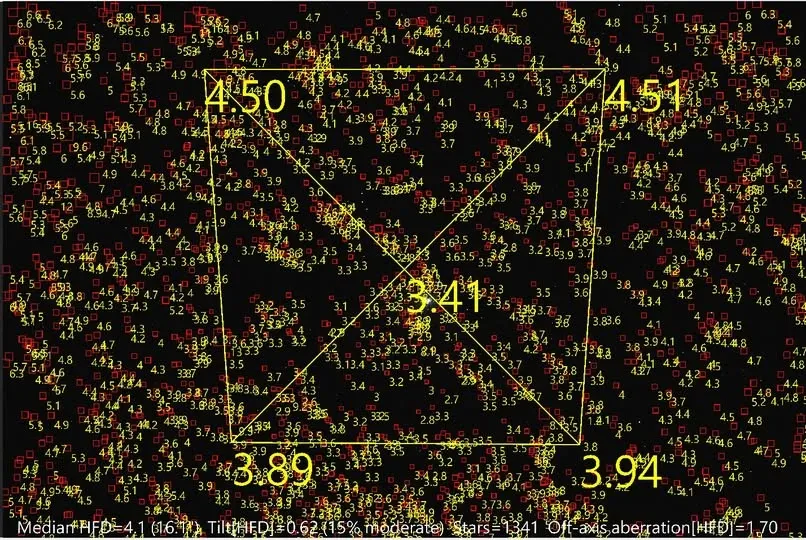
And with APS-C sensors, the problem seems especially pronounced. The amount of tilt I’ve measured is almost always roughly double that of a full-frame DSLR; and it’s not just my own setup—the machines at remote observatories measure out much the same way. On this point, the manufacturers probably can’t escape the blame.
On the Cloudy Nights (CN) forum—one of the largest English-language astronomy communities—someone mentioned that you can send the camera back to the manufacturer to have it re-measured and re-mounted with their more precise instruments, after which it comes back normal—because part of the tilt is something the user simply can’t correct no matter how they adjust, the crux being that we lack sufficiently precise measuring tools of our own. Still, the advanced users willing to go to all that trouble to send it in for service are surely a minority in the end.
What Kinds of Trouble Does Tilt Cause?
Unless you plan to mount the camera on a non-moving, fixed platform, adjust it once (assuming you can even get it right), and never take it off again; or unless you’re willing to spend nearly as much as the camera itself on a motorized tilt adjuster—otherwise, coexisting peacefully with tilt over the long haul really has little to recommend it.
What exactly does tilt aberration affect? Whenever focus is even slightly off, then besides deformed stars, the image also becomes more prone to all sorts of problems. Issues like dark rings and halos (halos can appear even with filters that shouldn’t produce them) all grow more severe in the part of the image affected by tilt. And for systems with a back-focus requirement, things get trickier still.
To sum it up in a sentence: tilt is the kind of problem that seems unremarkable day to day but is genuinely grueling to actually deal with. Getting a camera with low tilt when you buy one is, to some extent, a matter of luck.