Stretching with Multiscale Adaptive Stretch (MAS)
If you haven’t tried Multiscale Adaptive Stretch (MAS) yet, I genuinely think it deserves a shot. This article shares my impressions from putting MAS through its paces, along with my experience using it on a finished piece for the first time.
A round of RGB stretch tests — and I was impressed
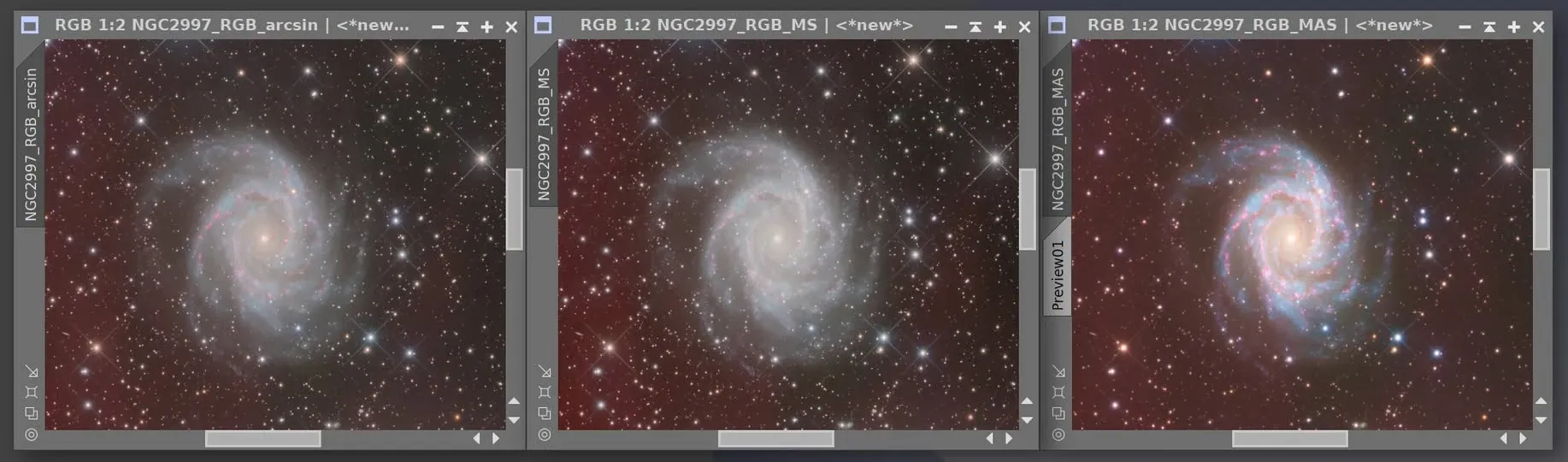
I ran a serious round of RGB stretch tests, lining up several common tools side by side for comparison: on the left is the familiar ArcSinh Stretch, in the middle is Masked Stretch, and on the right is MAS — and I came away rather impressed by MAS.
MAS performs exceptionally well at preserving color: what should be bright is bright, what should be saturated is saturated, and yet it never goes over the top. It doesn’t just look after the stars — it keeps the galaxy’s tonal layers and colors fully intact too, so the whole thing looks clean and has depth.
Maybe MAS doesn’t strike you as “black magic” at first glance the way BXT does, but among the RGB stretch tools commonly available right now, it definitely has a distinctive and very practical set of tricks of its own.
The first image of 2026: MAS in action
This piece actually had all of its pre-nonlinear-stretch steps completed back in 2025, and just as MAS was released, I put it to work in its first real outing. I blended the Ha luminance with the RGB channels, handed the entire nonlinear stretch over to MAS, and then made small adjustments with HistogramTransformation (HT) — no GHS, and no other stretch process.
MAS’s behavior with saturation is, to some extent, similar to the logic of the “Vibrance” adjustment in Photoshop: areas that are already highly saturated aren’t touched further, while the less-saturated parts get a measured boost instead.
That said, there is one thing to watch: when stretching the luminance channel, you can’t let the brightness run unchecked, or you’ll easily wash out the RGB color. Finish by adjusting the overall tonality and contrast. This image was shot with an ASA 500N; given sufficient SNR, the detail and features emerged pretty much effortlessly.