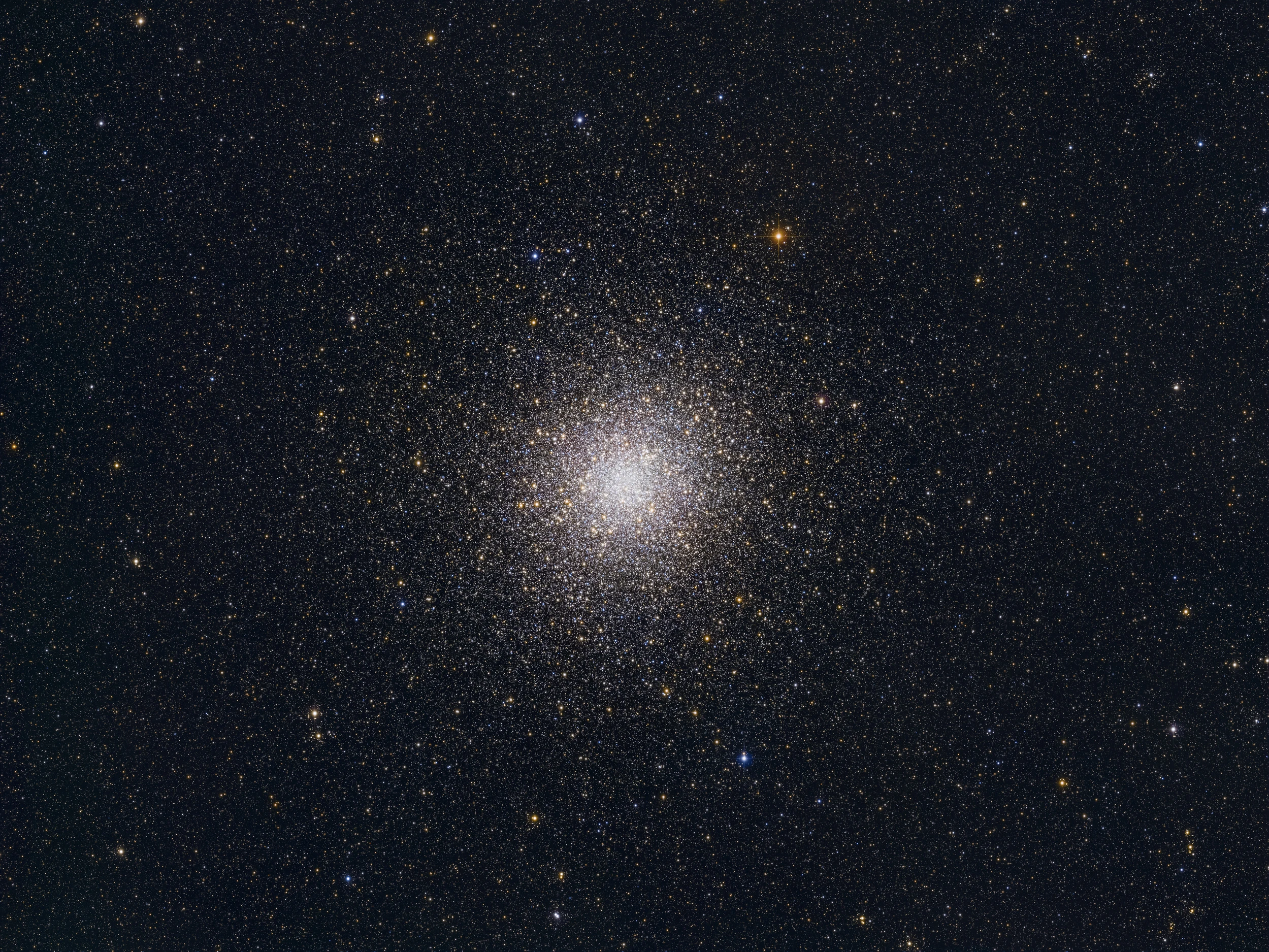
M22 Globular Cluster
- Type
- Cluster
- Acquisition
- Planewave CDK20 (f/6.8 version) · Moravian Instruments C5A-100M
- Integration
- 4.6h
M22 is an elliptical globular cluster located in the constellation Sagittarius, approximately 10,600 light-years from Earth. It is one of the brightest globular clusters in the night sky, with an apparent magnitude of about 5.1. The red giant branch (RGB) of M22 exhibits a wide range of colors, similar to those observed in Omega Centauri.
M22 is one of the only four known globular clusters that contain a planetary nebula (the other three being M15, NGC 6441, and Palomar 6). This planetary nebula was discovered in 1986 by Gillett et al. using data from the IRAS satellite and was confirmed in 1989. The central star of the planetary nebula is a blue star, and the nebula, designated GJJC1, is estimated to be only 6,000 years old.
Additionally, in 2012, astronomers using the Very Large Array (VLA) in New Mexico and the Chandra X-ray Observatory discovered two black holes in M22, each with a mass between 10 and 20 times that of the Sun. This discovery suggests that the efficiency of black holes being ejected from the cluster by gravitational interactions may be lower than previously thought, leading to the hypothesis that M22 could contain between 5 and 100 black holes. The interactions between stars and black holes may explain the unusually large core of this cluster.