Undersampling, Oversampling, and Drizzle
The look of a star actually reflects the matching relationship between the camera’s pixels and the telescope’s focal length. This matching relationship is “sampling,” and both too coarse and too fine leave marks on the stars. This article discusses undersampling, oversampling, and Drizzle, which comes in handy when you’re undersampled.
Reading sampling from the stars: blocks vs. bloated stars
The same camera attached to systems of different focal lengths will produce completely different-looking stars:
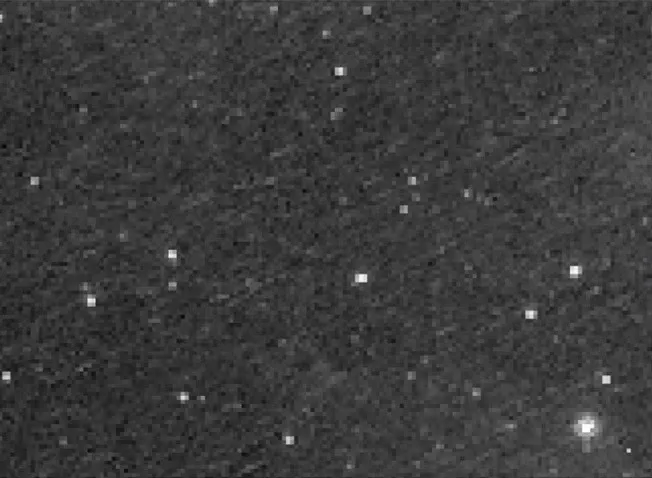
- Undersampling: for example, the Ha channel on an FSQ-106 — because the CCD pixels are relatively too large, the stars turn into blocky stars.
- Oversampling: the L channel from the same camera on a CDK24 — the stars become very bloated.
These two are the two opposite extremes of a mismatch between the camera’s pixel size and the system’s focal length.
Drizzle: recovering the detail lost to undersampling
The blocky stars caused by undersampling can be improved with Drizzle Integration. But Drizzle isn’t something you can just use anywhere; it has three requirements:
- Enough frames.
- The data itself is undersampled.
- Dither was done during capture.
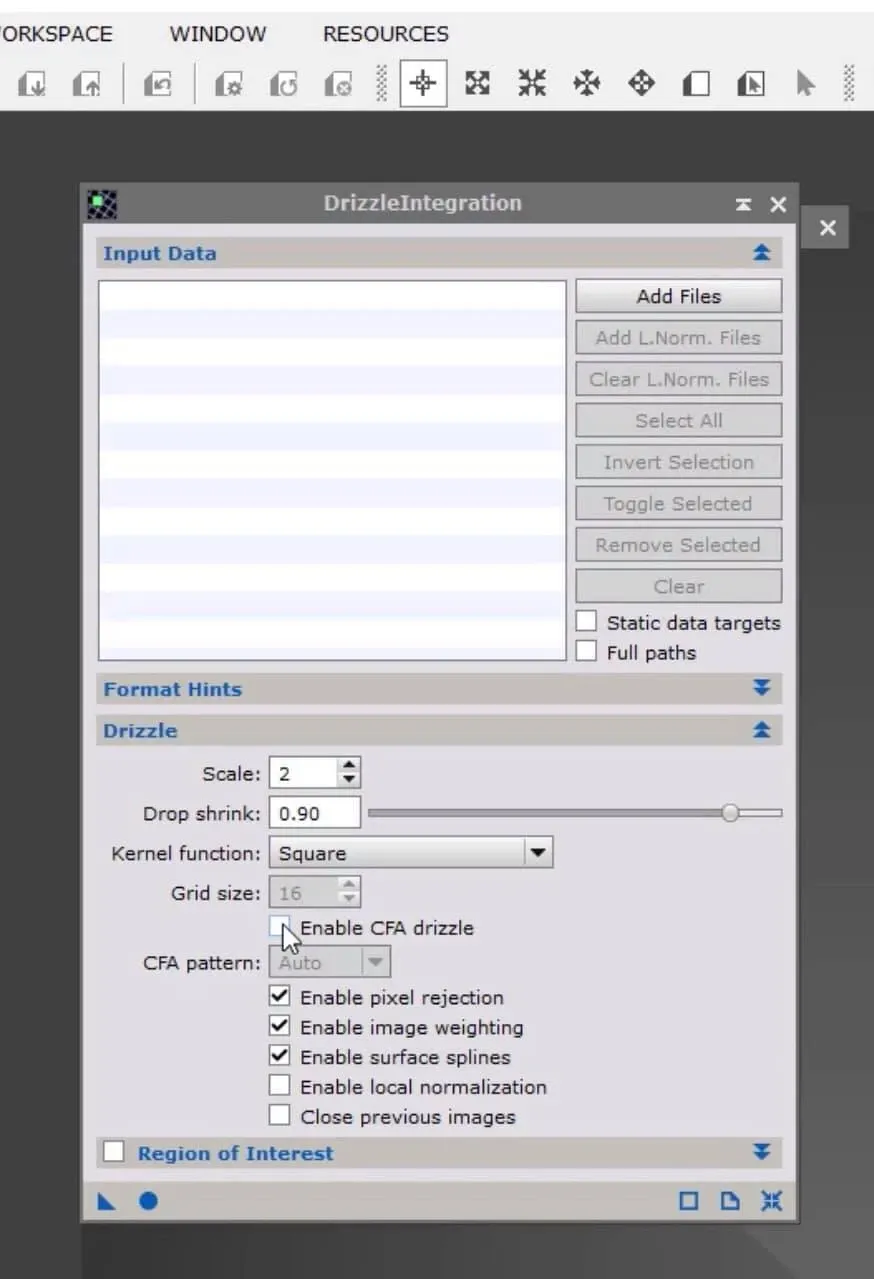
There’s also one operational note: before using PixInsight’s Drizzle Integration, remember to run Image Integration once first, so that Drizzle has the correct base data to work from.
A common misconception: big L-channel stars aren’t necessarily a sampling problem
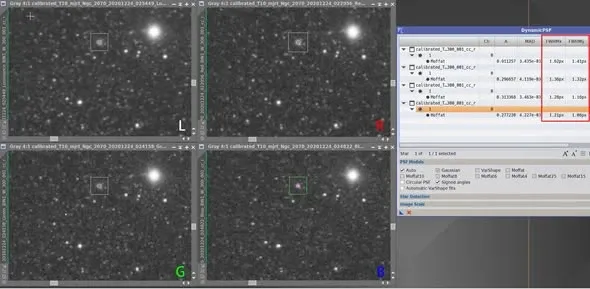
While we’re at it, let me clear up a commonly misunderstood phenomenon. After switching to a monochrome camera, an enthusiast felt that the L channel’s stars were always large and didn’t noticeably shrink even when he turned the focuser, so he assumed it was a focus or sampling problem. I compared data from two different systems — one set of oversampled data from a CDK 17″, one set of undersampled data from a TOA130, all single five-minute frames.
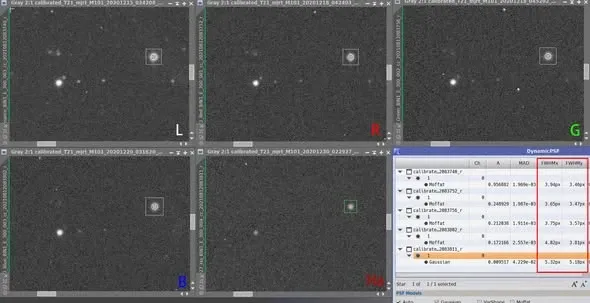
The result shows: aside from having stronger signal, the luminance (L) channel’s stars actually aren’t much bigger than the RGB channels’, and the PSF of the LRGB stars is in principle of the same type. (Worth mentioning: in the first set, the Ha and LRGB stars were of different types.) So the L stars looking big is often just because the signal is strong and appears prominent after stretching — not necessarily a sampling or focus problem.