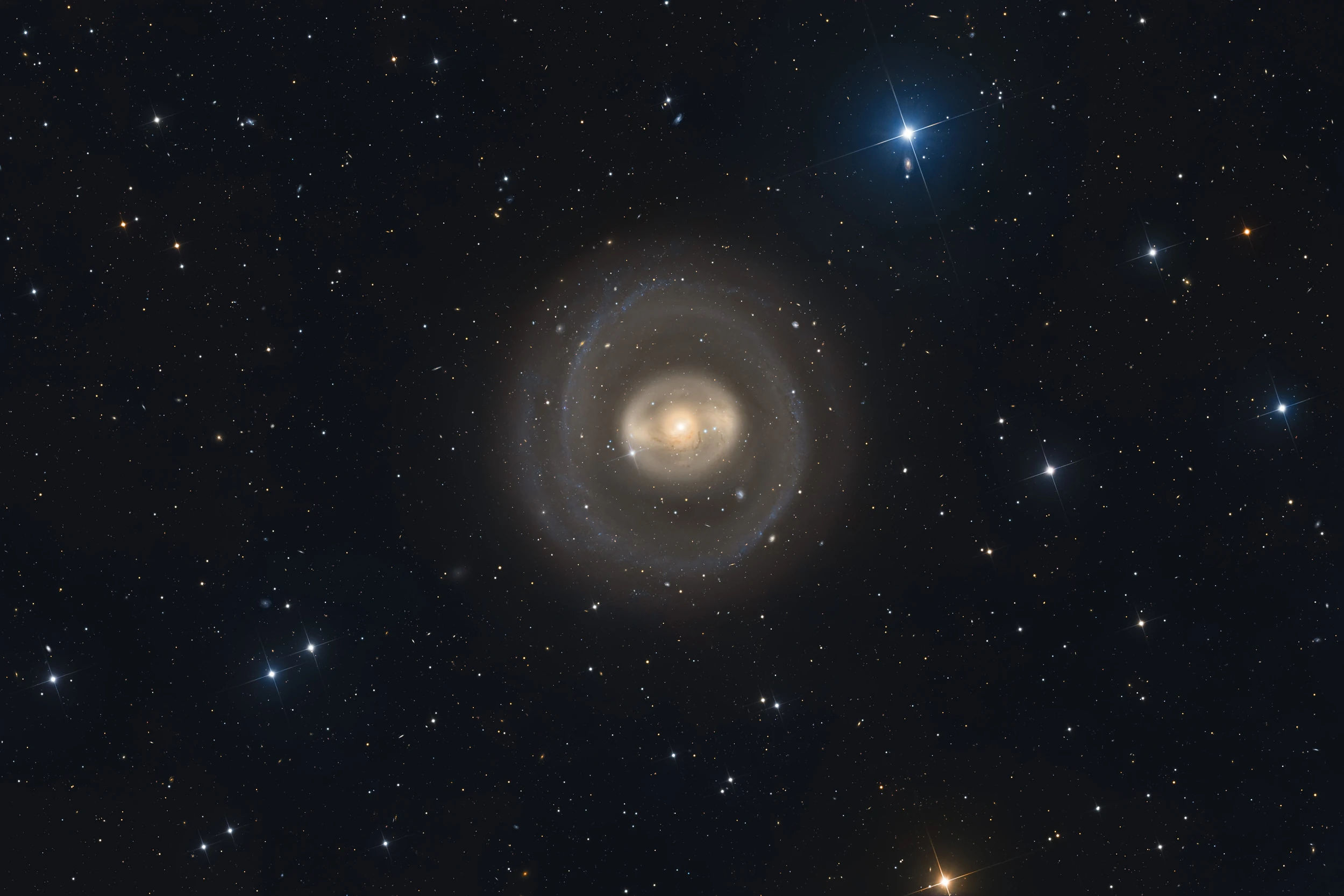
NGC 1291
- Type
- Galaxy
- Acquisition
- Planewave CDK17 · SBIG STXL-11002
- Integration
- 22.3h
NGC 1291 (also known as NGC 1269) is a ringed barred galaxy located in the constellation Eridanus, approximately 33 million light-years from Earth. Its most distinctive feature is a central stellar bar surrounded by an outer ring, giving it a unique “spoked wheel” appearance. Because it possesses both a mature galactic core and young star-forming regions in its outer ring, astronomers consider it to be in a transitional stage between a spiral galaxy and a lenticular galaxy, making it a classic example of a "transitional galaxy."
Estimated to be about 12 billion years old, NGC 1291 hosts most of its stars in the central bulge, while the outer ring remains actively forming new stars. These young, blue star clusters are observable in both ultraviolet and infrared wavelengths. According to infrared images from the Spitzer Space Telescope, more than 70% of the galaxy’s cold dust mass is concentrated in the outer ring, with a temperature around 19.5 K—significantly cooler than the central region’s ~25.7 K. From a dynamical perspective, the stellar bar of NGC 1291 may have undergone multiple episodes of buckling instability, contributing to internal structural evolution. Observations from the MUSE TIMER project reveal a first-order “box-peanut” structure, suggesting the bar has remained stable for over 6.5 billion years.
At its core, NGC 1291 harbors a supermassive black hole estimated to have a mass around 20 million times that of the Sun. Surrounding it are low-mass X-ray sources and diffuse gas that contribute to the galaxy’s high-energy environment.
Planewave CDK 17"
SBIG STXL 11002 with AOX
Paramount ME
Astrodon 50mm LRGB
L22,R15,G15,B15 1200s
Total integration time: 22.3hrs
Location: El Sauce, Chile
Software: PixInsight, Photoshop