How to Choose Post-Processing Software: Prices and Usage Distribution of Common Programs
This article is compiled from notes taken between 2021 and 2022. The software prices and exchange rates in the text reflect the information of that time and have changed a good deal since; the usage distribution likewise only reflects the situation at the moment of that particular survey. Before buying, please go by each vendor’s latest official pricing.
When you set out to do astro image post-processing, the first question is often “which software should I use.” This article gathers the prices of several common paid programs at the time, along with the usage distribution from one community survey, to give those still deciding a point of reference.
Prices of Common Paid Software
Here are the prices as compiled at the time (euro-to-TWD conversions use the approximate exchange rate of the day):
PixInsight
- 230 euros (about NT$7,654), a perpetual license with no device-count limit.
Astro Pixel Processor
- 165 euros (about NT$5,500), perpetual, three-device license;
- 60 euros (about NT$2,000), one-year rental, three-device license.
Photoshop
- Standalone subscription: about NT$640/month; about NT$7,680/year.
- Photography Plan (Photoshop + Lightroom): about NT$326/month; about NT$3,912/year.
Affinity Photo
- About NT$830, a perpetual license.
A few key points on purchasing logic: PixInsight has a high unit price, but it’s a perpetual license with no device limit, so amortized over the long run it’s actually a good deal for people using multiple machines; APP offers both perpetual and rental options; Photoshop runs on a subscription model, of which the “Photography Plan” is the cheapest way into PS; Affinity Photo wins on a low-cost perpetual license, well suited to those on a limited budget who also want a general image-editing tool.
What Does Everyone Actually Use?
Price is one thing; what people in the community actually use is another. At the time, I ran a survey on the usage distribution of deep-sky processing software, receiving 190 votes in total. The top four:
- Photoshop: 31%
- PixInsight: 22%
- DeepSkyStacker (DSS): 14%
- Astro Pixel Processor: 11%
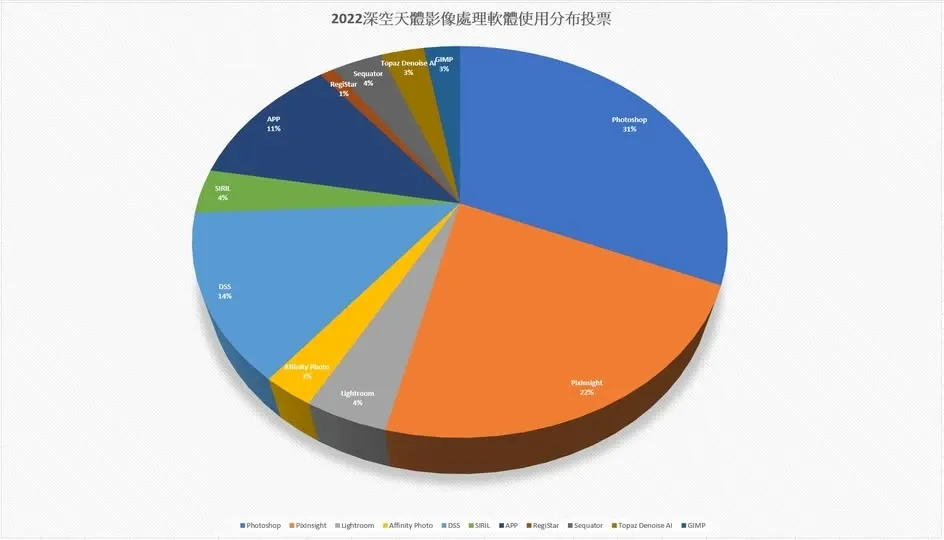
A few things can be read from this distribution: Photoshop, thanks to its versatility and existing user base, is still the most-used post-processing tool; PixInsight, as dedicated astro software, ranks second, showing its standing among advanced imagers; DSS, being completely free, holds firm as the mainstay for entry-level integration; and APP has a certain user base too.
Wrap-Up
No single piece of software is “the standard answer.” On a limited budget and just wanting to integrate for now, free tools like DSS or Siril are enough to get started; for a long-term commitment to professional astro processing, PixInsight’s perpetual, device-unlimited license is very appealing; and those already familiar with Photoshop can keep using their existing tool and add on as needs arise. Think through your own use case first, then check it against the prices and distribution above; that’s more practical than blindly chasing the priciest option.