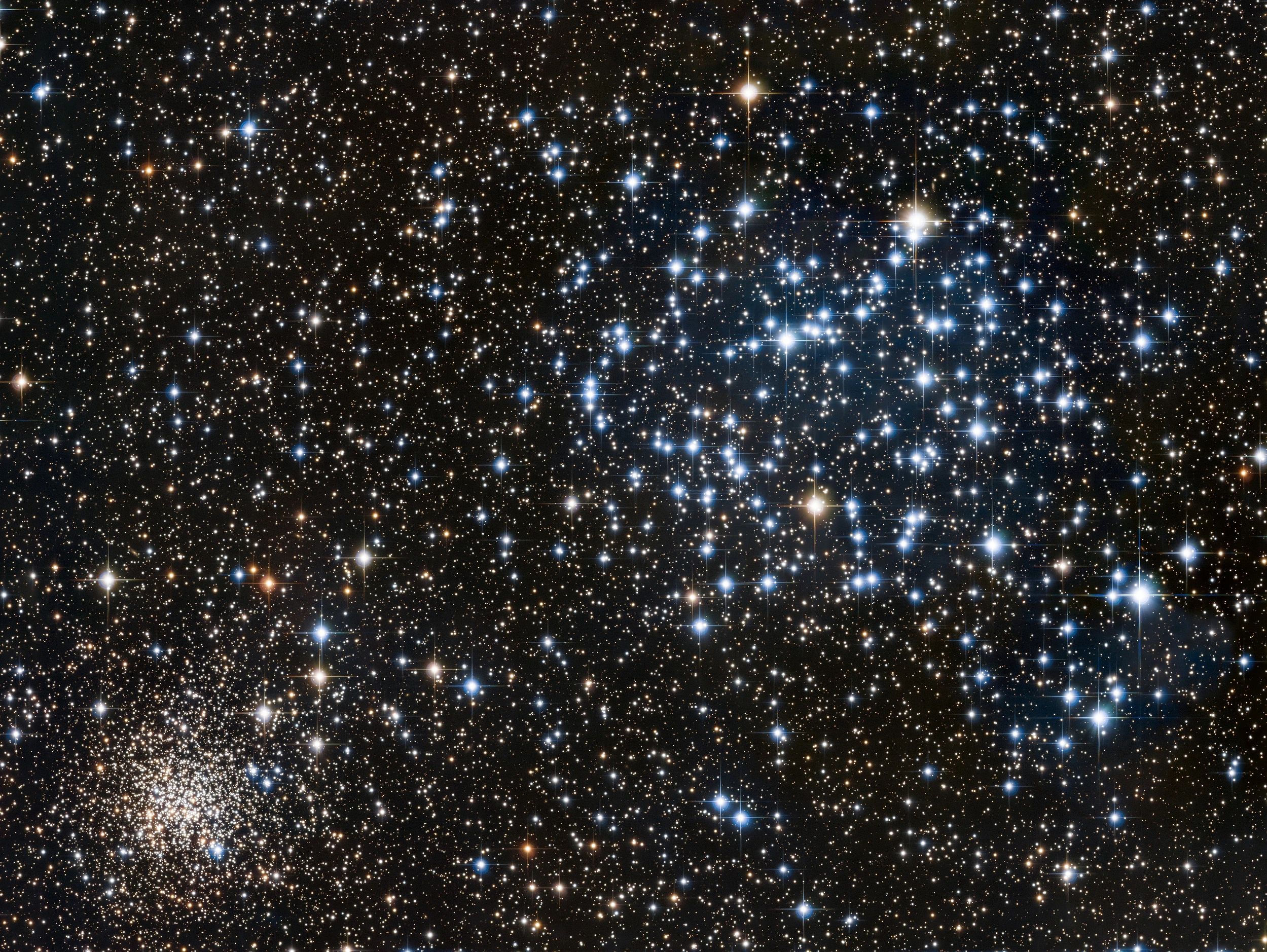
M35 & NGC 2158
- Type
- Cluster
- Acquisition
- Planewave CDK20 (f/6.8 version) · Moravian Instruments C5A-100M
- Integration
- 5.6h
M35 and NGC 2158 are two neighboring open clusters located in the constellation Gemini and are often observed together by astronomy enthusiasts. M35 (upper right in the image) is approximately 912 parsecs (about 2,975 light-years) from Earth, with an apparent magnitude of 5.3 and an angular diameter of about 28 arcminutes, roughly the size of the full moon. This cluster contains hundreds of stars, has an estimated age of around 150 million years, and a total mass approximately 1,600 times that of the Sun. The stars in M35 are loosely distributed, making it an ideal target for small telescopes. Its young, blue-white stars beautifully illuminate the night sky.
About 15 arcminutes southwest of M35 (lower left in the image) lies NGC 2158. Compared to M35, NGC 2158 is fainter, with an apparent magnitude of about 8.6 and a smaller angular diameter of approximately 5 arcminutes. It is an ancient open cluster with an estimated age of about 2 billion years, located around 4,980 parsecs (about 16,200 light-years) from Earth. Due to its dense stellar concentration, it was once mistakenly classified as a globular cluster. However, studies have shown that it is a moderately old open cluster with a low metallicity, associated with the old thin disk population of the Milky Way.