Draco's f/3.8 Catadioptric Light Path Turns Out to Be That Patent from June
In June I saw fellow enthusiasts passing around a concept image of the Little Photon, and at the time I only posted the claims of CN121679866A and remarked that the independent claim is written a bit “small”. Recently DWARF Lab’s Draco went on sale, with a spec of MC 90/340, f/3.8. Compared with Embodiment 1 of the patent (focal length 339.92 mm, f/3.78, total optical length 145 mm), it should be the same design (the applicant, Little Photon (Wuhan), is the company behind DWARF Lab). This time I read the whole specification through, and I’ve put my notes together for everyone’s reference.
Why an f/3.8 Catadioptric Is So Rare
Anyone who has used a Mak will probably do a double take on seeing MC and f/3.8 on the same line. Catadioptrics such as Maksutovs and SCTs fold the light path with a primary and secondary mirror, trading a short tube for a long focal length. The cost is that the focal ratio mostly lands around f/10–f/15, which is great for planets and the Moon but very demanding on exposure time for deep sky. As a rough estimate, to reach the same brightness on the same target, f/10 needs about 7 times the exposure time of f/3.8 (Figure 2).

Four Designs in the Specification
Going by the specification, it does roughly these things:
-
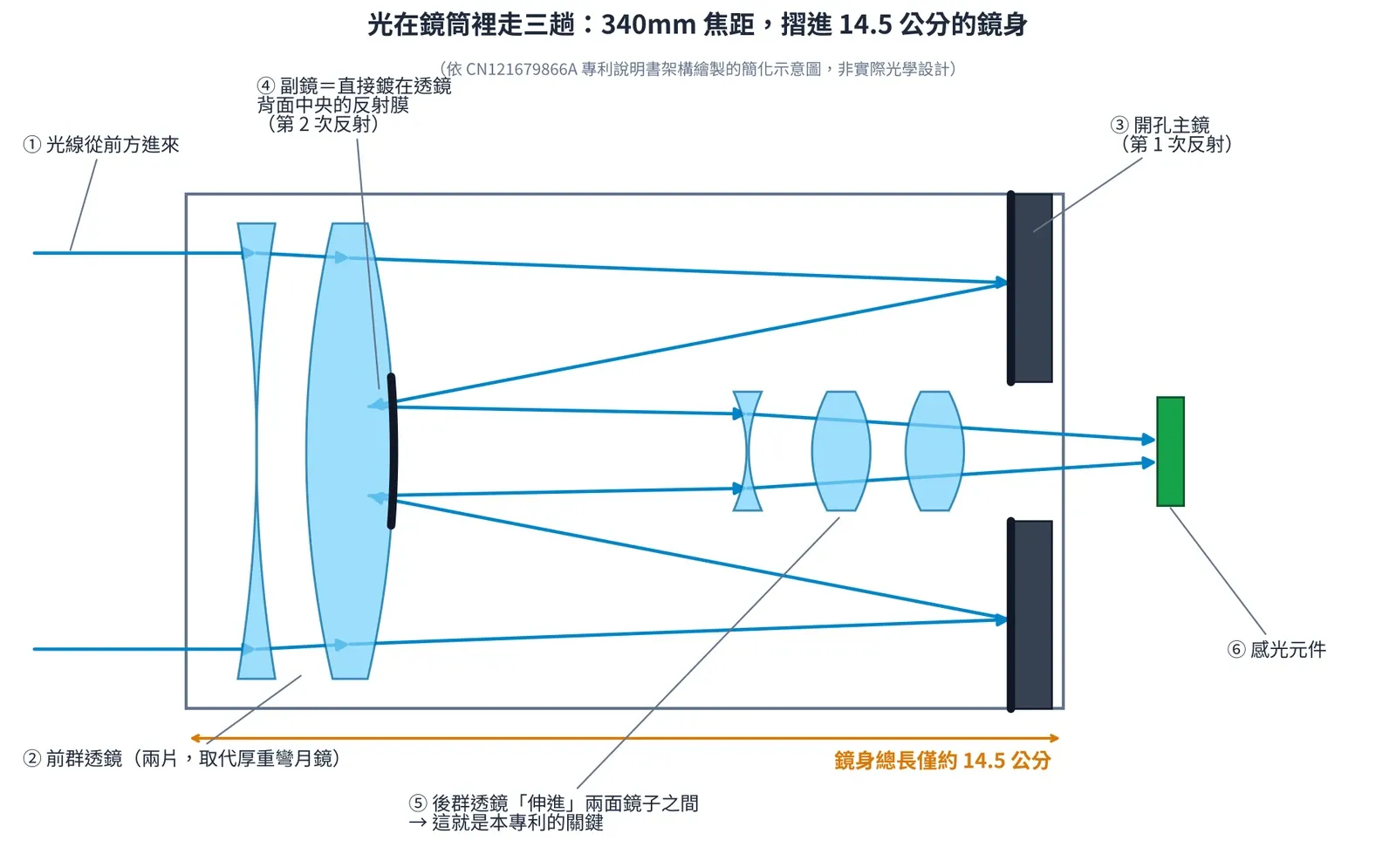
At the front, instead of the thick, heavy meniscus corrector of a traditional Maksutov, it uses one negative and one positive lens, which are easier to manufacture and easier to center. So strictly speaking, the Draco isn’t quite a Maksutov.
-
The secondary mirror isn’t a separate part but a reflective coating applied directly to the center of the back of the second lens. Questar did this a long time ago, and the benefit is one less component to assemble and align.
-
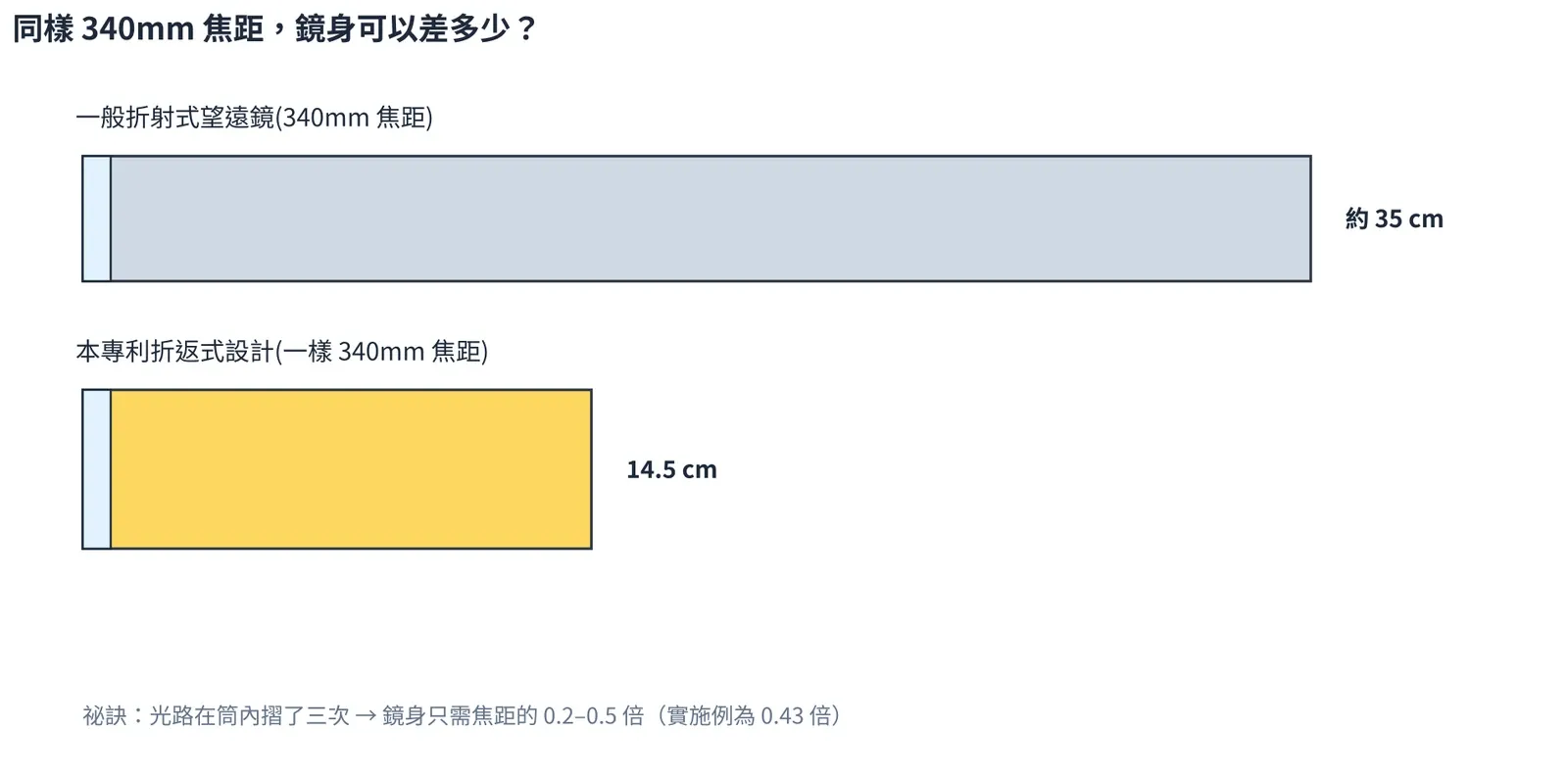
The rear lens group extends forward through the opening in the center of the primary mirror into the space between the two mirrors, with the insertion depth limited to 40%–80% of the distance between the two mirrors; too little and the tube can’t be shortened, too much and it blocks light. The total optical length can be brought down to 0.43 times the focal length mainly thanks to this (Figures 1 and 3).
-
The negative lens at the very front of the rear group does several jobs at once: it lengthens the focal length (effectively a built-in Barlow), corrects field curvature, and makes the system close to image-side telecentric. The specification gives a relative illumination of 98% at the maximum field of view, meaning almost no vignetting; if the real unit reaches that level, flats will be much easier to deal with.
From the Patent Side
Finally, a few words from the patent angle. Strictly speaking, this is still a pending application, not a granted patent. As with my impression when I read the claims in June, a primary mirror with an opening, a secondary coated on the back of a lens, and a two-lens corrector are each not new on their own; the only part of the independent claim that really limits anything is probably the L1/L2 range of 40%–80%, and a design whose ratio falls outside that range wouldn’t necessarily be covered. How much scope it can finally hold on to won’t be known until the office action comes out.
The timing, though, is rather interesting: filed in February, early publication in March, entered substantive examination in April, and the product on sale in the second half of the year. You can see it was positioned around the product launch.
Behind that oddly-looking line on the spec sheet, MC 90/340 f/3.8, is actually a redesigned optical path. How the stars and flats actually perform will have to wait until fellow enthusiasts get one and shoot with it.
(The figures are simplified diagrams I redrew from the patent specification; they are not the original patent drawings, nor the actual design of the Draco.)