ZWO's Next Smart Telescope Has Already Been Drawn in the Patent Gazette
After finishing the Draco catadioptric light path patent last time, I went on to look through ZWO’s patents as well. From 2014 to July this year, ZWO (Suzhou ZWO Co., Ltd.) has filed a total of 53 invention and utility model applications in China, plus another 14 design applications. The most interesting is the batch from the end of last year: one for a lens tube, one for a whole unit, plus a control method, a pan-tilt head, and a design application. Compared against the S50 Pro unveiled in August this year, the lens tube application has already become a product; the whole-unit one is something the S50 Pro doesn’t have yet. What ZWO’s smart telescope after that might look like has been pretty much drawn out in the gazette already, so I’ve put my notes together for everyone’s reference.
From Accessories to Complete Units
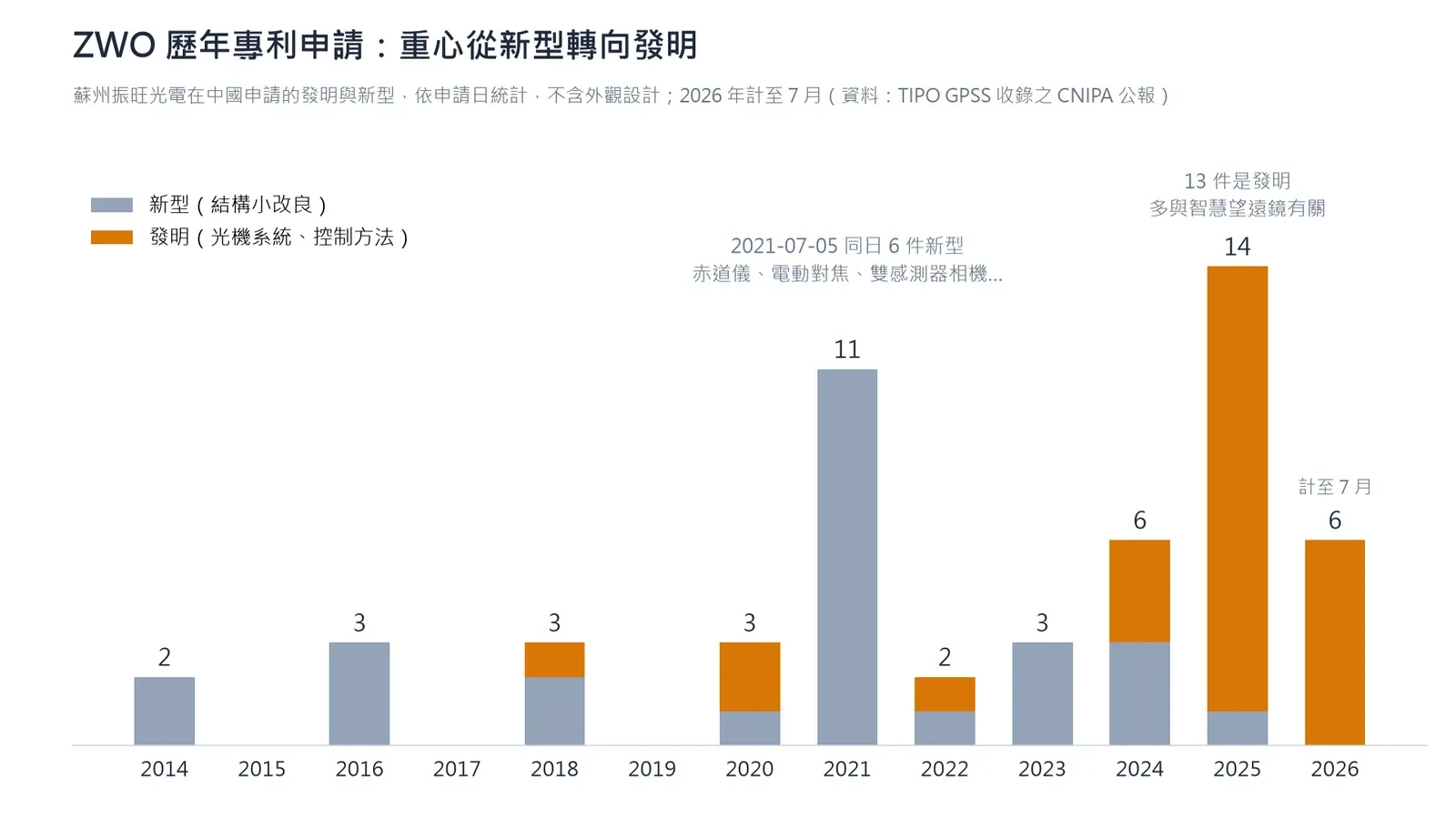
In the early days, ZWO mostly filed utility models, structural improvements to accessories such as filter wheels, ADCs, and guide cameras. 2021 was the year with the most utility models, 11 in total; the equatorial mount, electronic focuser, and dual-sensor camera all date from that year. After 2024 the share of inventions rises noticeably: of the 14 filings in 2025, 13 were inventions, almost all related to smart telescopes: polar alignment, target finding, imaging planning, temperature control, and calibration (Figure 1).
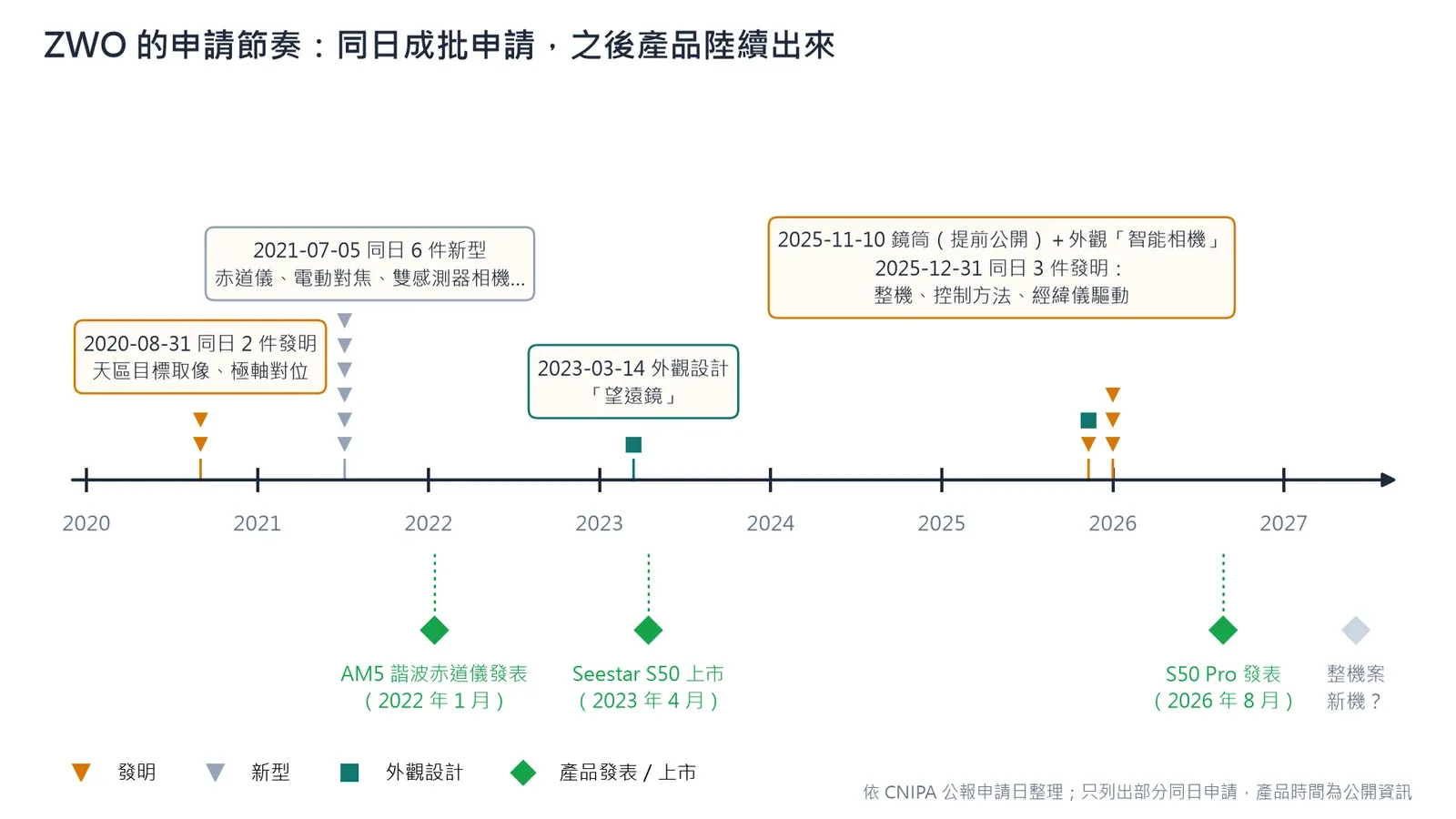
ZWO also has a habit of filing several applications on the same day. On July 5, 2021, it filed 6 utility models on a single day, and the AM5 was unveiled the following January; in March 2023 it filed a design application titled “Telescope,” and the Seestar S50 went on sale the next month. A design application is usually filed only when a product is close to being finalized, so the filing dates of these applications are often close to the product’s launch (Figure 2).
The batch from the end of last year follows the same pattern:
-
November 10, 2025: the invention “Lens Tube Structure and Imaging Device” (CN121254475A), for which ZWO also requested early publication, and it was published on January 2 this year; on the same day it also filed a design application for a “Smart camera” (CN310001094S, already published as granted in May this year).
-
December 31, 2025: three inventions on the same day: “Imaging Device” (CN121771506A), “Control Method for Imaging Device” (CN121771505A), and “Drive Structure, Alt-Azimuth Mount Thereof, and Astronomical Observation Device” (CN121477464A).
Lens tube, whole unit, control method, and pan-tilt head, plus the exterior design: at first glance it looks like the complete patent package for one new model, but compared against the products that followed, it should be split across two.
Lens Tube: Folding the Light Path into a Straight Barrel
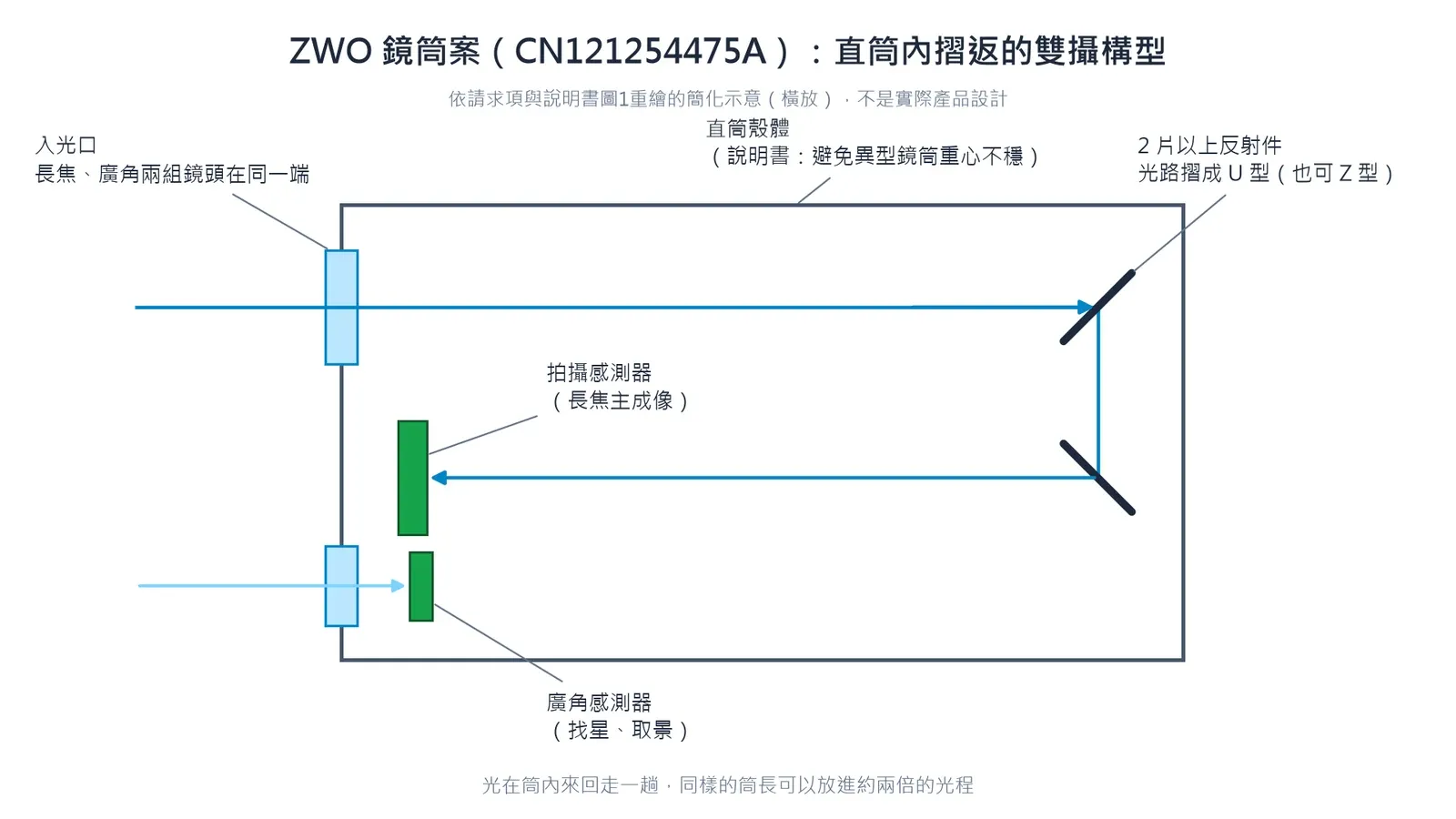
The claims of the lens tube application describe a straight-barrel housing; two or more reflective elements inside the barrel folding the light path into a U or Z shape; plus one sensor for imaging and one wide-angle sensor for finding stars and framing, with both lens groups taking in light at the same end (Figure 3). The specification mentions avoiding “an unstable center of gravity caused by an irregularly shaped lens tube”; the original S50 has a wedge-shaped body, which seems to be what it is talking about. With the light travelling back and forth inside the barrel, a longer focal length can be fitted into the same length.
This one later became, I think, the S50 Pro. The S50 Pro, unveiled on August 25 this year, lists a “folded light path” in its official specs, plus two lenses, a long-focal-length one (260 mm, f/5.2) and a wide-angle one, which matches the claims of this application; the “Smart camera” design application filed on the same day is very likely the exterior of the S50 Pro. From filing to unveiling is about 9.5 months.
Whole Unit: Three Lenses, Cooling, and a Harmonic Pan-Tilt Head
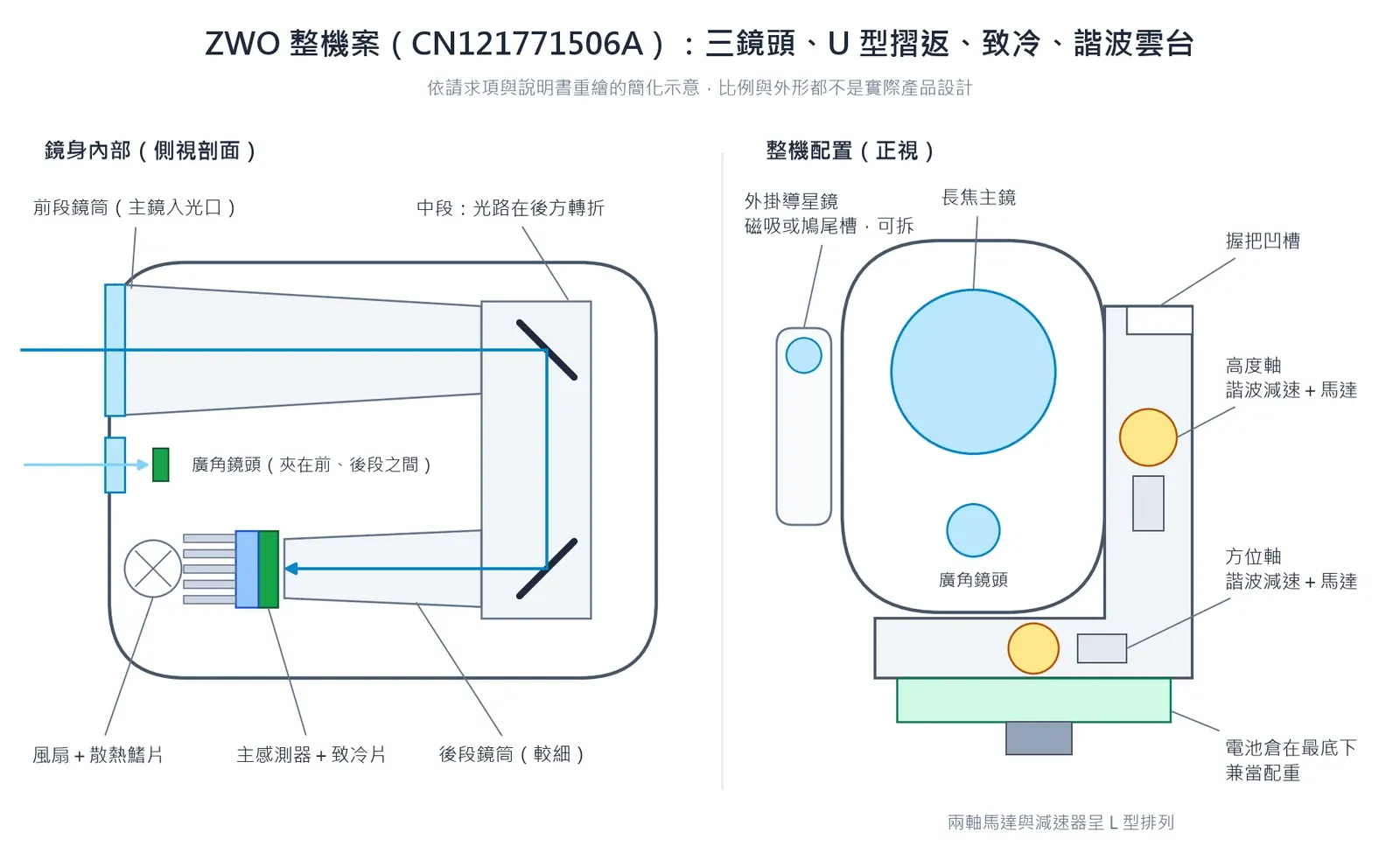
The “Imaging Device” filed on December 31 is the whole unit, and its 8 drawings show the body, the pan-tilt head, and the internal layout. Going by the specification, the main points are roughly these (Figure 4):
-
Three lenses: a long-focal-length main lens, a guide scope, and a wide-angle lens, with focal lengths decreasing in that order. The background section of the specification is quite blunt: current models only have a long-focal-length lens plus a wide-angle one, and limited by the mechanical error of the alt-azimuth mount itself, the maximum exposure time usually only reaches 60 seconds. Adding a guide scope looks aimed at lengthening each single exposure.
-
The guide scope can be built into the body or attached externally, mounted on the side of the housing with a dovetail groove, a snap-fit clip, or a magnet, and connected through USB or contacts. For short exposures that don’t need guiding, it can be removed, saving weight and power.
-
The long-focal-length lens tube is divided into front, middle, and rear sections, with the openings of the front and rear sections facing the same direction; the specification itself calls it a “U-shaped folded light path,” which matches the lens tube application from November. The diameters of the three sections get smaller along the light path, and the wide-angle lens sits between the front and rear sections with its optical axis parallel to the long-focal-length one, so a target chosen in the wide-angle view can be positioned directly at the center of the long-focal-length field of view.
-
A semiconductor cooler is attached to the back of the main sensor, with its hot side connected to heat-sink fins placed in the airflow of a fan, which amounts to active cooling of the main sensor. Thermal noise in long exposures should become much easier to deal with.
-
The pan-tilt head is single-arm, with each of the two axes using a harmonic reducer plus a motor, arranged in an L shape; the battery compartment sits at the very bottom of the base and doubles as a counterweight, balancing the tipping moment when the lens tube is raised; a recess is also cut into the top of the single arm to serve as a handle. The “Drive Structure and Its Alt-Azimuth Mount” filed on the same day is likewise two mutually perpendicular sets of harmonic drives, and the specification states its purpose as driving a “heavy lens tube.”
This one is not the S50 Pro. The S50 Pro has no guide scope and no cooling, and its official site says long exposures require switching to equatorial mode to reach 60 seconds, which happens to be exactly the problem the background section of this specification says it wants to solve. Putting these applications together, the whole-unit application should be the model after the S50 Pro, larger and heavier than the current models and heading toward long-exposure deep sky. Guiding, cooling, and harmonic drives were all standard equipment in traditional astrophotography, and now they are being packed into a single smart telescope.
Overseas Filings
Another change is overseas. ZWO had only one PCT application in 2021; after a gap of three years, it filed four all at once between December 2024 and January 2025, and the “Optical Imaging Device” among them was already published in Europe this June (EP4757335A1). The same goes for designs: in January 2025 it filed “Smart camera” on the same day in the US and Japan; Japan registered it last year, and the US allowed it this August. Its main market has always been overseas, yet its past patents were almost all filed only in China; it has only begun filing abroad in the last two years, and the timing happens to coincide with the Seestar selling best and with DWARF and Celestron Origin also competing for this market.
From the Patent Side
Finally, a few words from the patent angle:
-
These inventions are all still under examination; they are not granted patents.
-
The independent claim of the whole-unit application is essentially “three lens groups, long-focal-length, guide, and wide-angle, mounted in the same housing, plus two-axis drive, with focal lengths decreasing in that order.” Taken apart, no single element is new: long-focal-length plus wide-angle already exists in ZWO’s own Seestar S30, and long-focal-length plus guide is listed as prior art by the specification itself. China has no grace period for novelty for a product the applicant itself sold first, so the Seestar models already on the market can equally serve as prior-art references; during examination the scope will probably have to be narrowed, and what is most likely to remain in the end is probably a combination of dependent-claim features such as the U-shaped lens tube, cooling, and the pan-tilt head configuration. The lens tube application is similar: using reflective elements to fold the light path is itself a very old technique.
-
A patent portfolio only shows that the company is putting its R&D resources behind this direction; it does not guarantee that the product will look like this.
The timing, though, is very similar to the Draco: the Draco application was filed in February and published early in March, with the product on sale in the second half of the year; ZWO’s lens tube application was filed in November and published early in January of the next year, the design application was submitted on the same day, and the S50 Pro was unveiled this August. The whole-unit applications were filed a little over a month later and were also all published within one to three months of filing; going by the S50 Pro’s pace, it should not be long to wait. What it actually looks like, and its specs and price, will have to wait for the official unveiling and for fellow enthusiasts to get one and shoot with it.
(The figures are statistical charts I compiled from the gazette data and simplified diagrams I redrew from the patent specifications; they are not the original patent drawings, nor the actual product design.)