How the Application Strategy Differs Between BXT and Traditional Deconvolution
While recently using BlurXTerminator (BXT) to process images, a fellow imager asked: is there any difference in how it’s used compared to traditional deconvolution? Here I’ll share a few takeaways.
Traditional Deconvolution: Applied Only to the Luminance Channel
Traditionally, deconvolution is applied only to the luminance channel. Therefore:
- For images from a monochrome camera, you deconvolve the L channel directly and skip the RGB channels;
- For images from a color camera, you first extract the luminance channel from the RGB image and work on that, skipping the original RGB image.
This logic has stood for years, because deconvolution mainly deals with detail in the brightness levels and with star sharpness.
BXT Is a Bit Different: Stars Shrink Significantly
BXT has one key difference in use: it shrinks stars significantly. If you carry over the traditional “apply only to the luminance channel” approach, you get the situation on the right of the figure below: the RGB channels’ stars are noticeably larger than the L channel’s, so color fringing appears around the stars. Conversely, if you apply it to L and RGB at the same time, this problem barely occurs at all (as on the left).
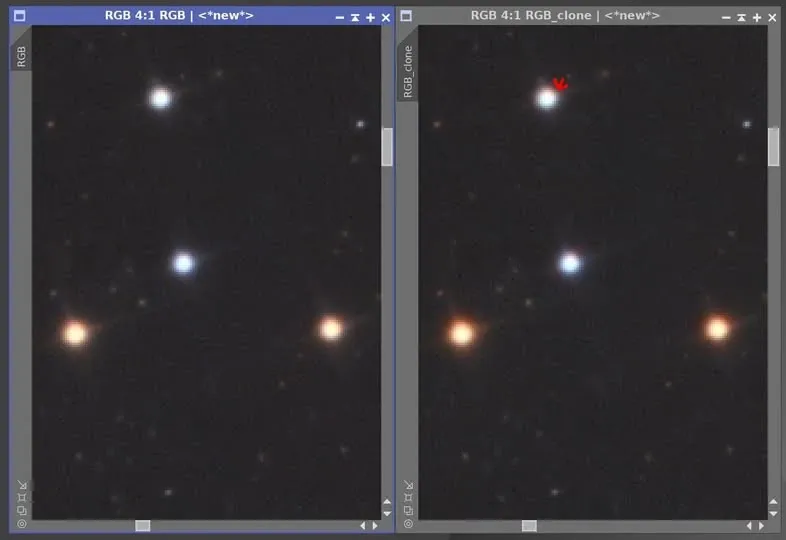
Recommended Application Strategy
By camera type, here’s the approach I recommend:
- Monochrome camera images: apply to L and RGB at the same time; or apply only to L, but then reduce the stars in the RGB channels separately to match the shrunken L stars.
- Color camera images: there’s no need to extract L first; just apply directly to the RGB image, then extract L afterward for any other processing or stretching you need.
BXT makes deconvolution both fast and good, but it changes the size of the stars, and with that it also changes the pairing strategy between channels. Understanding this is what lets you avoid trading a hard-won sharpening job for a ring of color halo. And feel free to share your own takeaways on BXT or traditional deconvolution.