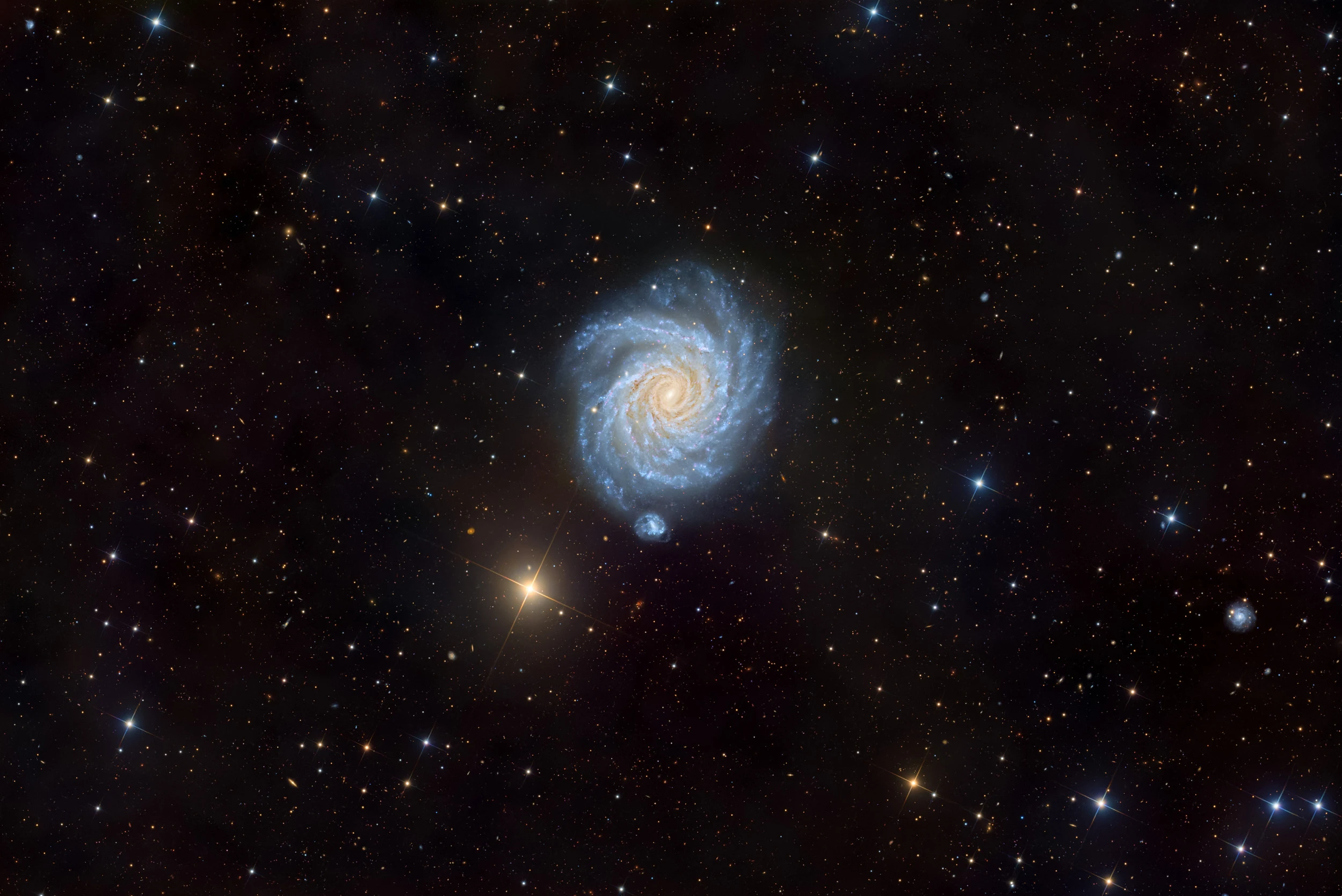
NGC 1232 – The Eye of God Galaxy
- Type
- Galaxy
- Acquisition
- Planewave CDK17 · SBIG STXL-11002
- Integration
- 22.3h
NGC 1232 — The Eye of God Galaxy
NGC 1232 is a grand spiral galaxy in Eridanus, about 50 million light-years from Earth. Spread almost perfectly face-on toward us, its structure is crisp and symmetric — a bright core wrapped in layer upon layer of turning spiral arms, like a great eye gazing into the cosmos. Hence its popular name: the "Eye of God".
Nearly 200,000 light-years across, its arms are strewn with blue young star clusters, pink star-forming regions and criss-crossing dark dust lanes. From the yellowish old stars of the center to the vigorous newborn stars of the outskirts, the color gradient makes plain that NGC 1232 is still an actively star-forming galaxy.
Observations reveal an extensive envelope of gas around NGC 1232 — possibly the aftermath of a brush with a small galaxy — that has shaped its internal gas distribution and star formation, leaving dynamical fingerprints that are invisible yet still at work.
Its apparent companion NGC 1232A actually lies at a very different distance; the two do not truly interact, merely align along our line of sight. Around December each year is the ideal season to observe NGC 1232 — and as we gaze into this 200,000-light-year eye, we are witnessing a galaxy's life story still being written.
Planewave CDK 17"
SBIG STXL 11002 with AOX
Paramount ME
Astrodon 50mm LRGB
Lx21 1200s; Rx21, Gx20, Bx20 900s
Total integration time: 22h 15m
Location: El Sauce, Chile
Software: PixInsight, Photoshop