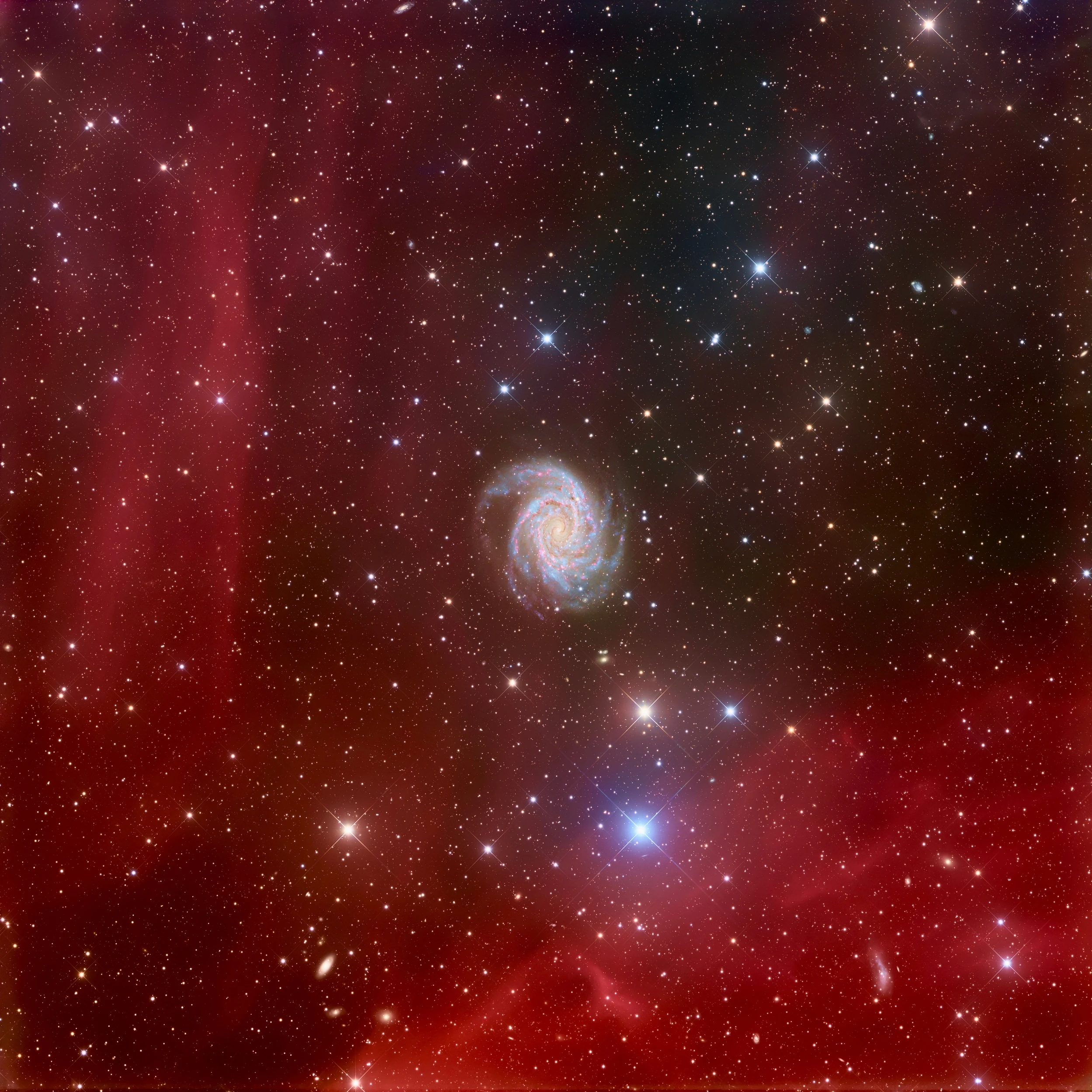
NGC 2997
- Type
- Galaxy
- Acquisition
- ASA 500N · FLI ML16803
- Integration
- 10h
NGC 2997 — A Southern Pinwheel in the Galactic Mist
In the direction of the southern constellation Antlia, some 30–40 million light-years away, lies a magnificent island universe: the Antlia pinwheel galaxy.
It opens almost squarely toward our line of sight, like an exquisite cosmic pinwheel with perfectly symmetric twin spiral arms. Over 120,000 light-years across, its arms weave together blue clusters of young giant stars, pink star-forming regions and dark dust lanes — a canvas full of life. But this image hides another cosmic story.
The broad wash of pale red mist around NGC 2997 does not come from that distant galaxy at all — it belongs to our own Milky Way: exceedingly faint Hα interstellar haze drifting beyond the galactic plane. Like a translucent cosmic veil suspended between us and the far galaxy, it lets this photograph record two vastly different cosmic scales at once.
This is a cradle of star birth. The core of NGC 2997 is ringed by ionized hydrogen clouds, its arms strewn with bright clusters and glowing gas, giving the galaxy a soft yet energetic blue-pink cast. At around a hundred billion solar masses it is the most luminous member of its group, attended by dozens of dwarf galaxies — clearly living in a busy, active corner of the universe.
Two supernovae have been recorded here within the past two decades or so, like beats struck by the universe itself — proof that it is still vigorously making new life. Studies also reveal that NGC 2997 possesses an ordered, beautiful spiral magnetic field, quietly guiding its gas clouds to rotate, collapse, and kindle one newborn star after another.
From ESO to the Hubble Space Telescope, countless great observatories have gazed at this southern gem. Now it appears, quietly, in this work.
A galaxy thirty million light-years away on one side; the whisper of our own Milky Way on the other — meeting in a single frame.
ASA500N
FLI Proline 16803
DDM85
Astrodon LRGBHa 50 mm
Lx10, Rx11, Gx10, Bx9, Hax20, 600s
Total integration time: 10hrs
Location: Chilescope