Why Use DBE?
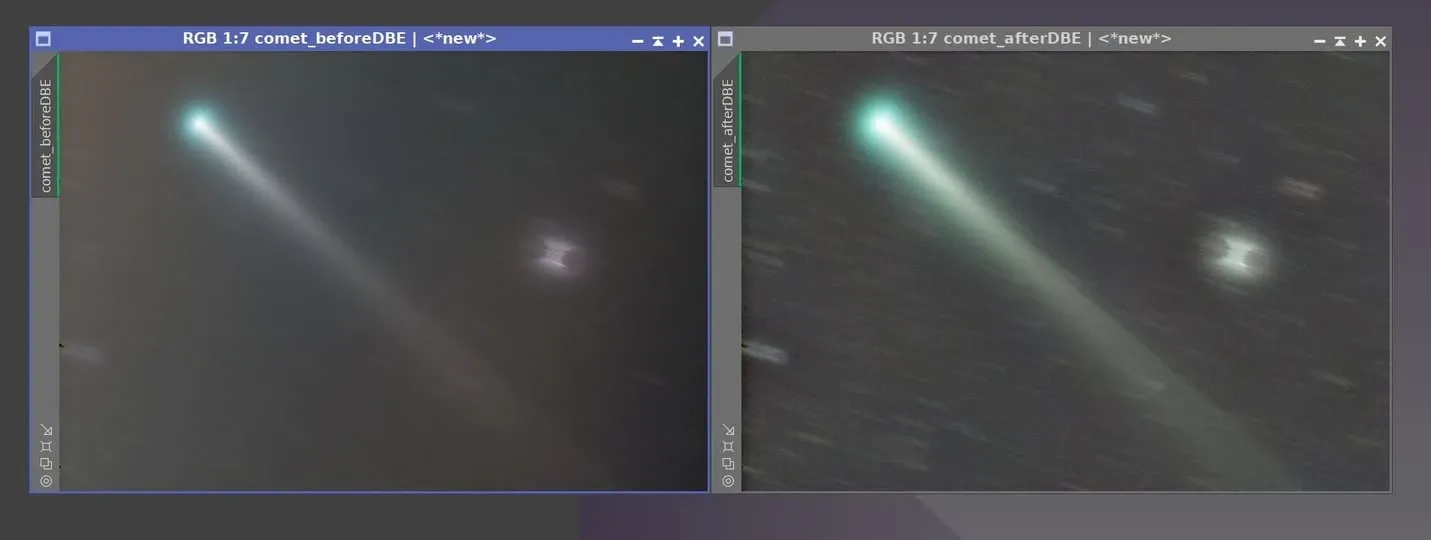
In the community, I often hear one question: after using DBE, the image seems to look worse. Take the comparison below, for instance; compared to the original on the left, the DBE-processed version on the right actually reveals more star-like dot defects in the background that were barely visible before. Given that, should DBE be done at all?
What DBE Does: Remove the Background’s Light Gradient and Color Gradient
DBE’s main job is to remove the uneven light gradient and color gradient in the background. Once this uneven layer of background is flattened out, the problems that already existed in the image naturally become more visible, and that’s actually a good thing, because it gives your subsequent processing something to work from. You’ll also notice that in a DBE-processed image, the signal that belongs to the celestial object becomes clearer too, such as a comet’s tail.
In other words, DBE doesn’t “create” defects; it merely lays out in the open what was previously hidden by the uneven background.
Defect Problems Can Wait Till Later; the Light Gradient Can’t
Those background defects that get revealed can be reduced in their final impact by other means later. You could, of course, choose not to do DBE, but the defects won’t disappear as a result. When you heavily stretch in the nonlinear stage, they’ll come out and clutter the frame all the same, and discovering them only at that point is more of a hassle, because the processing methods available to you by then are already quite limited.
By contrast, flattening the uneven light gradient and color gradient with DBE while in the linear state, and rooting out the image’s problems in advance, is like curing the illness at its source. In terms of the overall workflow, this is usually the better choice.
The linear stage doesn’t look like it has many steps, but each one has a large influence on what follows. DBE is precisely one of those steps where it’s worth establishing the right mindset first.