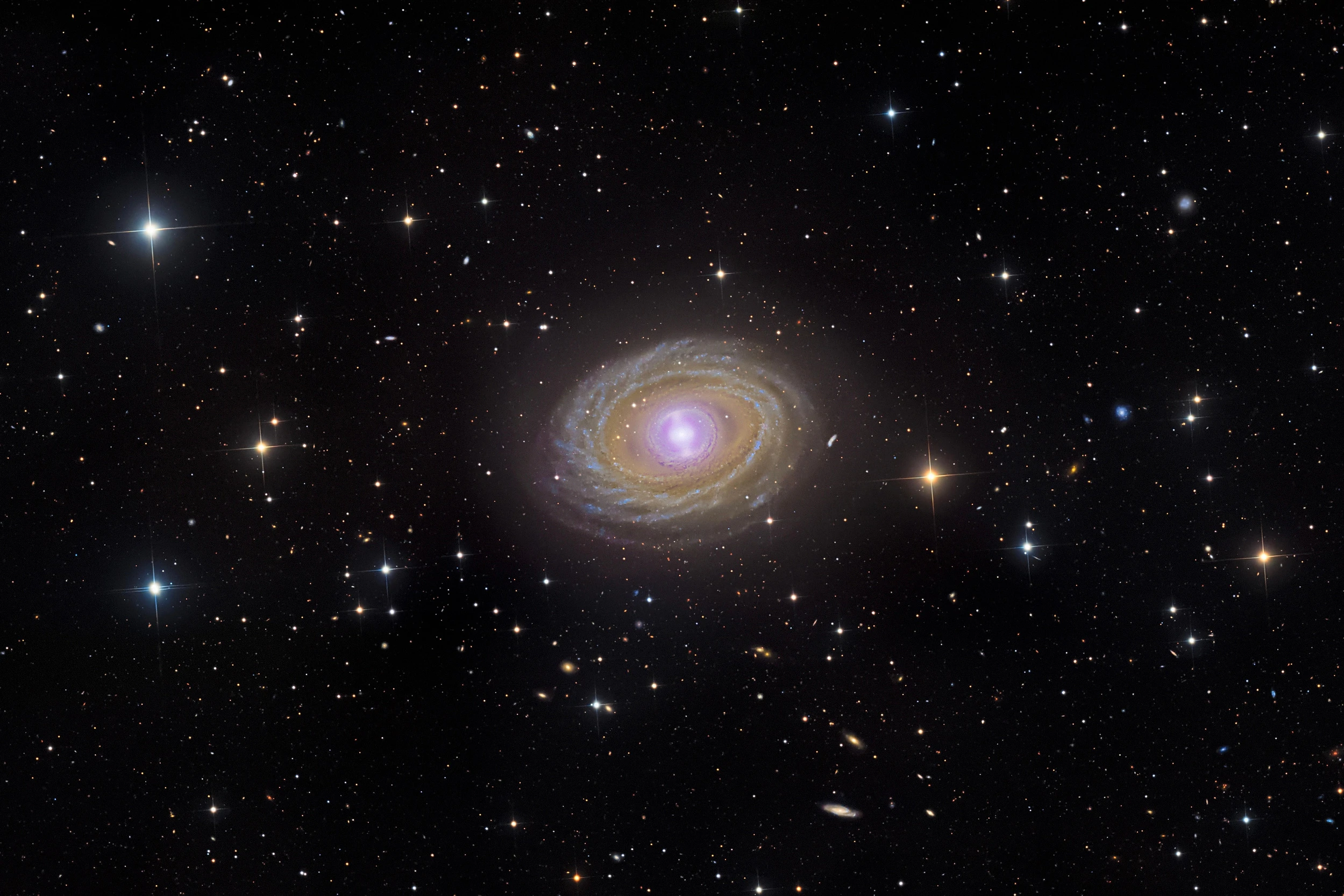
NGC 1398 A Barred Spiral Galaxy in Fornax
- Type
- Galaxy
- Acquisition
- Planewave CDK17 · SBIG STXL-11002
- Integration
- 29h
Ah, upon hearing this celestial secret, my heart ponders in quiet wonder. NGC 1398, a name for this stellar domain, lies hidden within the depths of Fornax, its distance from Earth exceeding sixty-five million light-years. The vastness of this galaxy is truly magnificent, spanning approximately 135,000 light-years in diameter, surpassing even our own Milky Way. Within it gathers a hundred billion stars, shining like a resplendent celestial river, boundless and eternal.
The structure of this stellar realm is both extraordinary and exquisite. It boasts a double-ring formation, with a central region that gleams like a pearl. This luminous ring is composed of stars, gas, and dust. Crossing its heart lies a long bar of stars and gas, pointing directly to the galaxy's core, while its outer spiral arms unfurl gracefully like ribbons across the infinite expanse of the cosmos.
Such characteristics render NGC 1398 a scientific treasure, an invaluable subject for exploring the structure and evolution of galaxies. On December 17, 1868, the German astronomer Friedrich August Theodor Winnecke, while searching for comets in Karlsruhe, serendipitously discovered this breathtaking galaxy, immortalizing its name in the annals of astronomy.
As for its central ring structure, it may be the creation of density waves fostering star formation. The origin of these waves could lie in the gravitational dance between galaxies or the asymmetry of the galaxy’s own gravitational pull. This is the wonder of cosmic mechanics, akin to a celestial poem, with infinite mysteries woven into its eternal fabric.
Planewave CDK 17"
SBIG STXL 11002 with AOX
Paramount ME
Astrodon 50mm LRGB
L25,R16,G15,B16,1200s
Ha10 BIN2, 1800s
Total integration time: 29hrs
Location: El Sauce, Chile
Software: PixInsight, Photoshop