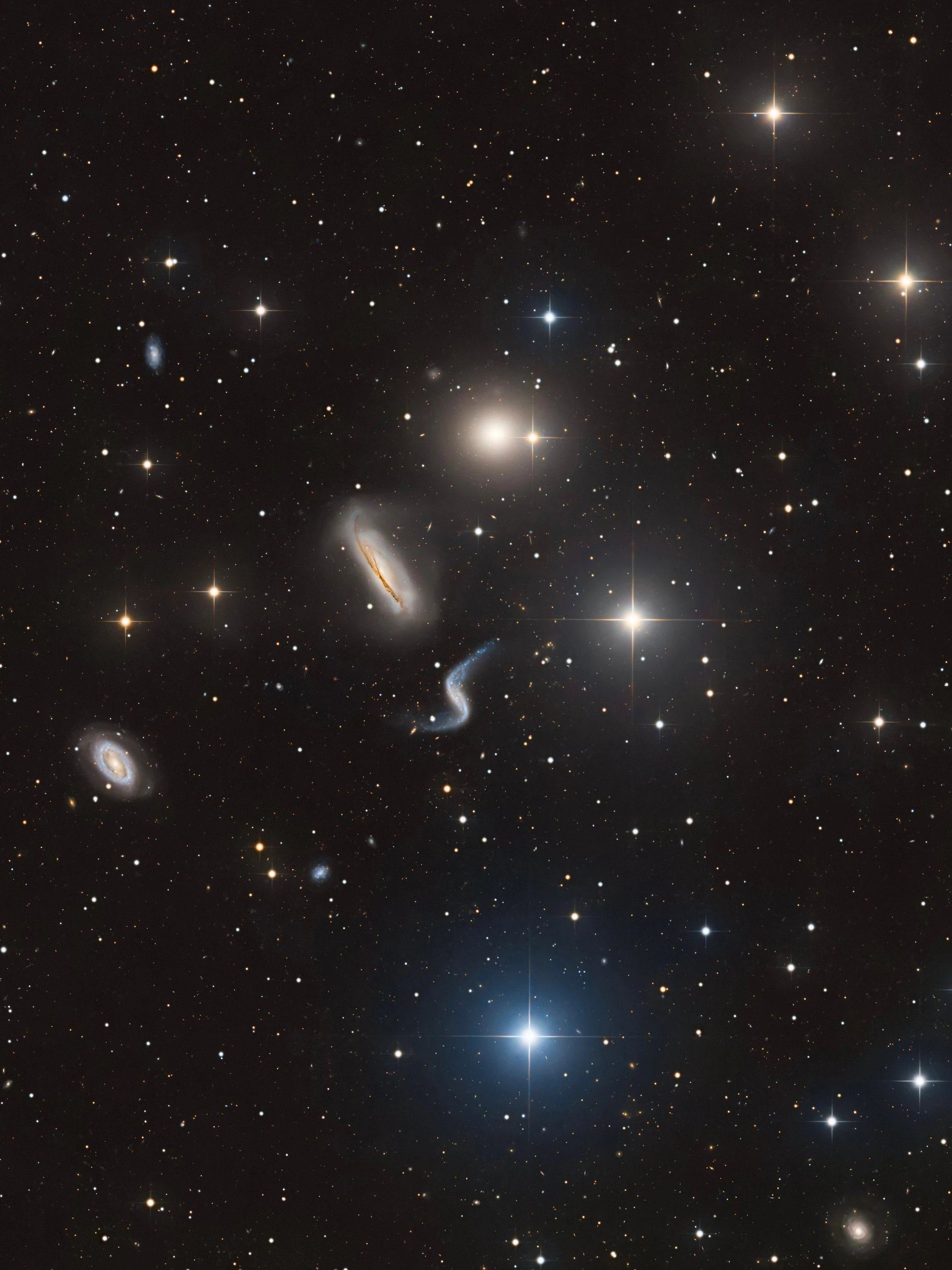
HCG 44
- Type
- Galaxy
- Acquisition
- Planewave CDK14 · Moravian Instruments C5A-100M
- Integration
- 23.3h
HCG 44 — A Gravitational Dance at the Lion's Neck
Near the neck of Leo in the spring sky hides a fascinating set of objects: HCG 44 (Hickson Compact Group 44). Not a lone galaxy but a tight-knit group some 80 million light-years away, it is like a small cosmic quartet. Its most eye-catching member is NGC 3190, a spiral seen nearly edge-on, with a prominent, warped lane of dark dust slicing across its core — the visual anchor of the image. Right beside it, NGC 3193 is a bright, smooth, rounded elliptical; together the two make a striking and elegant contrast.
Yet behind this serene scene, violent physics is at work. The members of HCG 44 are locked in a slow gravitational dance, and the clearest evidence is the oddly shaped NGC 3187, a barred spiral: tidal forces from its companions have wrenched and twisted its two spiral arms into a pronounced "S", as if torn by an invisible cosmic hand.
Over the ages these four galaxies (including NGC 3185 at the edge of the group) keep stripping gas and stars from one another, warping each other's forms. Astronomers predict that in the distant future they will likely collide and merge into a single giant elliptical galaxy.
Planewave CDK 14"
Moravian C5A-100M
Astro-Physics 1100w/AE
Chroma 50mm Lx70,Rx69,Gx70,Bx70, 300s
Total integration time: 23hrs
Location: New Mexico, USA