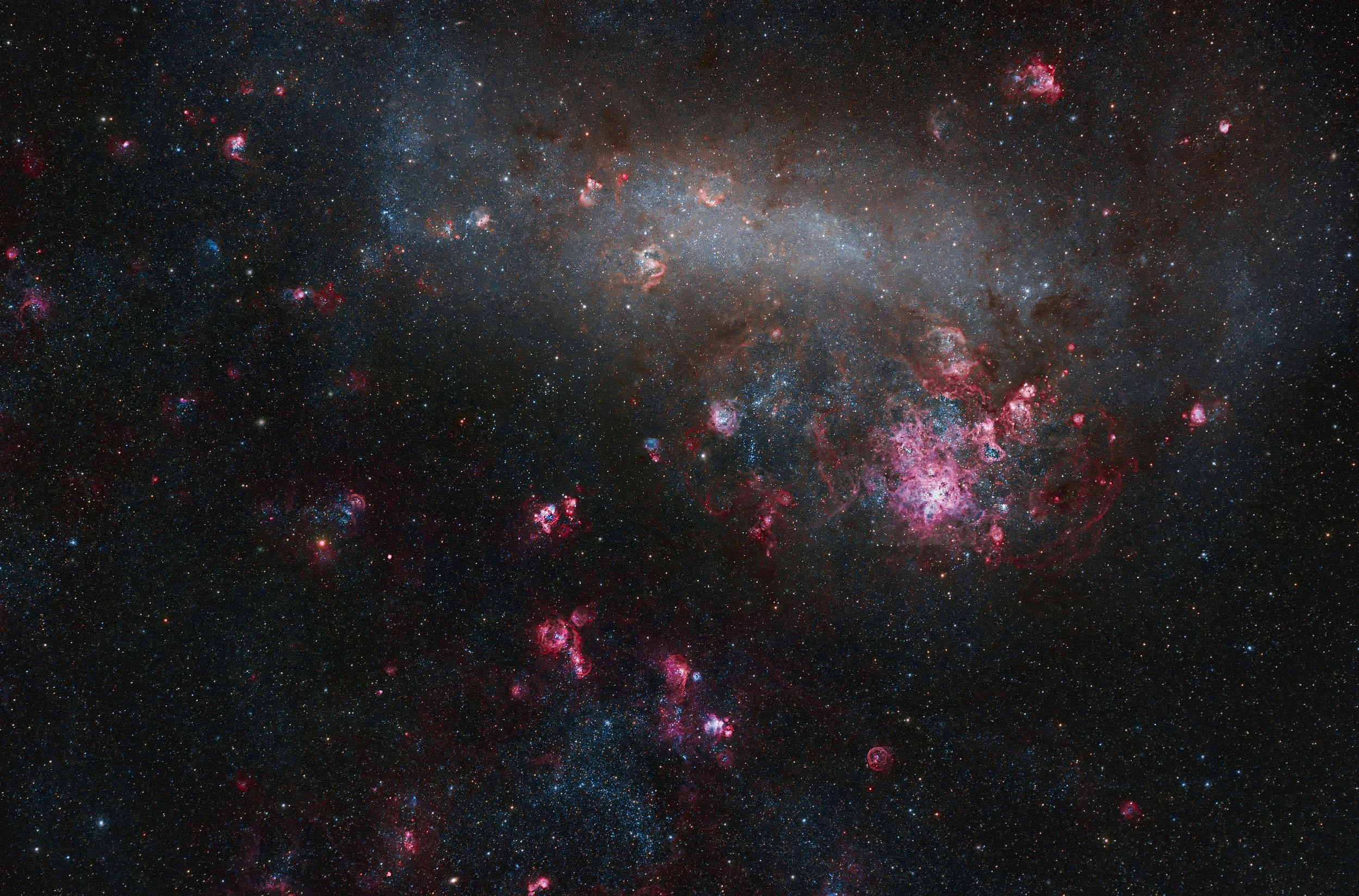
Part of the Large Magellanic Cloud
- Type
- Galaxy
- Acquisition
- Askar ACL200 · ZWO ASI2600MC Pro
- Integration
- 16.6h
The Large Magellanic Cloud (LMC) is one of the most awe-inspiring astronomical sights in the southern hemisphere's sky. As the largest satellite galaxy of the Milky Way, it is only 160,000 light-years away from us and ranks fourth in the Local Group, which includes the Andromeda Galaxy, Milky Way, Triangulum Galaxy, and the Large Magellanic Cloud itself. Most of the LMC lies within the constellation of Dorado, a southern sky constellation, but some of it extends further south into the neighboring constellation of Mensa. To appreciate the beauty of the LMC, you must be south of 20° north latitude. If you wish to see it high in the sky, near the zenith, you need to be at around 25° south latitude.
Within the LMC, aside from the traces of the galactic bar and spiral structure, the most captivating feature is undoubtedly the Tarantula Nebula nestled within. The Tarantula Nebula (NGC2070) is situated within the Large Magellanic Cloud. Through binoculars or a small telescope, you can clearly see the bright gas ring extending outwards from the nebula, resembling a massive tarantula. It appears to be the same size as a full moon, but its actual diameter is 1520 light-years, much larger than the Orion Nebula. Furthermore, the Tarantula Nebula is a significant region for star formation. By observing, we can even see the star cluster 30 Doradus at its center. In 1987, the supernova 1987A exploded within the Large Magellanic Cloud, very close to the Tarantula Nebula. Supernova 1987A reached a maximum brightness of magnitude 2.8, making it the brightest supernova observable from Earth since 1604. Surprisingly, it was visible to the naked eye for as long as ten months.