Does Stacking Software Matter? A Test and a Poll
Does stacking software matter? Many people figure stacking is just adding images together, so whichever software you use should be about the same. This article uses one hands-on test and one community poll to explore the question — and the conclusion is: the software really does make a difference.
An Accidental Test
It all started when a fellow enthusiast shared a broken image with strange patterns in it. I fiddled around in PixInsight’s WBPP for a long time and simply couldn’t reproduce his broken image; only after finally asking did I find out he’d stacked it with ZWO ASI Studio.
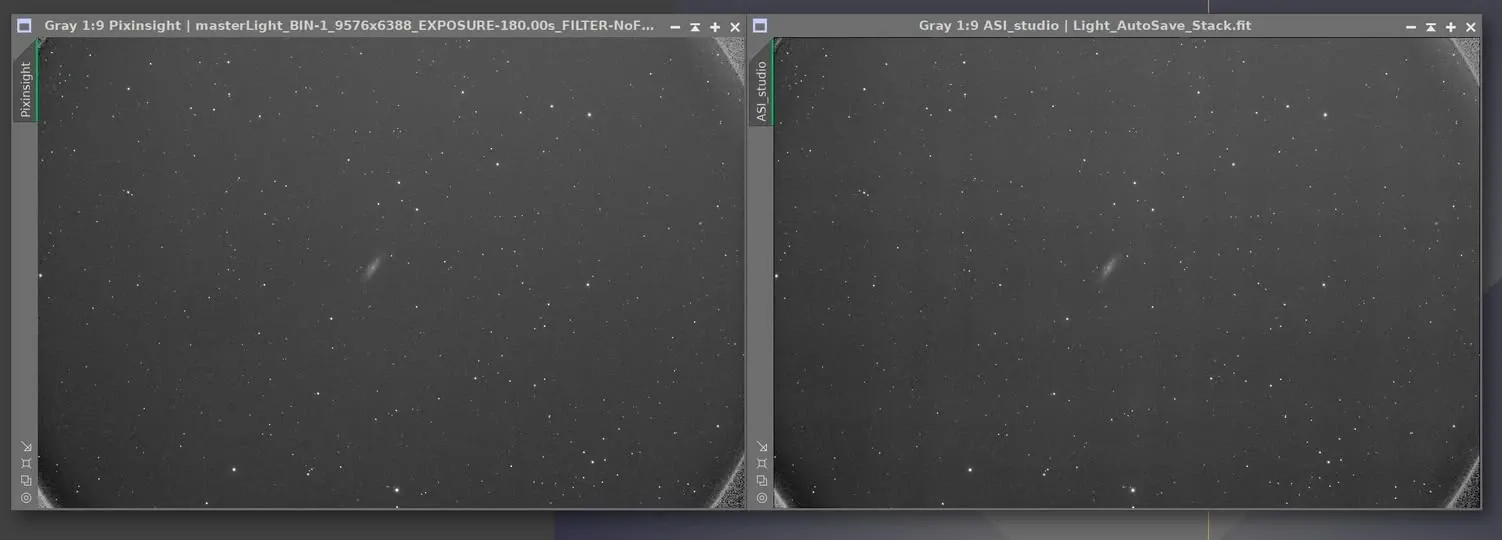
In the spirit of experimentation, I downloaded and installed ASI Studio too. Its stacking speed is blazing fast — so fast it made me wonder whether it was only doing simple arithmetic: 10 each of lights, darks, flats, and bias, done in about 20 seconds. Although the result didn’t look as severe as my friend’s, putting it side by side with PI’s stack confirmed it — ASI Studio stacked it wrong. In the image above, PI is on the left and ASI Studio on the right; can you tell the difference?
A word of reminder while we’re at it: image problems like this often have many possible causes, ones that a screenshot or a plain text description frequently can’t convey. So if you want to track down the cause, it’s best to provide the raw files as well — only then can the real cause be diagnosed and the right fix applied.
A Community Poll: What Does Everyone Use to Stack?
So what software does everyone actually use to stack? I once ran a community poll, 101 votes in total, with the top four as follows:
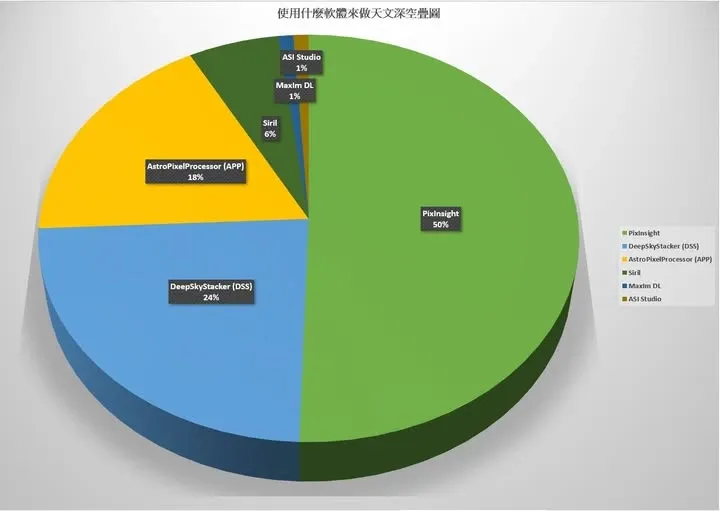
- PixInsight — 50% (about €300)
- DSS (DeepSkyStacker) — 24% (free)
- APP (AstroPixelProcessor) — 18% (€165)
- Siril — 6% (free)
A few observations:
- People who stack with PI already make up about half of the total votes. And according to an earlier poll, among the PI-using population, another twenty or thirty percent probably don’t stack with PI at all, but may only use processes like DBE or BXT. PI is probably the best platform for linear operations right now, the WBPP script has matured, and stacking with PI is no longer such a headache.
- Surprisingly, the veteran DSS still has close to a quarter of users, even surpassing APP, which is famous for its mosaics.
- Fourth-placed Siril, nicknamed “little PI,” has a Chinese interface and some of PI’s features, yet its usage share is a surprisingly low 6%.
- As for the remaining Maxim DL and ASI Studio, their user base is smaller, so I won’t discuss them further.
Back to the original question: does stacking software matter? From that test where ASI Studio ruined good data during stacking, the answer is clear — it matters. Free and fast are certainly appealing, but if the software goes wrong at the calibration or integration step, all the data you worked so hard to capture goes to waste.